DeKalb IL Epoxy Flooring brings more than 20 years of epoxy flooring in Yorkville garages, basements and shops to one question we ask before we price anything: how old is this particular slab? Not the house style, not the street, not the name on the entrance sign. The concrete itself, and how many winters it has already carried.
That sounds like a small detail, but it changes the whole job. A slab that has taken salt-laden tires and freeze-thaw cycles for close to two decades needs a different amount of grinding, crack work and joint repair than one that has seen a handful of seasons. Pricing both from one flat garage figure means one of them gets the wrong floor.
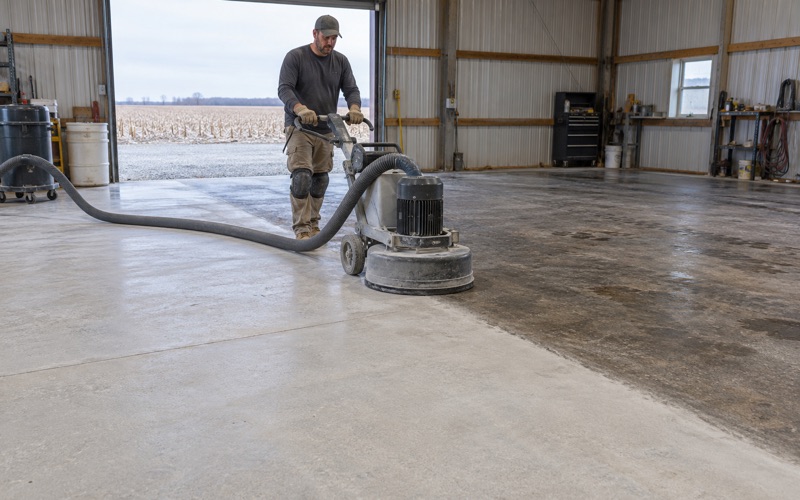
So our quotes start with the slab’s record and a close look at its surface. We grind every floor open mechanically, test it for moisture as a listed line item, and write the product, the system build and the finished thickness into the proposal so you can check what went down against what you were sold.
Half of Yorkville went up in a single decade
Most cities we work in have housing spread across many decades. Yorkville is different, and the difference is the reason this page reads the way it does.
What 51.4 percent means for a garage floor
Census figures from the 2024 five-year estimates count 8,295 housing units across the city, and 4,262 of them, or 51.4 percent, were built between 2000 and 2009. Another 1,358 units have gone up since 2010. Roughly a third of the housing stock predates 2000.
For a coatings contractor, that concentration matters more than any single landmark. It means the typical Yorkville garage floor is a production-built slab from the same general era, finished by the same kinds of crews, and now old enough that wear has started to separate one floor from the next.
Grande Reserve stalled, then started again
Grande Reserve is the clearest example of why age varies even inside one neighborhood. It is the city’s largest subdivision, planned for 2,200 units on 1,127 acres, and Patch reported during February 2012 that it had about 440 finished homes. Bank of America had filed a foreclosure suit against the original developers during 2008, and building stopped.
That year Avanti Properties Group and OA Management bought the unfinished subdivision, with plans to sell lots to homebuilders. A city document places Autumn Creek immediately west of Grande Reserve, and the mayor at the time spoke of getting all of Yorkville’s unfinished subdivisions moving again. Construction did resume, which means the houses built before the stall and the houses built after it now share streets.
Neighbors with very different slabs
The practical result is that two garages a few doors apart can be well over a decade apart. One slab may have nearly twenty winters behind it, and the one next door may have five. From the curb they look like the same floor.
We never assume either one. We do not know the age of any specific house’s slab until you show us the paperwork or we read the surface, and we will not guess from the subdivision name.
Looking for epoxy-flooring closer to Boulder Hill? See Epoxy-Flooring Services in Boulder Hill.
Reading your slab’s own year
The date that matters is when your garage floor was poured. The best evidence for it is usually already in your files.
Where the date comes from
The building permit for the house, the occupancy certificate or the closing papers from the original sale usually pin the construction year closely enough. If you bought the home later, the first-sale date on the title history often answers it. When no record turns up, the surface tells us a lot by itself: scaling, rust stains, sealed or painted patches and the condition of the control joints all show how hard the floor has worked.
We ask for that date before we quote because it tells us what to look for during the walkthrough. It does not replace the walkthrough, and the inspection always gets the final word.
What an older slab usually asks for
A slab poured early in the building boom has usually lived through many seasons of salt brine dripping off cars. That can leave a weak, chalky top layer, pitted spots near the door and joints that have opened or crumbled at the edges. Some of these floors also carry an old roll-on coating or a store-bought sealer that has started to lift.
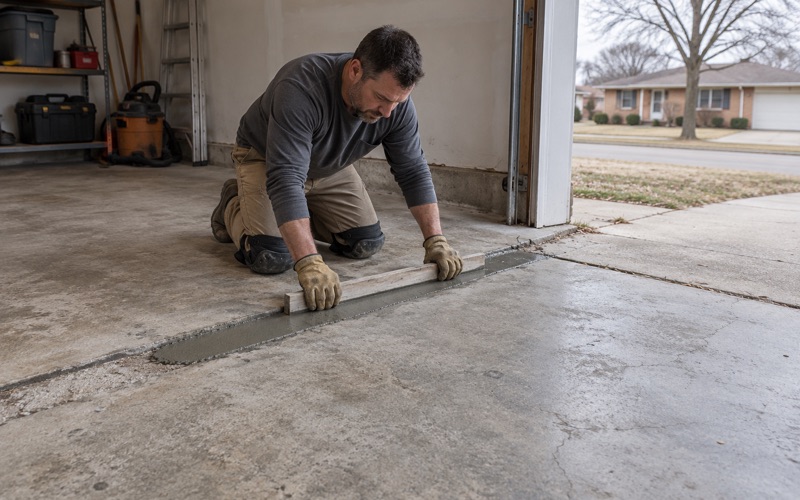
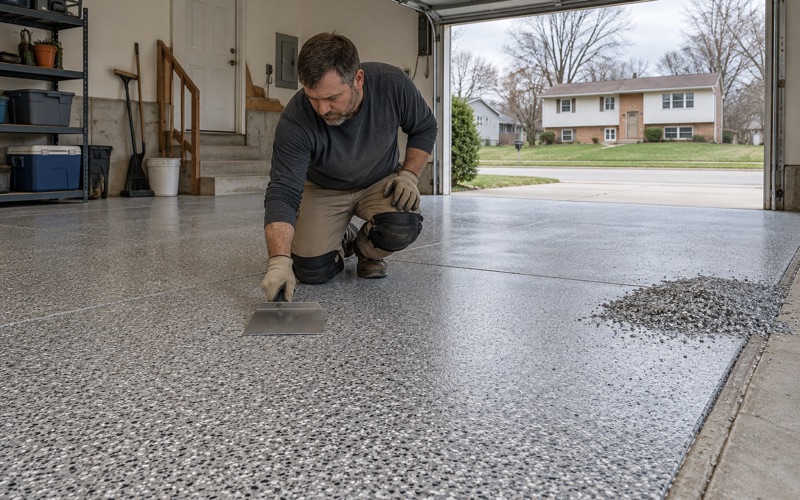
On a floor like that we diamond grind or shot blast down to sound concrete, often to a deeper ICRI surface profile than a newer slab needs. We remove any failing coating completely, rout and fill the cracks, and fill the control joints with a semi-rigid polyurea joint filler so the coating can bridge them. If a section is too far gone to coat, we say so before you sign, and we tell you when repair or replacement has to come first.
What a younger slab asks for
The floors built after the restart often need far less repair. The surface is usually tighter and the joints cleaner, so the grinding is about opening a dense top layer enough for the primer to bite rather than removing damage.
That difference only works as a contrast here. A younger slab still gets the same moisture test and the same mechanical prep, because a floor that skipped either step fails the same way at any age.
The quote follows the slab
Because prep and repair change with the slab’s age and condition, we price every Yorkville job per square foot for the system we are actually proposing. Two attached garages the same size on the same block can come out at different numbers, and the proposal shows exactly why.
We would rather explain that difference up front. Charging an older slab a newer slab’s price only means watching the coating peel at the worn edge by spring.
What Yorkville’s own code table says
Yorkville moved from the 2009 International Codes to the 2018 editions with local amendments, adopted into Title 8, Chapter 2 of the City Code. We have not confirmed whether the city has since moved to a later edition, so we check before each permitted job.
Severe weathering and a 42-inch frost line
When the city completed the climate and design table in its residential code amendments, it entered a weathering rating of Severe, a 42-inch frost line and an air freezing index of 2000. Those are the city’s own recorded design values, and they describe the conditions every slab here was built to face.
For a garage floor, a Severe weathering rating is a reminder that the concrete surface takes real punishment over time. It is part of why an older Yorkville slab so often needs more surface repair than its age alone would suggest, and why we build garage systems for the calcium chloride and rock salt a northern Illinois winter tracks in.
Who reviews what
Residential permits in Yorkville run through the city’s Building Department at City Hall on Prairie Pointe Drive. Fire code review works differently than in many towns: under an intergovernmental agreement, the Fire Marshal of the Bristol-Kendall Fire Protection District serves as the city’s Fire Code Official, and fire code permits run through the district.
That matters mostly for commercial and shop floors, where coatings, storage and egress can draw fire code questions. Illinois licenses no flooring or coatings contractor, so we confirm Yorkville’s own registration, bond and insurance requirements before a job goes on the calendar.
Curing against the slab, not the calendar
A garage that is attached and unheated in January is not the same place it is in June. We schedule cure times against the slab temperature and the dew point spread at the surface, and we say plainly when an unheated space has to wait for spring.
That applies to older and newer slabs alike. The age of the concrete changes the prep, while the temperature of the room decides when the coating can go down.
Attached garages and townhomes
Not every Yorkville garage sits under a detached single-family roof. The housing mix includes a meaningful share of attached homes, and those floors come with their own practical limits.
Roughly one home in five shares a wall
Of the city’s housing units, 1,803 are attached single-family homes, about 21.7 percent of the total, compared with 5,327 detached houses. Most of the attached units are owner-occupied, so a good number of the garage floors we quote here belong to townhome owners.
In a shared building, grinding noise, dust and coating odor reach neighbors as well as the owner. We collect grinding dust at the grinder, never wash it toward a floor drain or storm inlet, and plan the work days so the loudest steps happen at reasonable hours.
Product choices for a shared building
For an attached garage we often favor a 100% solids epoxy base or a polyaspartic topcoat, chosen within the Illinois limit on floor coating VOC content. That limit binds the installer as well as the manufacturer, and lower solvent content helps in a building where air moves between units.
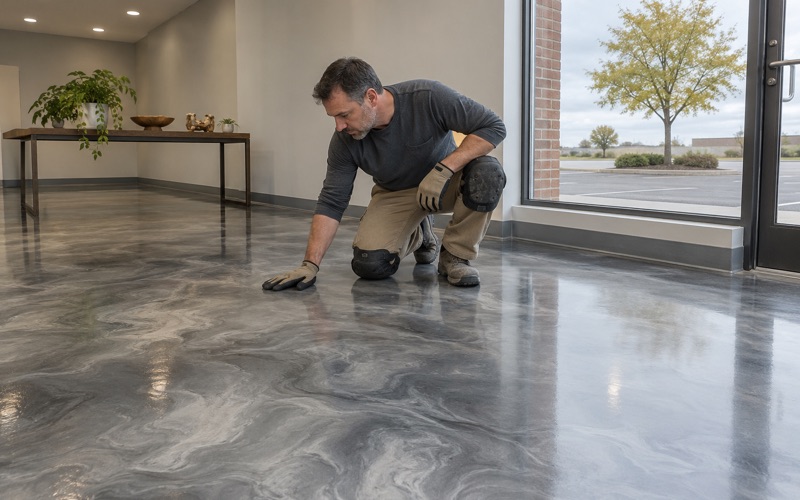
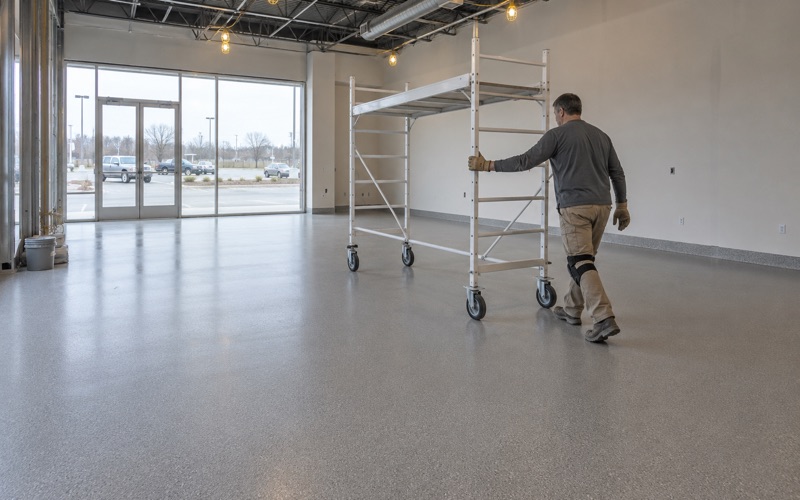
A vinyl flake broadcast hides the minor surface variation an older slab tends to keep even after repair, while a quartz broadcast adds texture where wet shoes come in from the driveway. Either way, the finished thickness is written into the proposal.
Paperwork before the first pass of the grinder
Every home job gets a written contract and the state’s Home Repair: Know Your Consumer Rights pamphlet before work starts, as the Illinois Home Repair and Remodeling Act requires. We read the warranty exclusions out loud before the job is sold, with moisture named first.
If your garage or basement has a water problem, we will say plainly that a coating is not waterproofing, flood protection or radon reduction. Radon work in Illinois takes a state radon mitigation license, and a floor coating is not that work.
Starting a Yorkville quote
The most useful thing you can send us is the year your home was built, along with a few photos of the garage floor showing the joints, any cracks and the area just inside the door. From there we can tell you roughly how much prep the slab is likely to need before we come out to test and measure it.
Whether your floor went down before Grande Reserve stalled or after building restarted, the plan is built around that slab’s own history, and the price follows the work it actually needs.
- 20+ Years of Floor Work
- Moisture Testing in Every Scope
- Written Proposals and Contracts