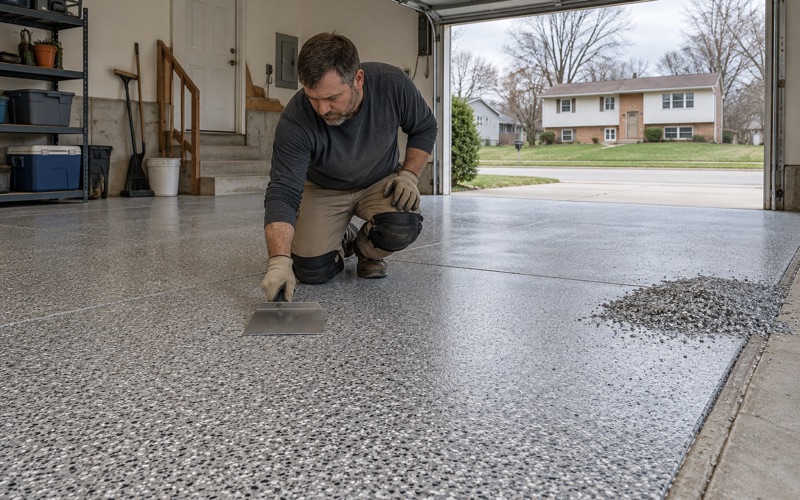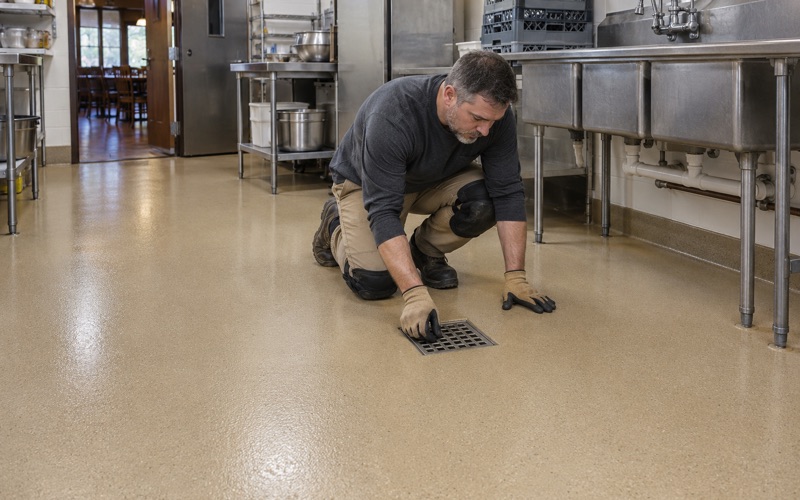
DeKalb IL Epoxy Flooring has more than 20 years on concrete behind it, and our approach to epoxy flooring in Warrenville starts with a question most owners never expect: what water touches this floor? On a garage or basement slab, that answer can decide whether a new coating stays clean for years or seals a stain under a glossy film. We would rather settle it at the estimate than after the topcoat cures.
The rest of our method holds steady from house to house. We open every slab with a diamond grinder or shot blaster and never acid etch, we price moisture testing into the scope as its own item, and the proposal spells out the product, the system build and the finished thickness so the floor can be checked against the paper.
Below we explain why iron matters to concrete in this city, which homes are most likely to see it, how we lift a rust-brown stain before coating, and how to keep a finished floor clean afterward.
Iron Removal Behind the City’s Water
Four wells and one shared treatment step
Warrenville sits on the DuPage River in DuPage County, and its tap water comes from the ground beneath it. The city’s 2024 Water Quality Report describes four wells drilled into the Silurian-Devonian aquifer to an average depth of 300 feet. Homes normally receive a blend from Wells 9, 10, 11 and 12, and each one uses iron removal equipment in production, taking the iron out before the water enters the distribution system.
That detail says something about the geology. A utility does not build iron removal into every well unless the groundwater calls for it. The report publishes no iron figure and we quote none, but for a floor the lesson is simple: treated city water and raw well water are not the same rinse.
Well No. 13 and its own filtration building
The city finished drilling Well No. 13 at 30W121 Estes Street in fall 2023, its fifth public supply well. In 2025 the City Council approved a $5,815,000 contract with Whittaker Construction and Excavating for the well and an associated iron filtration building.
The Public Works work plan targets that water treatment building, solar panels included, for September 30, 2026. A new well that gets its own filtration building from the start is the plainest sign that iron is part of the local groundwater. We have no part in the project; it is public record, and it tells us what the water carries.
Private wells on Briggs Avenue and Estes Street
Not every house is on the blended supply. The city’s project page says staff continue to monitor private well readings along Briggs and Estes through construction and after the plant is running, working with cooperating residents, and so far report no detrimental impact from the new well.
Those private wells draw raw groundwater from the same aquifer country, and no city treatment touches it before it reaches the hose bib. We have not seen any private well’s iron level, and we do not test or treat water. We simply ask at every estimate here whether the property is on a private well or city service, because the answer changes how we prepare the floor.
Looking for epoxy-flooring closer to Cortland? See Epoxy-Flooring in Cortland.
How Clear Water Leaves a Rust-Brown Stain
Ferrous iron meets air
Well water carrying dissolved ferrous iron usually looks perfectly clear. Penn State Extension explains that it turns cloudy once exposed to air, and as it takes on oxygen the iron shifts to the less soluble ferric form and settles out as reddish-brown iron oxide. The same article says high-iron problems mostly center on staining of concrete surfaces.
The Illinois Department of Public Health makes the household version of the point: iron leaves reddish-brown stains that are very hard to remove, and as little as 0.3 mg/l can turn water reddish brown. Penn State adds a twist that surprises owners, noting that rust-colored water can test lower in iron than its staining suggests.
Where the marks gather on a slab
On concrete, iron staining follows the water. It collects where the floor is hosed down and left to dry, below a water softener’s discharge line, around a sump that pumps onto or near the floor, and in the bay where a car is washed and drips. Each evaporating puddle leaves a little more oxide behind, so the marks build into rust-brown rings and streaks.
A softener is one of the iron treatments IDPH lists, alongside catalytic filtration, but its discharge can still carry iron-bearing water across the floor while it regenerates. We look at where that line ends. If it runs onto the slab rather than to a drain, that is worth changing before a new floor goes down.
Rust spots on a city-water property
An owner on city service who finds rust spots in the garage is usually looking at another source. Steel tools left on damp concrete, a rusting shelf leg, exposed rebar near a spall and granular fertilizer all leave orange marks. We identify which one it is before choosing a cleaner, because each lifts differently.
Lift the Stain Before a Clear or Light Coat Locks It In
Why the order matters
A clear epoxy, a light gray solid color or a sparse flake broadcast shows everything beneath it. Put that system over an iron stain and the stain is sealed in for good, magnified by the gloss, with no way to reach it short of grinding the coating off. A dark solid or a dense vinyl flake broadcast can hide some shadowing, but we would rather remove the stain than count on concealment.
Identify first, then lift
We start by confirming the mark is iron and not oil, tannin or a fertilizer burn, since the wrong cleaner can set a stain instead of lifting it. Iron oxide responds to a stain remover made for rust on concrete, worked into the stained area, given time and then rinsed thoroughly. This is spot cleaning on the stain itself, not an etch of the slab, and if a faint shadow survives more than one pass we tell you plainly.
Grinding comes after the stain is out
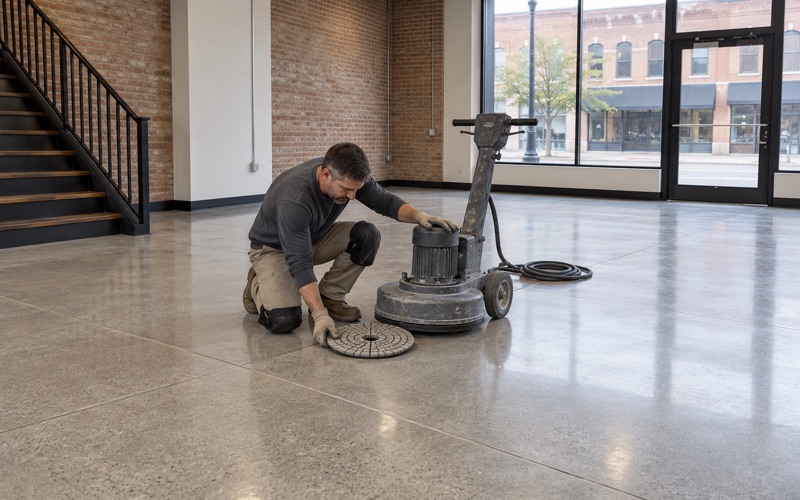
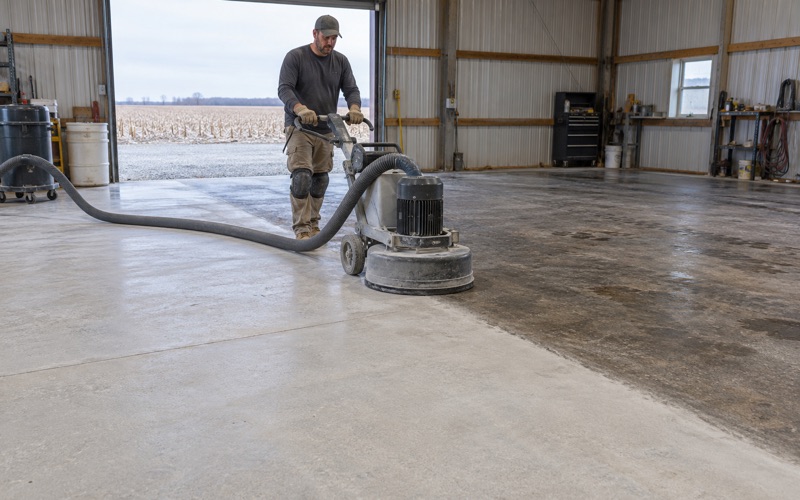
Once the floor is clean and fully dry, we open the surface with diamond grinding or shot blasting to the ICRI CSP profile the system calls for. Grinding also removes the top skin of cement paste, where any faint residual oxide tends to sit. Dust is collected at the grinder by vacuum and is never hosed toward a floor drain.
Moisture testing follows as a priced line on the proposal. Depending on the slab we use ASTM F1869 calcium chloride tests or ASTM F2170 in-situ relative humidity probes, and if the readings call for a moisture-mitigation primer, it is priced before you sign. Our warranty exclusions are read out before the sale, with moisture first on the list.
Older slabs and attached homes
The city’s most common construction decade is the 1970s, with 1,650 housing units, and most of its homes went up between 1970 and 1999. A slab that age may carry an old sealer, a failed coating or years of layered stains. We read the cracks, joints and old coating before quoting, and we say so when a slab needs repair or replacement rather than a coat.
Attached homes are a large share of the stock, with 1,612 single-family attached units, more than a quarter of the total. An association may govern contractor access, work hours and the exterior, so we ask owners to check its rules before we put a date on the calendar.
Rinse and Clean With Treated Water Afterward
The final rinse before primer
On a private-well property, the last rinse before coating matters as much as the cleaning. Rinsing a freshly cleaned slab with raw well water can lay a new film of iron down as it dries, right where the primer is about to go. We do that final rinse with treated water, either city water brought to the job or the home’s own filtered supply where the owner already has iron treatment, and we let the slab dry completely.
Cure timing set by the slab
Curing is scheduled against slab temperature and the dew point spread at the surface, not against the calendar. A garage floor on a cool, damp morning can sit close enough to dew point that a fresh coat blushes or bonds poorly. An unheated garage in deep winter may simply have to wait for spring, and we would rather say that early than force a date.
Everyday cleaning on a well-water property
Once the floor has cured, the cleaning water matters for the life of the finish. Mopping a light epoxy or polyaspartic floor with raw well water leaves the same rust-brown residue on top of the coating, and while a sealed surface keeps it out of the concrete, a film left to build will dull the gloss. Use treated water and a pH-neutral cleaner, and squeegee the rinse out the door or to a drain instead of letting it evaporate.
Point the softener discharge and the sump outlet away from the coated floor, and wash the car on the driveway. A coating is not water treatment and does nothing about what is in the well. If iron is a household problem, that is a question for a water specialist, and the floor benefits from the answer.
Winter salt, basements and the paperwork
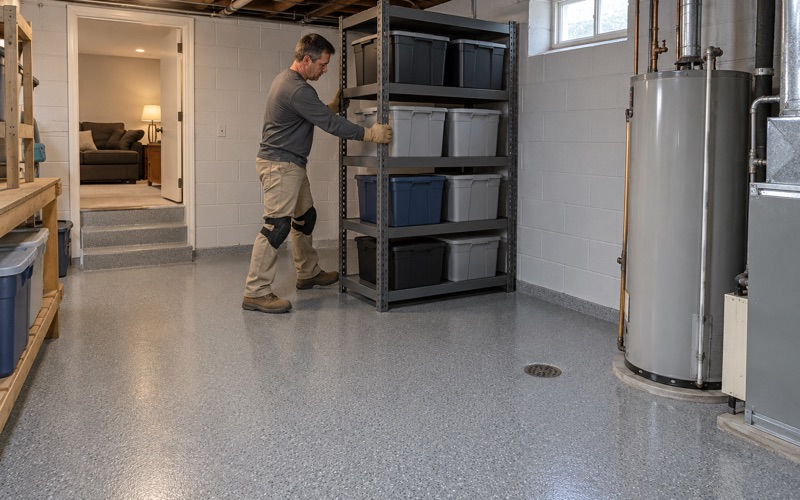
Garage systems here are built for the calcium chloride brine and rock salt that tires carry in from plowed roads, with a topcoat chosen to resist both. In a basement we start with where the water is coming from, and we say plainly that a coating is not waterproofing. Our coatings stay within the Illinois limit on VOC content, which binds the installer as well as the manufacturer.
The City of Warrenville Community Development Department lists flooring among the work exempt from a building permit, so a residential garage coating usually needs none. Commercial and multi-family floors still pass through the Warrenville Fire Protection District’s plan review. Illinois issues no state license for flooring work, so we confirm the city’s own registration, bond and insurance rules before scheduling.
Every home job gets a written contract and the Home Repair: Know Your Consumer Rights pamphlet before work starts, as the Illinois Home Repair and Remodeling Act requires. Prices are quoted per square foot for the system we actually propose, never from a national per-garage figure.
- 20+ Years of Floor Work
- Moisture Testing in Every Scope
- Written Proposals and Contracts