DeKalb IL Epoxy Flooring has spent more than 20 years on epoxy flooring in Sycamore and the rest of DeKalb County, and the first thing we look at on any slab is not the color chart. It is the holes. Every floor that carries plumbing, gas or wiring has places where something comes up through the concrete, and the way those places are handled decides whether a resin floor looks finished or merely covered.
Our approach is plain. We open the slab mechanically with a diamond grinder or a shot blaster, never acid, and we put moisture testing in the written scope rather than selling it after a blister shows up. The proposal names the product, the system build and the finished thickness, so you can check what went down against what was quoted.
This page is about one detail most quotes skip: the gap around a pipe. A licensed medical building in town is held to a written rule about those gaps, and the same discipline works on a basement or garage floor at home.
A Licensed Surgery Center and the Rule About Floor Holes
Sycamore is the county seat of DeKalb County, a city of 18,577 people at the 2020 census, with its commercial district strung along Illinois Route 64. At 2120 Midlands Court sits Northwestern Medicine Surgery Center Sycamore, a multi-specialty ambulatory surgical treatment center owned by NM Kishwaukee Hospital. A state review filing from November 2024 describes it as having three operating rooms.
What the filing actually said
That November 2024 application to the Illinois Health Facilities and Services Review Board added gastroenterology to the existing rooms. The filing states that there would be no new construction; the project was equipment only. We mention the center because of the rule it operates under, not because of any floor work, and it is not a customer of ours.
The address is also a useful local footnote. The Census geocoder places Midlands Court inside Sycamore city limits but in DeKalb Township, while City Hall on West State Street sits in Sycamore Township, so the city reaches across both.
What Illinois writes about floor penetrations
Surgery centers in Illinois are licensed under 77 Illinois Administrative Code 205.1400, the section on details and finishes. Subsection (m) reads that floor and wall penetrations by pipes, ducts and conduits shall be tightly sealed to minimize entry of rodents and insects, and that joints of structural elements shall be similarly sealed. Nearby subsections ask for floor materials that are easily cleanable, unaffected by germicidal and cleaning solutions where floors are wet-cleaned, and nonslip where people walk on them wet.
Notice what the rule does and does not say. It requires sealed penetrations. It does not require a resin floor, and it does not name any coating, brand or system.
Why the rule reads the floor with its holes in it
The point of the language is that a floor is not one continuous surface. It is a surface interrupted at every place a service line passes through, and each interruption is an opening to the space below unless someone closes it. The code treats those openings as the weak points, which is exactly how we treat them when we plan a coating.
Looking for epoxy-flooring closer to Genoa? See Genoa Epoxy-Flooring.
Why a Coating Cannot Do the Sealant’s Job
It is tempting to think a thick flood coat of epoxy will simply run into the gap around a pipe and close it. On a small hairline gap it may appear to. On a real annulus, the space between a pipe and the hole cored for it, it does something else.
Resin and moving pipes do not agree
A pipe moves. Hot water lines expand and contract, drain lines shift slightly as they fill, and a gas line carries vibration from the appliance at its end. A cured epoxy is rigid, and a rigid film bridging a moving joint cracks along the pipe, usually within a season, leaving a ring of broken coating and an open gap underneath it.
Self-leveling resin falls into open holes
A 100% solids epoxy poured across an open annulus does not stop at the edge. It runs down into the void until it fills whatever is below or cures in place, which leaves a thin, unsupported skin over the hole. That skin looks sealed on the day of the job and breaks under the first boot, mop or rolling cart.
The honest answer is that a joint which moves needs a material made to move. That material is a sealant, chosen to bond to both concrete and the pipe, and the coating is then brought up to it rather than asked to replace it.
What we will and will not promise
We are a coatings contractor. We do no plumbing, no pest work and no licensed-facility compliance work, and a resin floor is not pest control. What we can promise is that our floor will not be the reason a gap stays open, because we close each one with the right material before the coating goes down.
Planning a Resin Floor Penetration by Penetration
When we walk a Sycamore slab before quoting, we mark every penetration on a sketch of the floor. That list becomes part of the scope, the same way the moisture test and the system build do, so nobody is surprised by a pipe the morning of the install.
Prep stops at each seal
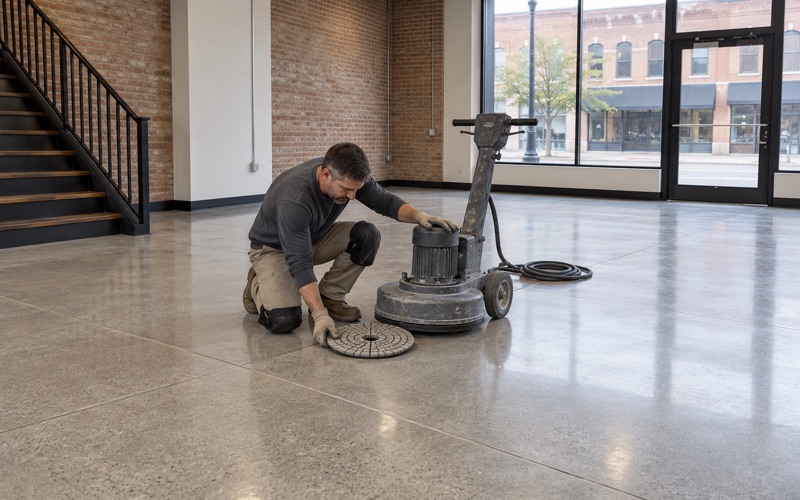
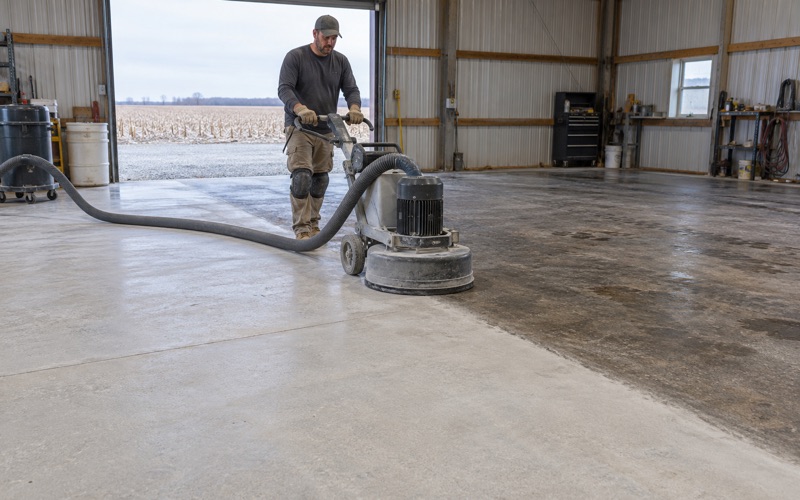
Our grinder opens the slab to a profile the primer can grip, measured against the ICRI CSP scale, but it stops short of an existing seal around a pipe. We clean that zone by hand, check whether the old sealant is still bonded, and cut it out where it has let go. Grinding dust is collected at the machine and never washed toward a floor drain.
Sealant first, then the coating meets it
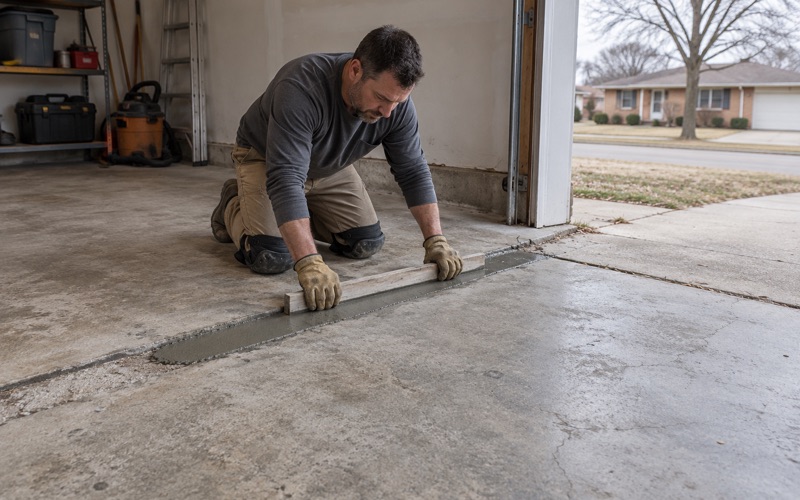
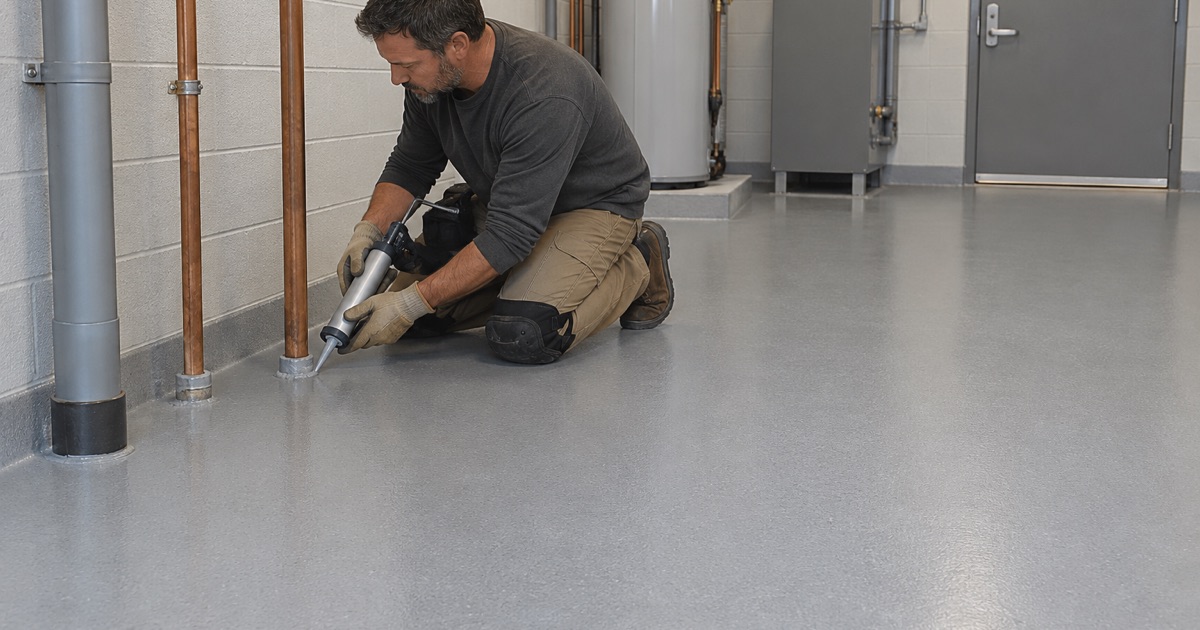
Each open gap is cleaned, backed where it is deep, and filled with a sealant compatible with the coating that will follow. Once it has cured enough to accept a primer, the epoxy base coat is brought up to the sealant and stops there, so the rigid film meets the flexible joint at a clean line instead of bridging across it.
That order matters more than any product choice. Coat first and seal second, and the sealant ends up sitting on top of a film that is already cracking at the pipe. Seal first and coat second, and each material does the work it was made for.
Joints and cracks are read the same way
The same code subsection asks for structural joints to be sealed as well, and a home slab has its own version of that: control joints and cracks. We read each one before quoting, fill moving joints with a semi-rigid polyurea joint filler, and say plainly when a crack is structural and the slab needs repair before it can be coated at all.
Timing the cure in a northern Illinois building
Sealants and resins both cure on temperature, not on the calendar. We schedule against slab temperature and the dew point spread at the surface, and when an unheated garage or shop is too cold, we say so and wait for spring rather than trap amine blush under a topcoat.
The Same Holes in a Sycamore Basement or Garage
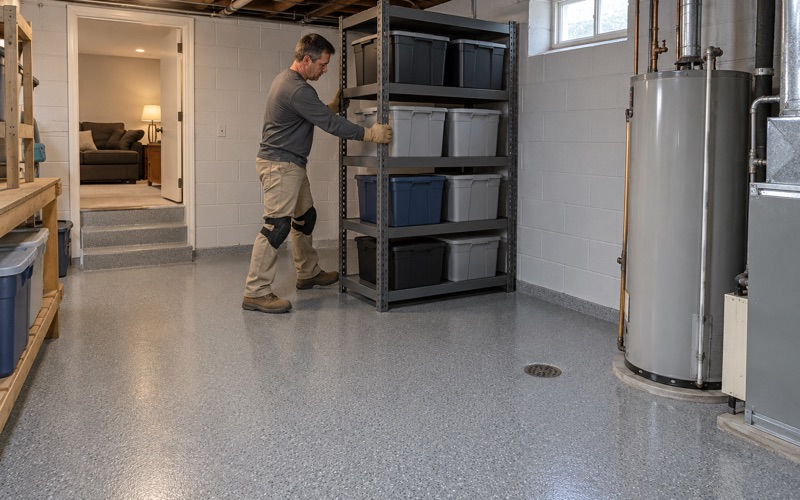
A home slab in Sycamore has fewer pipes than a surgery center, but it has the same kind of holes. Water lines come up through the basement floor to the softener and the water heater. A gas line may rise near the furnace. The sump discharge pipe leaves the pit, and plumbing vents and drain stacks pass through or sit right against the slab.
Gaps that let insects in
Every one of those is a place where the concrete was cored or formed around a pipe, and many were left with a rough, open ring. Spiders, ants and other insects use those gaps, and so do drafts and dust from the space below. A coating will not keep pests out of a house, but a sealed penetration gives them one less easy entry, and our floor is built to meet that seal rather than hide an open gap.
Older homes and newer ones
Sycamore’s housing runs from the downtown historic district, where about 13.4 percent of homes were built in 1939 or earlier, to a large wave of 2000s construction that makes up about 32.2 percent of the stock. In the older basements we often find penetrations patched several times over the decades. In the newer ones the pipes are cleaner, but builders rarely finished the gaps with anything meant to be seen under a glossy floor.
Garage floors and winter salt
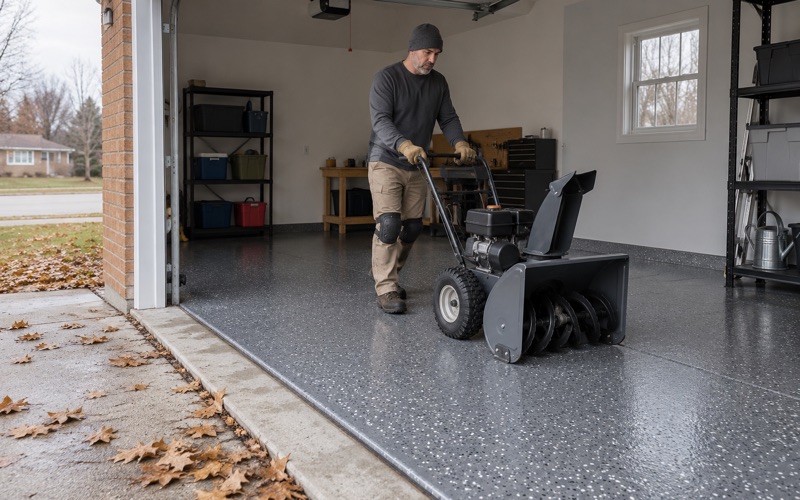
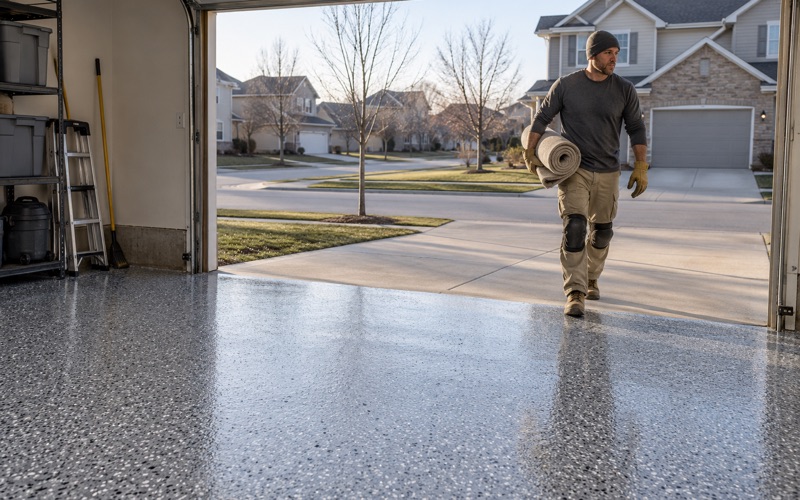
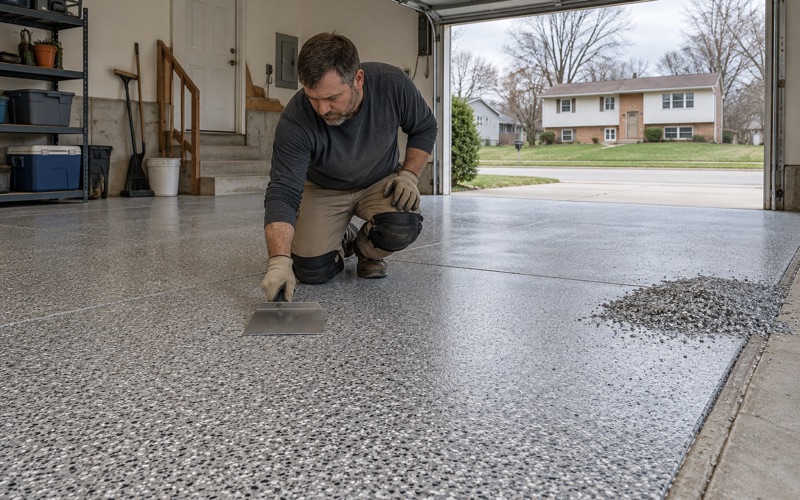
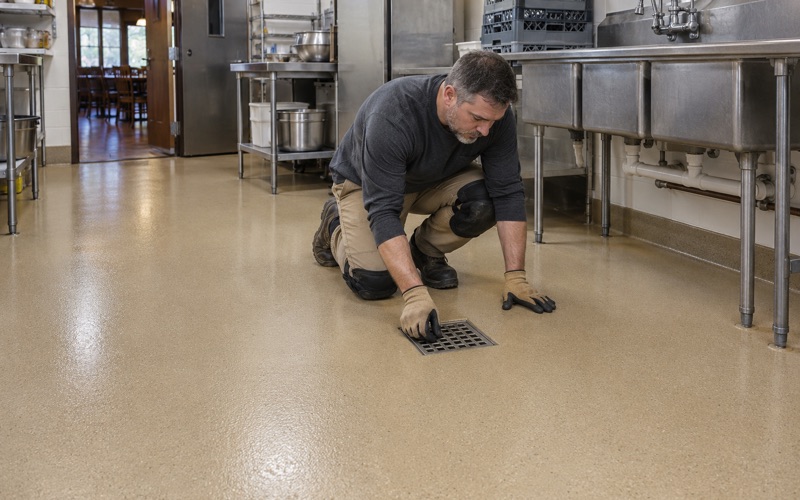
Garage slabs have fewer pipes but take a harder beating. We build them for the calcium chloride brine and rock salt that come in on the tires every winter, with a polyaspartic or polyurea topcoat over the base coat and a broadcast of vinyl flake or quartz aggregate for traction. Any floor drain, gas stub or conduit in the garage gets the same sealant-then-coating treatment as the basement.
Water first, then the floor
If a basement is taking water, that comes before any coating, because a resin floor does not stop water from coming up through or around the slab. We start every basement job by finding where the moisture is coming from, test the slab with ASTM F1869 or ASTM F2170 methods, and read the warranty exclusions out loud before the job is sold, with moisture named first.
Paperwork and what we quote
Every home job gets a written contract and the state’s Home Repair: Know Your Consumer Rights pamphlet before work starts, as the Illinois Home Repair and Remodeling Act requires. Illinois issues no license for flooring work, so we check with the City of Sycamore Building Division on DeKalb Avenue about registration, bond and insurance before scheduling. Coatings are chosen within the statewide Illinois limit of 250 grams per liter of VOC for floor coatings, and the price is given per square foot for the exact system on the proposal.
- 20+ Years of Floor Work
- Moisture Testing in Every Scope
- Written Proposals and Contracts