DeKalb IL Epoxy Flooring brings more than 20 years of slab work to epoxy flooring in Sugar Grove, and the first thing we look for on a basement floor here is not a crack or a worn paint job. It is a dusting of white powder along the walls, around the sump pit or spread across the middle of the slab. That bloom has a name, efflorescence, and it decides whether a coating can go down at all.
Efflorescence is salt that moving water carried up out of the concrete and left behind when it dried. Coating makers are blunt about it: do not coat over it. So on a basement job our scope starts with where the water is coming from, moisture testing is written into the quote as its own line item, and we say plainly that a floor coating does not seal water out of a basement.
Below we explain why this question carries extra weight in parts of Sugar Grove, what the powder is telling you, why a coat laid over it lets go, and the order we follow before any resin touches the floor. The village’s own code and contractor rules close out the page.
Field Tile, Groundwater and Mallard Point
Subdivisions built over farm drainage
Sugar Grove is a village in Kane County that grew from 326 residents in 1960 to 9,278 at the 2020 census, and much of that growth landed on former farm ground. Fields here were drained with buried tile long before houses went up, and that tile does not disappear when a subdivision is platted over it.
Census figures show 60.5 percent of the village’s homes were built since 2000, and 93.1 percent are owner-occupied. Most of the basement floors we see here are fairly young concrete in owners’ hands. Young concrete is not the same as dry concrete when the water table sits close to the slab.
Mallard Point and the Rob Roy Drainage District
Mallard Point is the clearest local example on the record. Trotter and Associates, the engineering firm on the project, described a subdivision developed in four phases over about 15 years, with a retention basin and an improved wetland built for stormwater, where residents were still having drainage problems. The firm tied them to elevated groundwater and field-tile conditions, linked to deferred maintenance of wetlands, stormwater facilities and tile during a stretch of extreme wet weather.
The subdivision sat inside the Rob Roy Drainage District, the local body for that agricultural drainage. The village, the Kane County Division of Water Resources and the drainage district formed an engineering design panel to work on it, and a 2011 Daily Herald report described a village agreement with Rob Roy to disconnect Mallard Point and de-annex it from the district.
What the county hazard plan records
The Kane County Natural Hazards Mitigation Plan, in its Sugar Grove entry, notes that Mallard Point has had a history of flooding problems mainly due to a high groundwater table. Those sources date from 2011 to 2017, and we make no claim about any particular basement today.
What they do establish is that groundwater close to the slab is a documented condition in this part of the village, not a guess. That is the reason we treat a white bloom on a Sugar Grove basement floor as information worth reading before anyone talks about color charts or flake blends.
Looking for epoxy-flooring closer to Pingree Grove? See Pingree Grove Epoxy-Flooring.
Reading the White Bloom Before Anything Is Coated
Salt carried up from below
Efflorescence is a white deposit of calcium compounds, hydroxide residues and salts. Water moving through the slab dissolves them out of the cement paste, carries them to the surface and leaves them behind as it evaporates. A Dulux technical note on concrete floors says it is driven by hydrostatic pressure or moisture vapor transmission and may indicate moisture entering from a source outside the concrete itself.
Over high groundwater and old field tile, we read a white bloom exactly that way, as a symptom. Sweeping it up removes the evidence, not the cause, and it tends to return for as long as water keeps moving through the floor.
Where it gathers on a basement slab
Bloom collects where moisture finds the easiest path: along the wall-floor joint, around the sump pit, at control joints and over cracks. A floor with a crusty ring at the pit and a clean center tells a different story than one with a haze across the whole slab, and we note both before quoting.
While we are down there we also read the cracks, joints and any old coating. If the slab needs repair first, or is a poor candidate for a coating at all, we say so in plain terms before anyone signs anything.
Why a coat over efflorescence lets go
The manufacturer guidance is direct: efflorescence should not be coated over. The deposit is a poor, friable base, so resin applied on top of it bonds to loose powder rather than to concrete. When that powder lets go, the coating goes with it.
The larger problem is the water behind the powder. Even after the deposit is removed, the same note warns, hydrostatic pressure will force moisture to the surface and collect under the coating system, forming blisters. A dense film such as 100% solids epoxy gives that moisture nowhere to go, which is how a basement coating ends up lifting in bubbles.
What a coating can and cannot do here
A floor coating holds back no groundwater, replaces no sump or drain tile and offers no flood protection. It is a wearing surface laid on concrete that has to be sound and dry enough to accept it.
Warranty exclusions are something we read out before a job is sold, and moisture is the first one we name. On a basement with a history of bloom, that conversation happens at the first visit rather than after a floor has blistered.
Remove, Dry, Recheck: Our Order on a Sugar Grove Basement
Learn whether the water is still moving
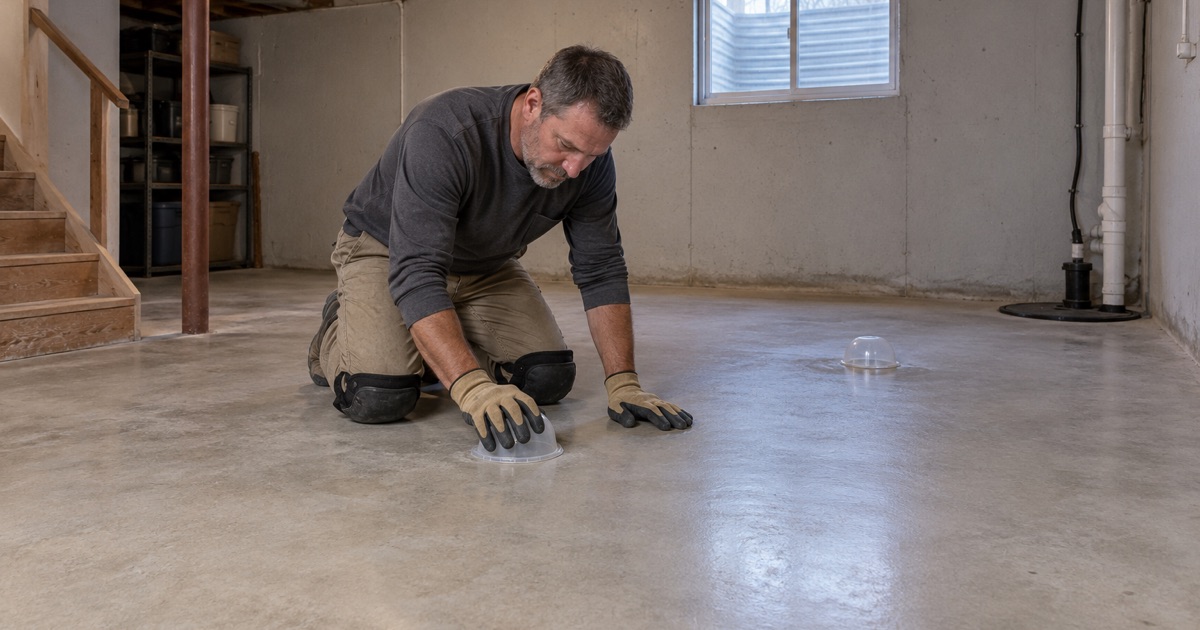
The Dulux note is explicit that efflorescence will cease when moisture transfer through the concrete stops. So before we discuss systems, we try to learn whether the bloom is old residue or an active deposit. A taped-down plastic sheet under ASTM D4263 gives a quick read, and ASTM F2170 relative humidity probes set into the slab tell us what is happening below the surface.
The house itself offers clues too. The village’s Structure Flooding page describes the usual setup, with gravel backfill, perimeter drain tile and a sump pump, and notes that water rising out of the pit means the pump cannot keep up with inflow. A pit that fills fast after rain, or bloom that returns within days of brushing, points the fix toward drainage or the sump system, and we say so rather than selling a floor that would fail.
Remove it mechanically, then open the slab
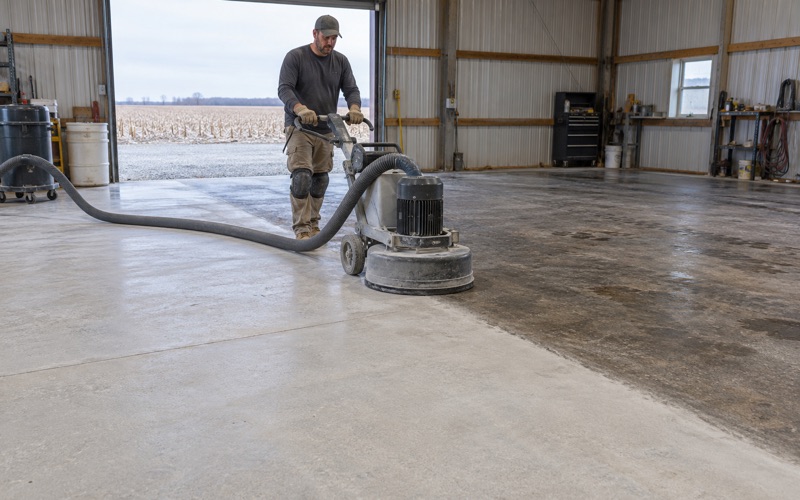
The manufacturer sequence calls for removing efflorescence by wire brushing, dry abrasive blasting or water jetting. We then open the concrete with a diamond grinder or shot blaster to a profile the primer can grip. We never acid etch, which would put more water and residue into a slab already carrying both.
Grinding dust is collected at the grinder through a vacuum shroud. None of it is rinsed toward a floor drain or the sump pit, which on a basement job often sits a few steps from where we are working.
Recheck, then coat
After removal and drying we look again. The sequence is to check for recurrence, check moisture with a standard meter (below 6 percent), correct the moisture entry, recheck, and only then coat. Where readings sit near the line, we may specify a moisture-mitigation primer, and the proposal names that primer alongside the product, the system build and the finished thickness.
If the bloom comes back, the floor waits. A delay is frustrating when a project is planned, but a coating that lifts in its first season costs more than the wait. Basement slabs also run cooler than the room above them, so we time each coat against slab temperature and the dew point spread at the surface rather than the calendar.
Village Rules: 2021 Codes and Registered, Bonded Contractors
The code change on May 1, 2026
Effective May 1, 2026, the Village of Sugar Grove adopts the 2021 International Residential, Building, Fire, Mechanical and Property Maintenance codes, among others, under Ordinance 2025-1216CD1, replacing the 2015 editions. The village requires permits for most improvements and alterations to structures and property, and its Building Division works out of 601 Heartland Drive.
We have not read the village’s local amendments, so we confirm with the Building Division whether a given floor job needs a permit rather than assuming. Where one is required, the village asks homeowners to make sure every final inspection is approved before making final payment to a contractor, which is sound advice on any job.
Registration, insurance and the bond
Illinois issues no state license for flooring or coating work, so the rules that matter are local. Sugar Grove requires every contractor on a permit to register with the village for 150 dollars a year, file a certificate of insurance naming the village with at least 1,000,000 dollars of general liability, and post a 10,000-dollar license and permit surety bond. Self-issued bonds are not accepted.
We confirm those requirements before a Sugar Grove job goes on the schedule, not after. Every home job also gets a written contract and the Home Repair: Know Your Consumer Rights pamphlet before work starts, as the Illinois Home Repair and Remodeling Act requires.
Work hours and air rules
Permitted construction hours run from 6:30 a.m. to 8:30 p.m. on weekdays and from 7:00 a.m. to 6:00 p.m. on weekends, and our grinding and coating days fit inside them. All of Kane County lies within the Chicago ozone nonattainment area, and we choose floor coatings within the Illinois limit on VOC content, which binds the installer as well as the manufacturer.
Pricing follows the same plain approach. We quote per square foot for the system actually proposed for your floor, after the moisture work is done, rather than from a national per-basement figure that assumes the slab is dry.
- 20+ Years of Floor Work
- Moisture Testing in Every Scope
- Written Proposals and Contracts