DeKalb IL Epoxy Flooring installs epoxy flooring in St. Charles with more than 20 years in the trade, and the first thing we study on a garage job is the top of the slab rather than the color chart. A coating is only as strong as the concrete it grips, so a floor with a flaking, scaled surface changes the conversation before any price is written.
We read the cracks, joints, old coating and surface scaling on every slab before quoting. When the concrete is sound, we propose a system by name, build and finished thickness. When the top layer is giving way, we say so plainly and explain why the next step is repair or a new pour rather than a coat of resin.
That honesty matters more in this city than in most, because the paperwork splits along the same line. Concrete work and coating work sit under different contractor rules here, and the sections below walk through how we sort a slab into the right one.
How the 2025 Contractor Rules Divide Concrete Work From Coatings
What changed on January 1, 2025
Starting January 1, 2025, the City of St. Charles requires contractor paperwork to be submitted before a permit is issued. There are no registration fees, but general contractors must file a certificate of insurance first, with public liability of $100,000 for one person and $300,000 for one accident, or a $300,000 combined single limit, plus $50,000 of property damage coverage.
Blacktop, concrete and paver brick contractors carry one more requirement. On top of the same insurance, they post a $10,000 surety bond payable to the City and list the City as certificate holder.
Who is on the list, and who is not
The city’s list also covers electrical, water and sewer, and excavation contractors with their own $10,000 bonds, roofers with a state license and plumbers with the state 055 license. No flooring or coating contractor category appears anywhere on it. Illinois issues no state license for flooring work either, which is why we confirm each municipality’s own registration, bond and insurance rules before a job goes on the calendar.
The practical result is that the crew who coats a garage floor and the crew who replaces one can be held to different requirements. Whether a coating or a slab replacement on its own needs a permit is a question for the Building & Code Enforcement Division at 630-377-4406, and we would rather you hear that answer from the city than from us.
Why the line matters to a homeowner
A scaled slab sits right on that dividing line. If the damage is shallow, it is coating work with careful preparation; if the top has lost its strength, the fix is concrete work, and here that means a contractor carrying the bond and insurance the rules describe. Concrete replacement is not our work, so when a slab crosses that line we tell you and wait until the concrete is right.
Looking for epoxy-flooring closer to Garden Prairie? See Garden Prairie Epoxy-Flooring.
Reading a Scaled St. Charles Garage Slab
Sound, scaled or failing
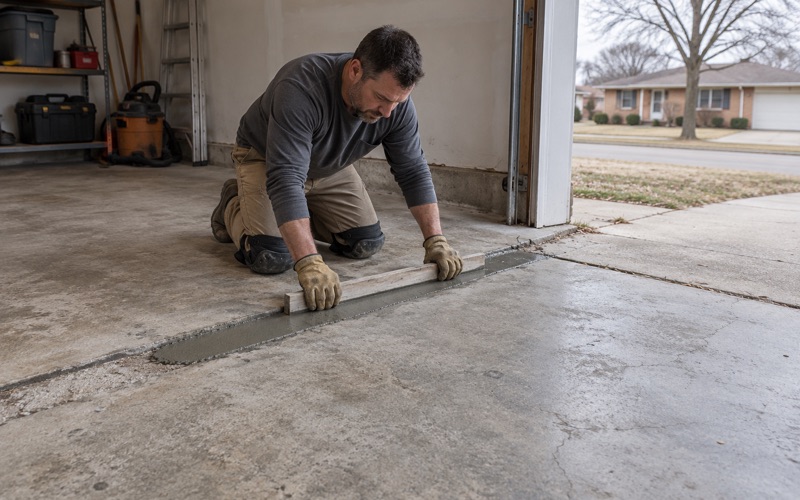
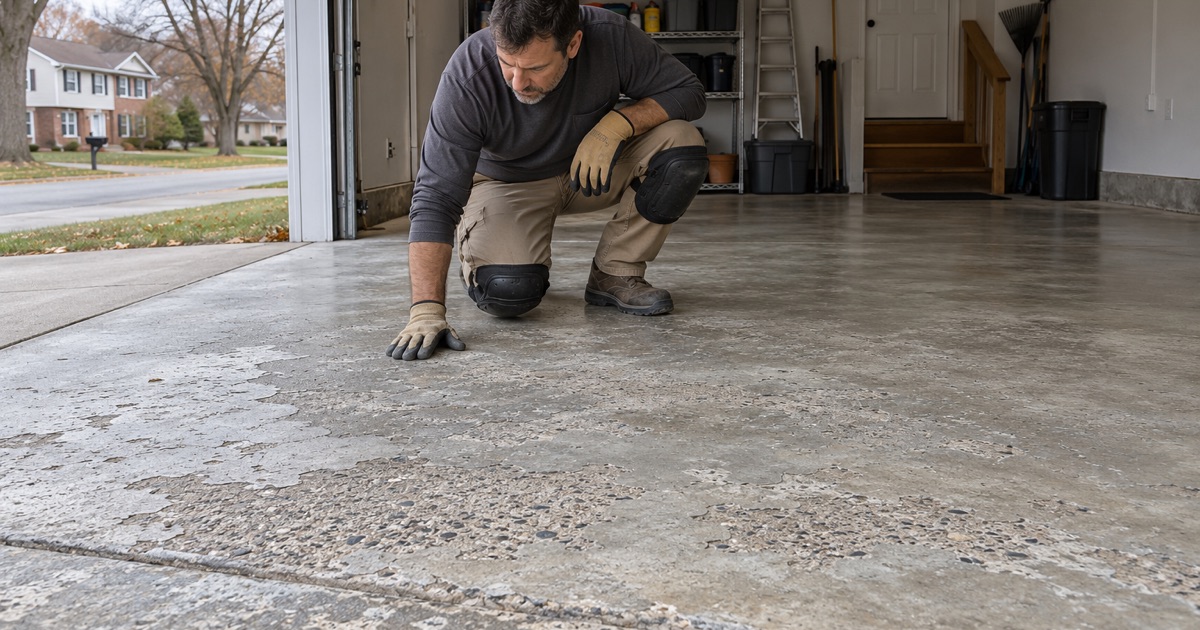
We sort garage floors into three rough groups when we walk them. A sound slab has a hard, intact surface with ordinary cracks and joints. A scaled slab has lost flakes of its top paste, usually in a band near the overhead door, while the concrete underneath is still firm. A failing slab crumbles under a scraper, sounds hollow when tapped, or has coarse aggregate loose at the surface.
Scaling is common on garage floors across northern Illinois because calcium chloride brine dripping off tires forms an expansive compound inside the concrete paste. It shows up first where cars park and melt off, and it can look worse or better than it really is depending on how deep it runs.
What we check on the walk-through
We tap the slab with a hammer and listen for hollow spots, scrape the scaled areas to see how far the loose layer reaches, and note every crack, joint and patch. Old coatings get scraped at the edges to see whether they peel off clean or take concrete with them. Each of those observations goes into the written scope so you can see what we saw.
Moisture testing is part of that same visit rather than an upsell. On a garage slab we use an ASTM D4263 plastic sheet test or a calcium chloride test under ASTM F1869, because a slab with a vapor problem will push a coating off no matter how strong its surface is.
The housing behind the garage work
This is a city of owner-occupied houses, which is why garage floors make up so much of the work. Census figures show 9,246 of 13,161 occupied homes are owner-occupied, and 7,197 of those owners live in detached houses, about 77.8 percent. The housing stock runs from 1,281 units built in 1939 or earlier to 764 built from 2010 to 2019, so garage slabs here vary widely in age and condition.
Why the Top Quarter Inch Decides Coat, Repair or Replace
The 218 psi threshold
Coating makers publish what they need from the concrete underneath. The Sikafloor-264 data sheet asks for concrete of at least 3,625 psi at 28 days and a minimum of 218 psi of tensile strength at the time of application. That is one manufacturer’s requirement for its own product, not a building code, but it states the point plainly: the surface has to hold together under pull before a coating can.
The same sheet reports tensile adhesion above 400 psi with the failure landing entirely in the concrete. In other words, a well-applied epoxy grips harder than the concrete holds itself together, so the weakest layer of the slab sets the limit for the whole floor.
Scaling is the top paste of the slab losing its bond to the concrete below. A coating rolled over a scaled area bonds to that loose layer, and when the layer lets go, the coating comes up with it in sheets. That is why we never treat a scaled floor as a cosmetic problem to hide under flake.
When patching and resurfacing are enough
Shallow scaling over firm concrete can usually be repaired. After grinding, we fill the scaled areas with a profiling or resurfacing mortar, which is what Sika directs for repairs and leveling, and let it cure before the base coat. Cracks get a repair material suited to their movement, and control joints get a semi-rigid polyurea joint filler so they can still move.
Those repairs are written into the proposal as their own line items, so the cost of fixing the slab is not buried inside the coating price. Pricing is per square foot for the system we actually propose, never a national per-garage figure.
When the answer is tear-out and a new pour
Some slabs have scaled too deep, crumble under the grinder, or have cracked into sections that move. Patching cannot give a coating a sound base on that floor, and no coating restores the strength of concrete that has failed. The honest answer is replacement, and in this city that is concrete work for a contractor who meets the bond and insurance rules above.
We tell you that before you have spent money on a coating that would fail. Once the new slab has cured, we can test it for moisture and coat it like any other sound floor.
Timing a new slab or a repair
New concrete needs time before it can take a coating, and patch mortars need their own cure as well. We test moisture with ASTM F2170 in-situ relative humidity probes or calcium chloride kits instead of guessing from the pour date. Coating cure is scheduled against slab temperature and dew point, and DuPage Airport, just east of the city, logs 133.9 days a year at or below 32 degrees with a median last spring freeze of April 25, so an unheated garage often waits for spring.
Coating a Sound Slab: What the Job Includes
Grinding comes first
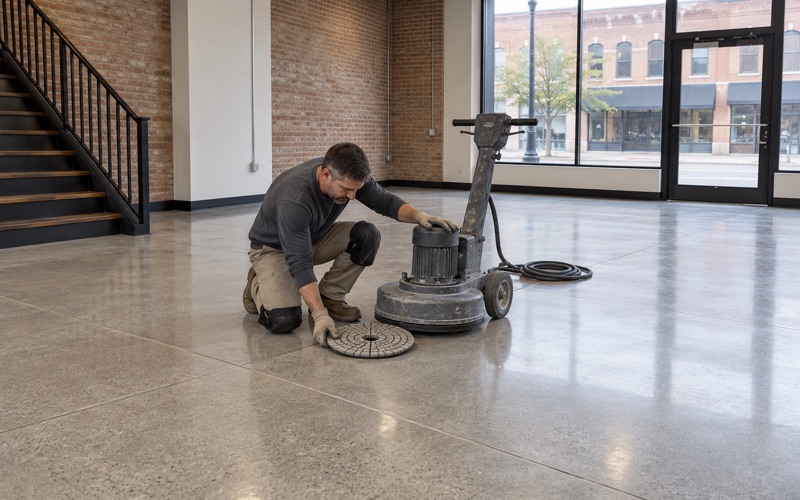
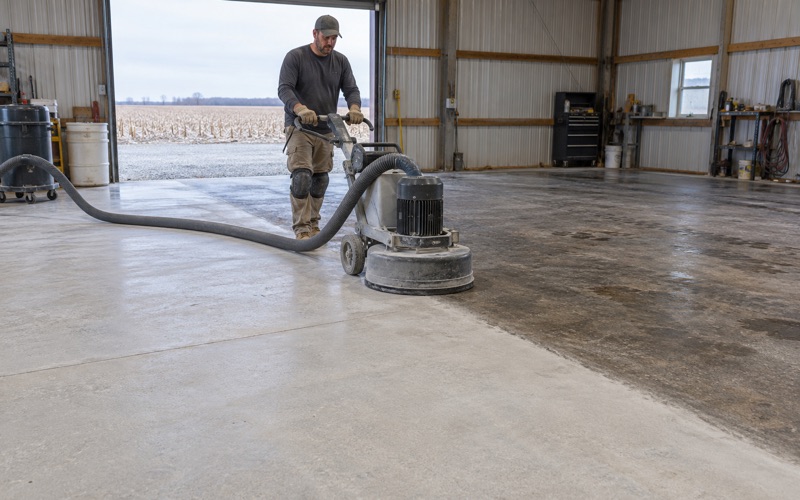
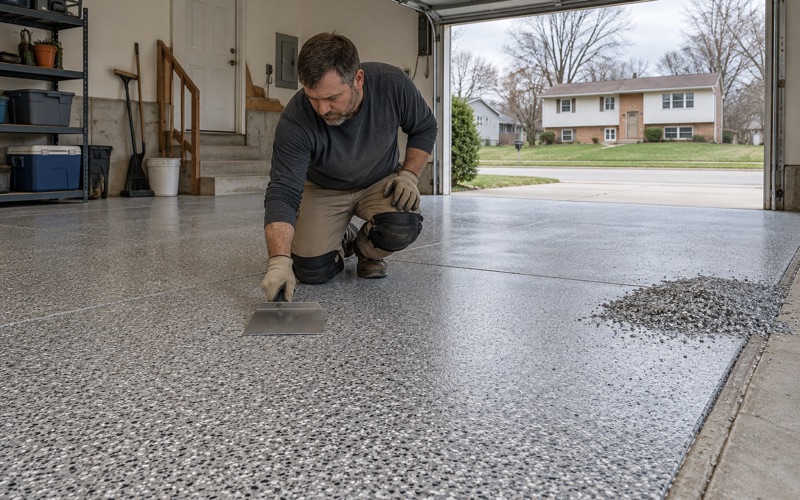
Every slab we coat is opened mechanically with a diamond grinder or a shot blaster to an ICRI CSP 3 to 4 profile, the range Sika specifies, and we never acid etch. Grinding removes the weak paste, laitance, oil and brake fluid that would break a bond. It also shows what the slab is made of, because a grinder that keeps finding soft material is telling us the scaling runs deeper than it looked.
Dust is collected at the grinder through a vacuum rather than swept or washed toward a floor drain. That keeps the garage clean and keeps concrete fines out of the storm sewer.
The system, named in writing
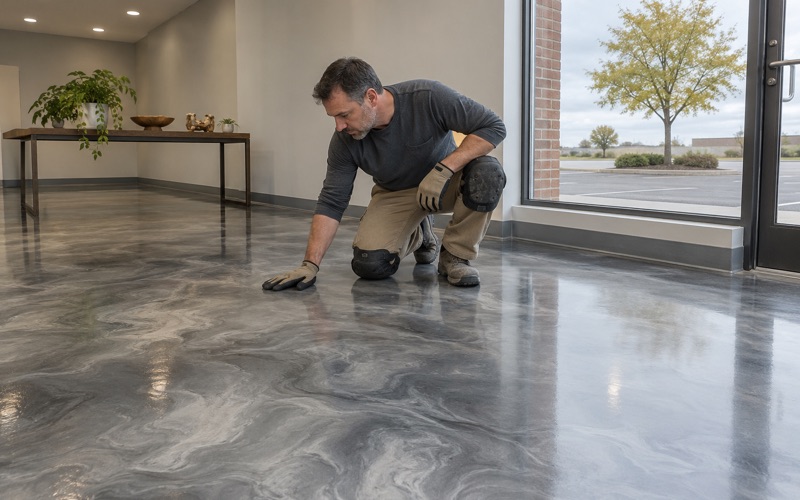
On a sound garage floor, a typical build is a 100% solids epoxy base coat, a full broadcast of vinyl flake or quartz aggregate, and a polyaspartic or polyurea topcoat that resists hot tire pickup. The proposal names the product, the number of coats and the finished thickness, so what was quoted can be checked against what went down. Coatings are chosen within the Illinois VOC limit for floor coatings, a rule that binds the installer as well as the maker.
Brine and rock salt still come in on the tires every winter, so we build garage floors with a textured broadcast and a chemical-resistant topcoat. The coating protects the surface it covers, but it does not stop salt damage that has already reached below that surface, which is one more reason the slab is judged before a floor is sold.
Contract, warranty and moisture
Every home job gets a written contract and the Home Repair: Know Your Consumer Rights pamphlet before work begins, as the Illinois Home Repair and Remodeling Act requires. Warranty exclusions are read out before the job is sold, and moisture comes first on that list. A coating is not waterproofing, and we do not sell one as radon reduction.
Beyond the garage
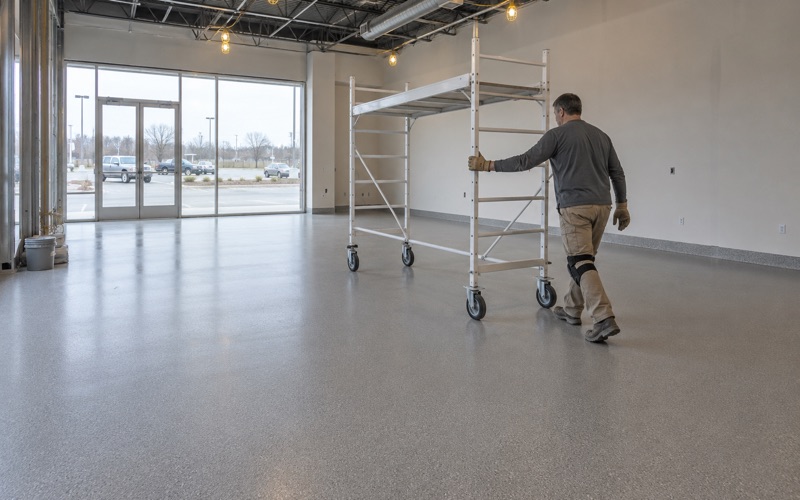
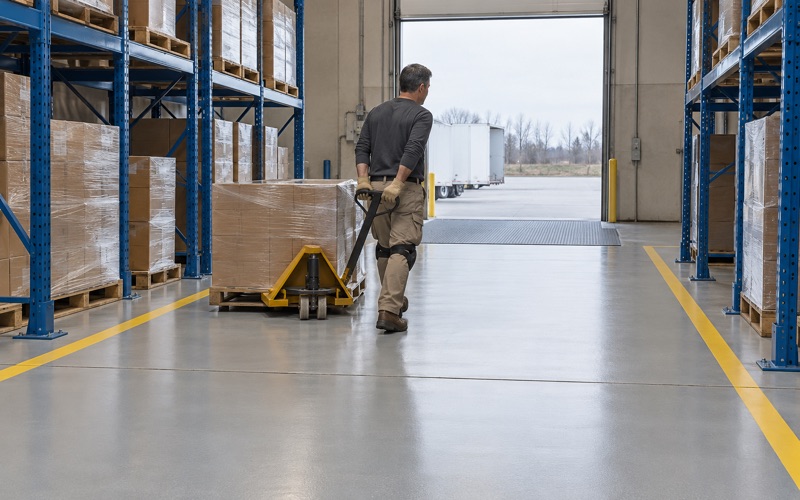
Not every call here is residential. The east side has long been a hub for light industrial growth, and the former Pheasant Run Resort golf course has been developed into an industrial park of warehouse buildings along Kautz Road. For any shop or warehouse slab, we schedule around the hours the building has to keep running, including overnight and weekend windows.
Getting a slab assessed
Call us for a walk-through and we will tell you whether your garage floor is a coating job, a repair-then-coat job or a concrete job. You get that answer in writing, with the reasons, before anything is scheduled.
- 20+ Years of Floor Work
- Moisture Testing in Every Scope
- Written Proposals and Contracts