DeKalb IL Epoxy Flooring brings more than 20 years of epoxy-flooring work to South Elgin homes and businesses, with garage, basement and shop slabs prepared by grinding rather than by a jug of acid. A floor is only as good as the concrete under it, so we start every visit by looking at that concrete before we talk about color or flake.
Our proposals spell out the product, the system build and the finished thickness, so you can hold what we quoted against what went down. Moisture testing sits on that proposal as its own line item, not as an upsell after a floor has already lifted. If a slab needs crack repair or replacement before it can carry a coating, we say so before anything is sold.
This page covers what changes about the work in South Elgin specifically. The short version is that a village built along a river asks a floor to tolerate water now and then, and the order of the work matters more than the brand on the pail.
The Fox River at the South Elgin Dam
The National Weather Service tracks the river at a gauge called Fox River at South Elgin Dam, and the gauge point itself sits inside the village. Its published impact statements are unusually specific about what happens as the water climbs. They are also the only flooding statements we rely on when we talk with homeowners here.
What each stage means on the ground
At 14 feet the river starts to overflow low-lying banks near the dam. At 14.5 feet, the minor flood stage, the weather service says low-lying areas of Panton Mill Park are flooded. At 15.5 feet it says structures just upstream of the dam are threatened.
Those statements name the park and those structures, and nothing more. We do not guess which streets or houses took water in a given year, and we would rather ask you what your own basement or garage saw. Your memory of a wet floor is better evidence than any map we could draw.
Three near-record crests: 2013, 2017 and 2020
The highest crest on record at the gauge is 15.04 feet, reached on April 18, 2013, a figure the weather service still marks as preliminary. The river came close again with 14.93 feet on July 22, 2017, and 14.92 feet on May 18, 2020. A more recent rise reached 14.08 feet on April 7, 2024.
The pattern matters more than any single number. Three crests within about a tenth of a foot of each other across seven years tell us the river reaches minor flood stage often enough that a homeowner near it should plan for a wet floor rather than hope against one. That shapes which finishes make sense below grade.
Why we never call a coating protection
An epoxy floor does not keep river water out of a building, and it does nothing to a flood insurance policy or its premium. Water that comes over the bank or up through a basement will reach the slab whether that slab is bare, painted or coated. What a coating can change is how much of the floor has to be torn out once the water leaves.
Looking for epoxy-flooring closer to Elgin? See Elgin Epoxy-Flooring.
What FEMA’s Flood-Material Ratings Say About Floors
FEMA publishes a guide called Technical Bulletin 2, Flood Damage-Resistant Materials Requirements, and the 2025 edition replaced the 2008 version. Its Table 2 sorts common finish materials by whether they can survive direct contact with floodwater and be cleaned afterward. For floors, the ratings are blunt.
Epoxy rated Acceptable, carpet rated Unacceptable
In that table, formed-in-place epoxy flooring is rated Acceptable for floors. Carpeting and linoleum are both rated Unacceptable, and so is asphalt tile. Ceramic and porcelain tile set in mortar is Acceptable, while the same tile set with organic adhesives is not.
The bulletin rates a class of material, not a brand and not an installer. FEMA does not approve or certify any coating or any contractor, and we never suggest otherwise. What the table does give a South Elgin homeowner is a neutral reference for choosing a finished floor that is likely to come through a flood as something to clean rather than something to haul to the curb.
What that means for a finished basement
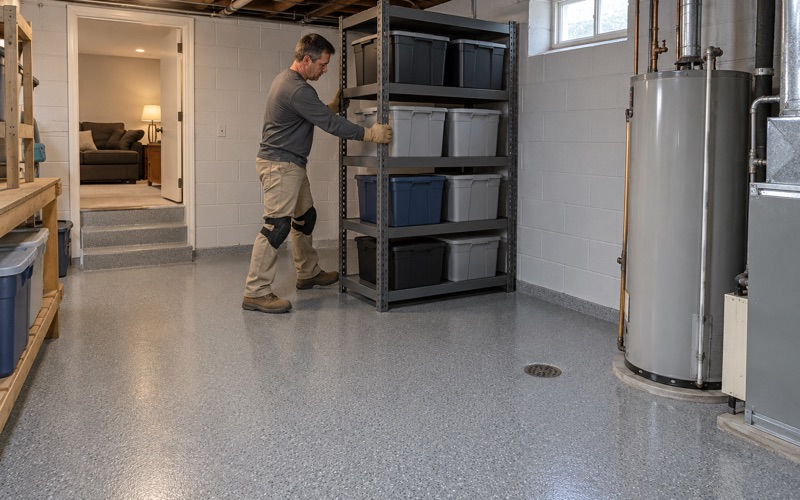
A carpeted basement near the river is a soaked pad and a dumpster after high water. A seamless resin floor bonded to the slab gives water nothing to wick into and leaves a surface that can be scrubbed and disinfected. That difference is the practical reason the bulletin sorts them the way it does.
It is also worth knowing that FEMA’s basement fact sheet excludes finished flooring from flood insurance coverage in a basement. A homeowner choosing a floor down there is effectively choosing what they will pay to replace themselves, which is one more reason to pick a finish that tolerates the water.
Garages close to the river
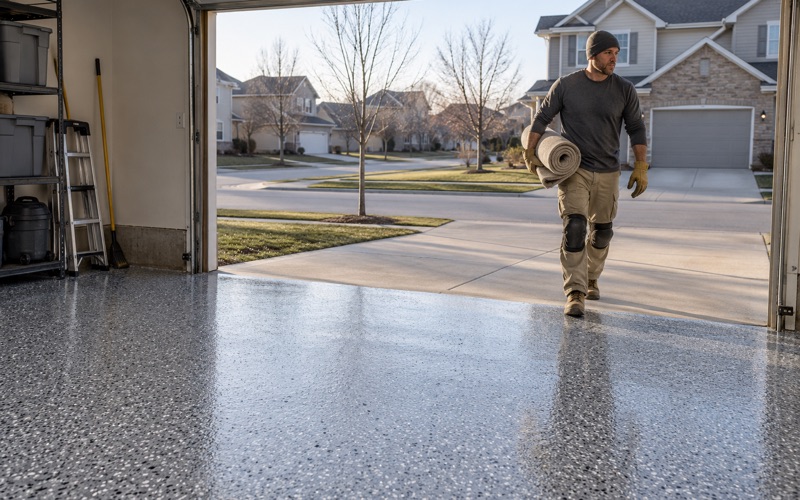
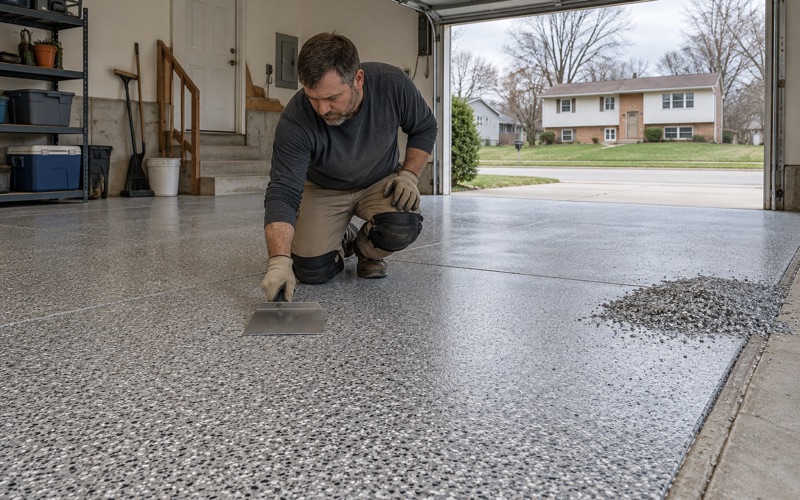
Garage slabs see river water less often than basements, but they see salt brine every winter. We build garage systems for the calcium chloride and rock salt that come in on the tires, usually a 100% solids epoxy base with a vinyl flake broadcast and a polyaspartic topcoat. The same seamless surface that handles salt also rinses clean after standing water.
Cleaning, Drying and Testing a Slab That Took River Water
The most common mistake after a flood is coating too soon. Concrete soaks up water like a sponge and gives it back slowly, and a coating laid over a wet slab can blister or lift within months. We do not begin until the slab has been cleaned, dried and measured.
Cleaning comes first
River water leaves silt, oils and whatever it picked up on the way in. The slab has to be cleaned of that residue before grinding, because a diamond grinder will drive contamination into the surface rather than remove it. We are a flooring company, not a flood restoration or mold company, so cleanup of the building itself belongs to the specialists you hire for that.
Once the room is clean and dry to the touch, we come back to assess the concrete. Dry to the touch is not the same as dry enough to coat, and that is where testing comes in.
Moisture testing we write into the scope
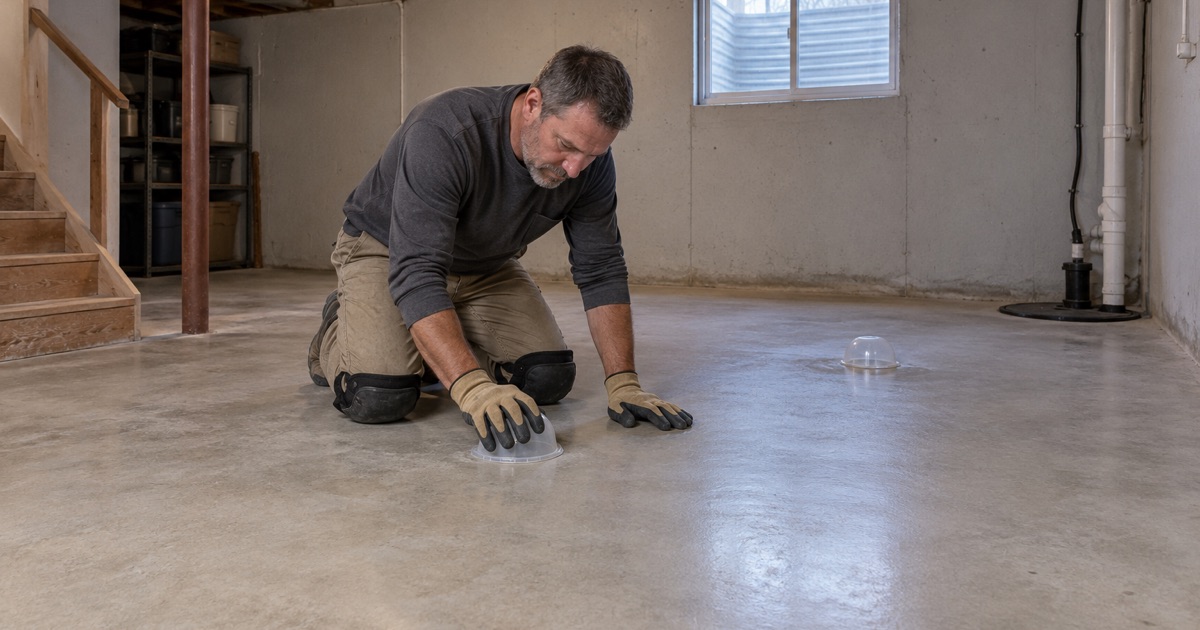
We use the ASTM D4263 plastic sheet test as a quick screen, then rely on ASTM F2170 in-situ relative humidity probes for numbers we can stand behind. Where it fits the job, we also run ASTM F1869 calcium chloride tests for vapor emission. The readings tell us whether the slab is ready, needs more drying time or calls for a moisture-mitigation primer.
Warranty exclusions get read out before the job is sold, and moisture is the first one we name. A homeowner near the dam should know exactly what a coating will and will not cover before signing anything.
Opening the slab mechanically
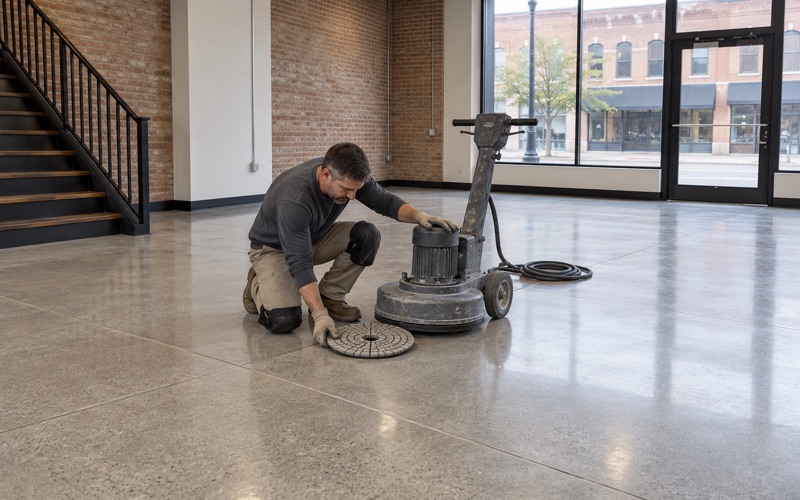
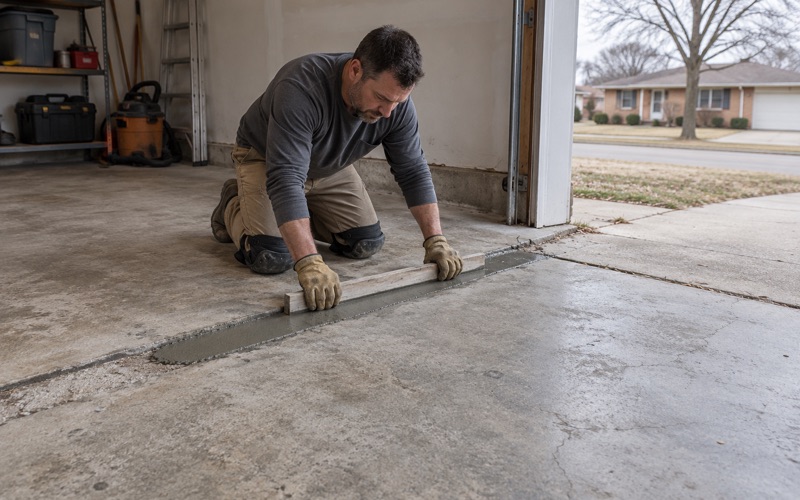
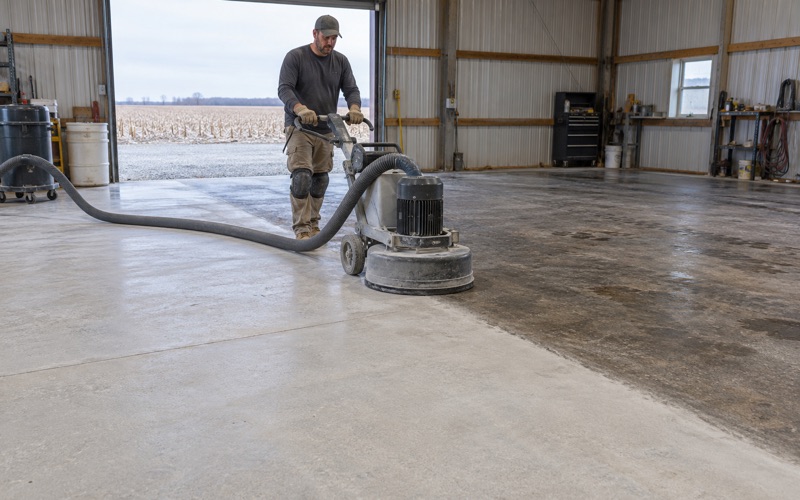
Every slab is ground with diamond tooling or shot blasted to the surface profile the system calls for, usually measured on the ICRI CSP scale. We do not acid etch, because acid leaves residue and adds more water to a slab we just spent weeks waiting on. Grinding dust is collected at the grinder and never washed toward a floor drain.
A Finish That Survives the Water Versus One That Comes Out
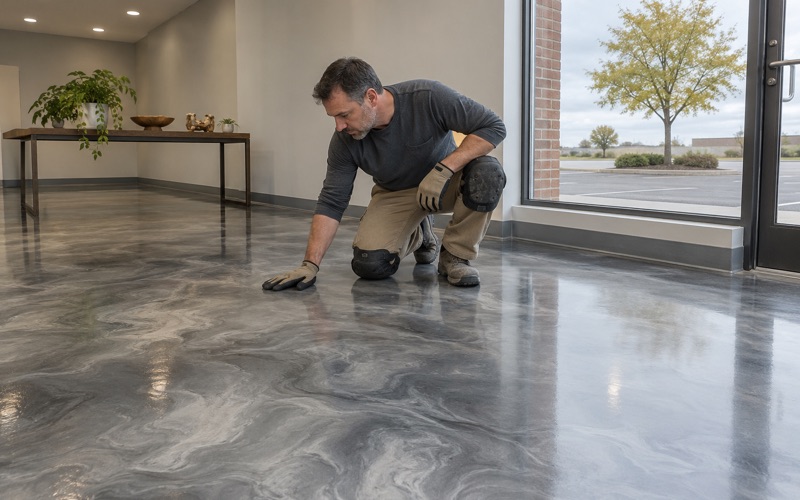
Choosing a floor in a river village comes down to what you want left behind after a bad spring. A bonded resin system can be cleaned and kept, while soft goods and glued-down tile usually come out. We help you weigh that against cost, look and how the room is used.
South Elgin homes and the slabs under them
Census figures for South Elgin show 58.2 percent of homes were built between 1990 and 2009, and 79.1 percent are owner-occupied. About 65.6 percent of units are detached houses and 15.7 percent single-family attached. That means a lot of relatively young slabs owned by the people who live on them, which is a good starting point for a coating.
Younger concrete still cracks and still has control joints. We read the cracks, joints and any old sealer before quoting, and we fill joints with a semi-rigid polyurea filler so they can move without breaking the topcoat.
Permits, contracts and VOC limits
The village lists painting, tiling and carpeting among work that needs no permit, but it does not say how it treats a floor coating. We ask the Village Community Development Department before a job is scheduled rather than assume. Illinois issues no state license for flooring or coating work, so we also confirm any village registration, bond and insurance rules first.
Every home job comes with a written contract and the Home Repair: Know Your Consumer Rights pamphlet, as the Illinois Home Repair and Remodeling Act requires. Our coatings stay within the Illinois Administrative Code limit of 250 grams per liter for floor coatings, a rule that binds the applicator in Kane County as much as the manufacturer.
Food businesses and shops
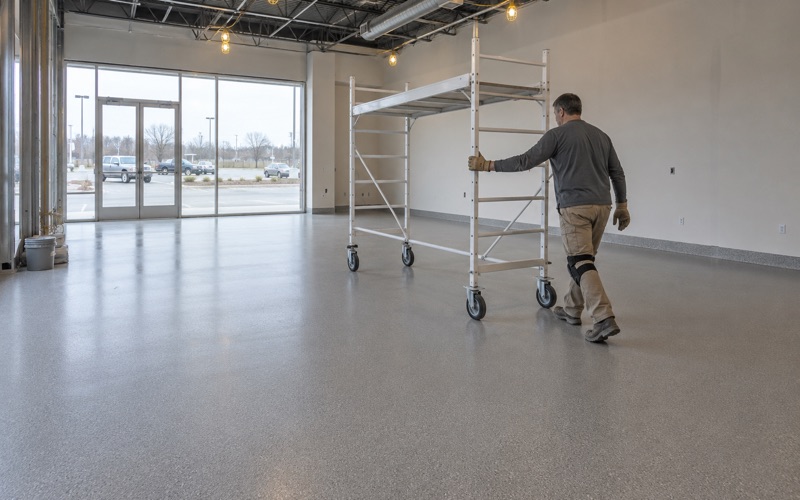
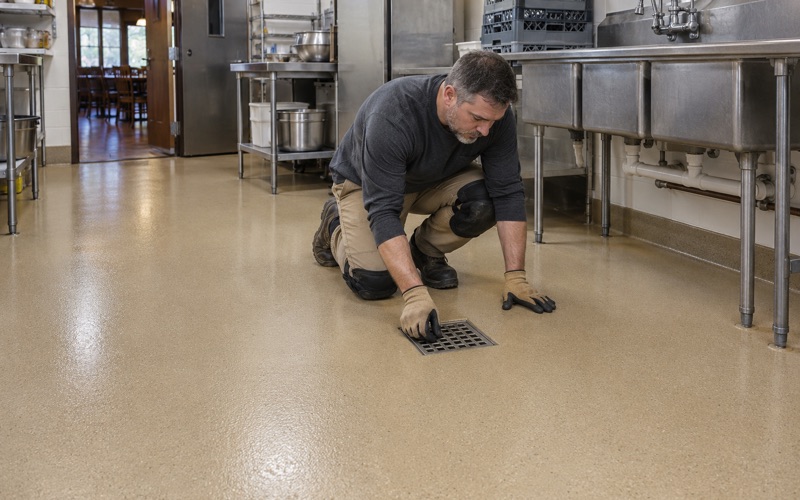
Restaurant and food floors in South Elgin go through plan review with the Kane County Health Department. Its construction manual lists seamless poured epoxy at a minimum of 3/16 inch thick among example floors and requires 3/8-inch base coving, so we specify to that before the permit is issued. For shops and commercial spaces, we schedule overnight and weekend windows so the building can keep running.
Quotes built for your floor
We price per square foot for the system we actually propose, not from a national per-garage number. Curing is scheduled against slab temperature and dew point, so an unheated garage may have to wait for warmer weather. If your floor sits near the river and has taken water before, tell us when you call and we will plan the drying and testing time into the quote from the start.
- 20+ Years of Floor Work
- Moisture Testing in Every Scope
- Written Proposals and Contracts