DeKalb IL Epoxy Flooring has spent more than 20 years installing epoxy flooring in Sandwich and across DeKalb County, and on a production floor here we start from one question: can a broom or a shop vacuum get everything off it? Plants that handle plastic pellets, powders or granules depend on a floor that comes clean far more than on one that merely looks good.
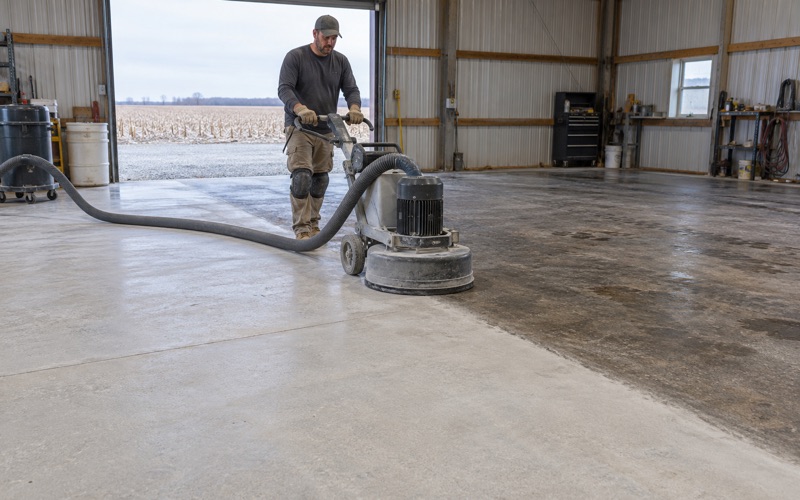
That question shapes how we build. A seamless resin floor with filled cracks and sealed edges leaves loose material nowhere to hide, and a color chosen to contrast with what the plant runs makes a spill obvious before someone steps on it. Every slab is opened with a diamond grinder or shot blaster, never acid, so the coating bonds to sound concrete.
The sections below cover why pellet housekeeping starts at the floor, what the plastics industry’s own guidance asks of concrete, how we build a surface that is easy to sweep and easy to read, and what changes for Sandwich homes, garages and small shops.
Why Pellet Plants Look at the Floor First
Sandwich’s largest private manufacturer molds plastic
The DCEDC Top 40 Employers report, dated March 20, 2026, lists Plano Molding in Sandwich with 170 employees, the largest private manufacturer the list places in the city. Among Sandwich locations only Sandwich CUSD 430, with 350 employees, ranks higher. The plant is listed at 500 Duvick Avenue, and the Census geocoder places that address inside the city on the Little Rock Township side of Kendall County.
Plano Molding keeps its headquarters in Plano, but the bulk of its production now runs in Sandwich and Mendota. We have no relationship with the company. We name it because it shows the kind of floor problem that defines industrial work in this town.
Pellets turn a floor into a rolling surface
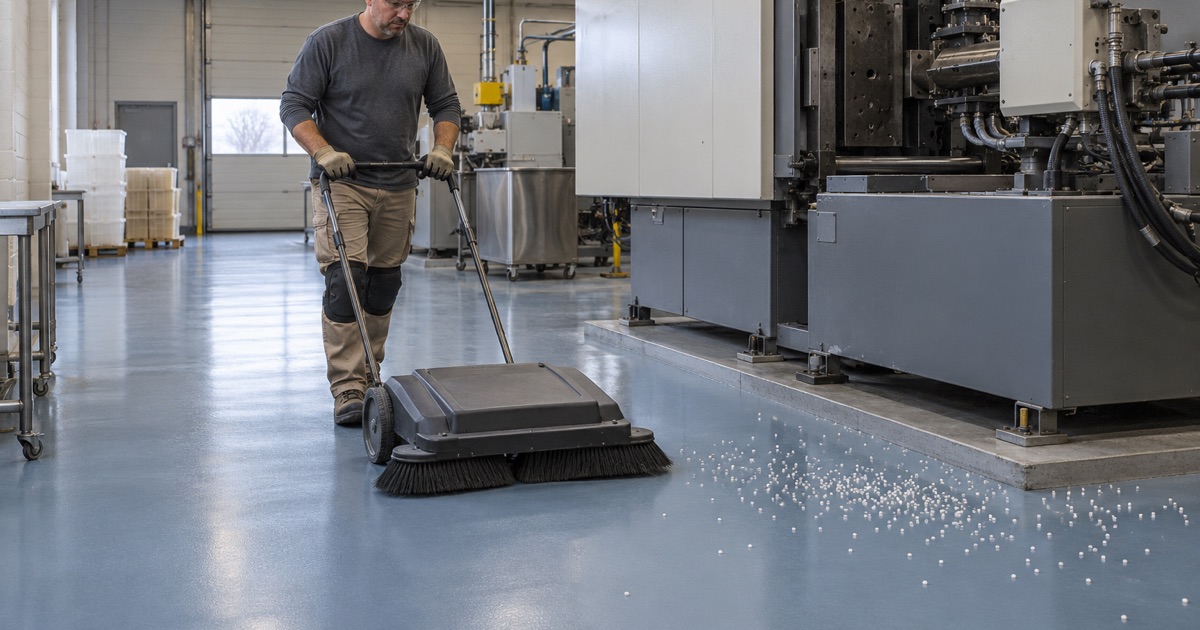
Injection molding feeds plastic resin pellets to the presses, and pellets that escape a hopper, a bulk box or a conveyor end up underfoot. OSHA’s plastics industry hazards page described walking surfaces with spilled resin pellets or beads as providing minimal traction. The same page said the hazard can be minimized through proper safety and good housekeeping practices.
Housekeeping is the part a floor can help with. A coating does not make a pellet less slippery, and no floor removes the need to pick pellets up. What the right floor does is make that cleanup fast, complete and repeatable on every shift.
Slips lead the accident list
The Operation Clean Sweep Program Manual, published by PLASTICS and the American Chemistry Council’s Plastics Division, is blunt on this point: slips and falls are the number one cause of plastics industry accidents. A sidebar on the same page adds that a clean work area reduces slips and falls.
For a plant manager weighing a floor project, that line reframes the decision. The floor is housekeeping equipment as much as the brooms and vacuums hanging on the wall, and it should be judged by how easily it gets clean.
Looking for epoxy-flooring closer to Geneva? See Geneva Epoxy-Flooring.
What Operation Clean Sweep Asks of a Concrete Floor
Guidance, not a mandate
Operation Clean Sweep is voluntary industry guidance. Its manual says none of its guidelines are intended as a mandate and that compliance with state and local regulations is mandatory, so a new floor satisfies no pellet-containment rule and no OSHA duty on its own. We put that in writing, and we never sell a coating as a certified slip-resistant surface.
What the manual does offer is a practical picture of a floor that supports good housekeeping. Several of its recommendations land directly on the concrete, and those are the ones we build toward.
Seal the joints so pellets cannot collect
The manual recommends sealing expansion joints in concrete floors with a flexible material to avoid pellet, flake and powder accumulation in hard-to-clean spaces. An open joint is a trough about the width of a pellet, and once it fills, sweeping only packs it tighter.
When we coat a plant floor, joint sealing is one step inside that housekeeping picture rather than a separate project. Before quoting we read every joint, crack and old patch, and we say plainly when a section of slab needs repair or replacement before any coating can do its job.
Dry cleanup and the tools that do it
The manual asks plants to employ dry cleanup methods whenever possible, and its equipment list reads like a janitor’s closet: brooms, dustpans, rakes, heavy-duty shop vacuums for inside use, catch trays or tarps, and scrap pellet containers. It also recommends paving loading and unloading areas where spills are most likely, with a slope or berm to keep pellets inside the paved area.
Every one of those tools works better on a tight, continuous surface. A broom glides across a smooth resin floor instead of catching on worn aggregate, and a vacuum head seals against it rather than losing suction through pits and spalls.
A Floor That Is Seamless, Sweepable and Easy to Read
Fill the cracks before the coating goes down
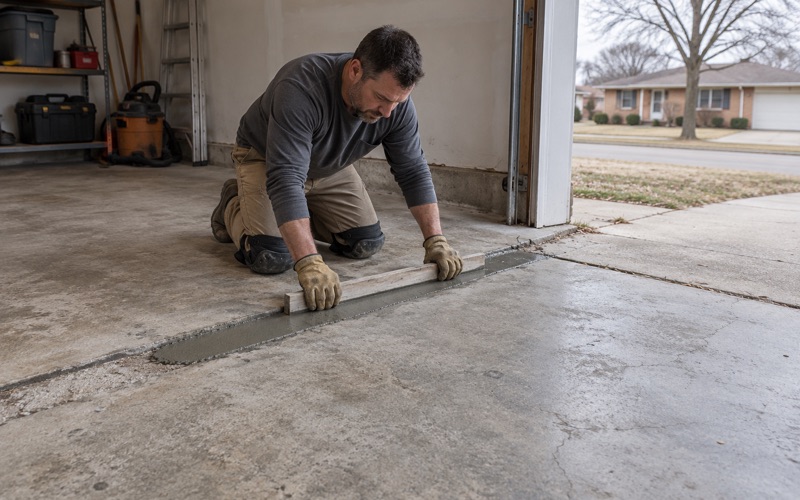
Seamless only means something if the slab underneath is continuous. We grind the surface to the ICRI concrete surface profile the system calls for, then fill cracks, spalls and pop-outs so the finished floor has no hidden low spots where powder or flake can settle.
Moisture testing is part of that same scope, not an add-on sold later. On a plant slab we use in-situ relative humidity probes under ASTM F2170 or the ASTM F1869 calcium chloride test, because a coating that blisters from vapor drive opens new pockets for pellets to lodge.
Pick a color that shows the spill
A pellet the same color as the floor is a pellet nobody sees until a boot rolls on it. We help a plant choose a base color and a flake or quartz blend that contrasts with the resins it runs, so stray material stands out from across the aisle.
Busy broadcast patterns hide debris, which suits a garage and works against a molding floor. For pellet areas we usually steer toward a solid color or a light, sparse broadcast, with texture added to the topcoat rather than a pattern that camouflages what has spilled.
Systems that stand up to forklifts and cleaning
Most production floors get a 100% solids epoxy body coat with a polyaspartic or polyurethane topcoat, or urethane cement where heat, impact or wash-down is heavier. The proposal names the product, the system build and the finished thickness, so what was quoted can be checked against what went down.
Every coating we specify stays within the Illinois VOC limits for floor coatings, which bind the applicator as well as the manufacturer. Grinding dust is captured at the grinder by vacuum and never swept or rinsed toward a floor drain.
Working around the production schedule
A molding plant rarely stops for a week. We phase plant floors by aisle or bay and schedule around the hours the building has to keep running, including overnight and weekend windows. Cure times are set by slab temperature and dew point rather than by the calendar.
Sandwich Across Two Counties, and Its Homes and Shops
DeKalb County and Kendall County
Sandwich lies mostly in DeKalb County, about 77.9 percent of the city by Census Reporter’s count, with the remaining 22.1 percent in Kendall County. The line matters more than people expect, since the Duvick Avenue plant sits on the Kendall side of it.
For a food business, which county health department reviews the floor depends on which side of that line the building stands, so we confirm it before specifying a kitchen or processing floor. Neither side of town falls inside the Chicago ozone nonattainment area, though the state’s floor-coating VOC limits apply here as they do everywhere in Illinois.
Registering with the city before work starts
Illinois issues no state license for flooring or coatings work, so local rules carry the weight. The City of Sandwich requires contractors to register before any permit is issued, through its Cloudpermit online system, and the city site says registration carries no fee.
We confirm registration, bond and insurance requirements with the City Building Official’s office before a Sandwich job goes on the calendar. That check happens whether the floor is a plant bay or a single garage.
Garages in a mostly detached-house town
Sandwich is largely a town of houses with their own driveways. About 70.5 percent of homes are detached single-family and roughly 75.5 percent of occupied homes are owner-occupied, which means a steady run of garages, home workshops and outbuildings.
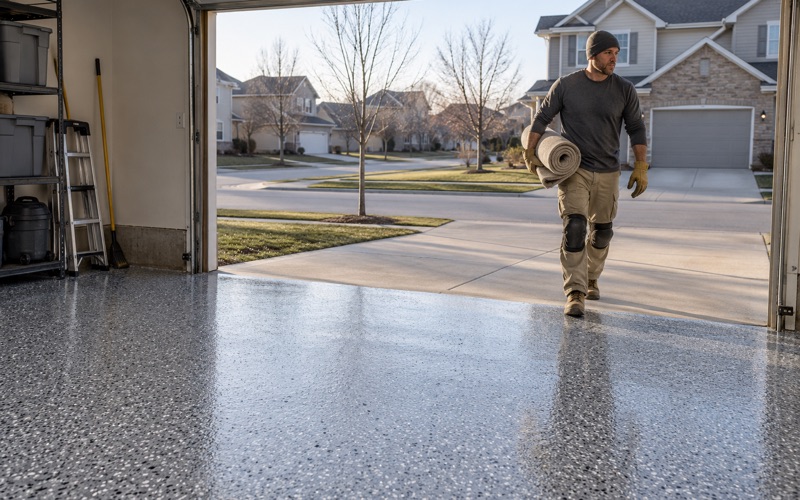
Garage floors here face the calcium chloride brine and rock salt that a northern Illinois winter tracks in on the tires, so we finish them with a dense topcoat that resists salt and hot tire pickup. Every home job gets a written contract and the Home Repair: Know Your Consumer Rights pamphlet before work begins, as the Illinois Home Repair and Remodeling Act requires.
Basements and unheated shops
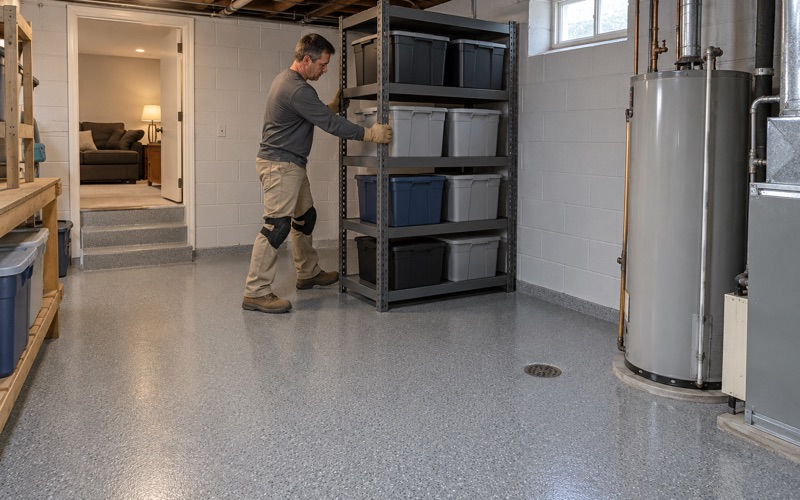
For a basement we start with where the water is coming from, and we say plainly that a coating is not waterproofing. In an unheated garage or machine shed, cure depends on slab temperature and dew point, and some Sandwich floors simply have to wait for spring.
Pricing is quoted per square foot for the system we actually propose, and warranty exclusions are read out before the job is sold, with moisture named first. Whether the floor is a molding bay or a two-car garage, the goal is the same: a surface that comes clean easily and is honest about what it can do.
- 20+ Years of Floor Work
- Moisture Testing in Every Scope
- Written Proposals and Contracts