DeKalb IL Epoxy Flooring has spent more than 20 years putting down resin floors, and our epoxy flooring in Rochelle keeps returning to one question other towns rarely ask: what happens where steel runs through the concrete. A rail cast into a slab, a filled trench where track used to run, a spur that ends at a building door. Each is an edge a coating has to respect rather than paper over.
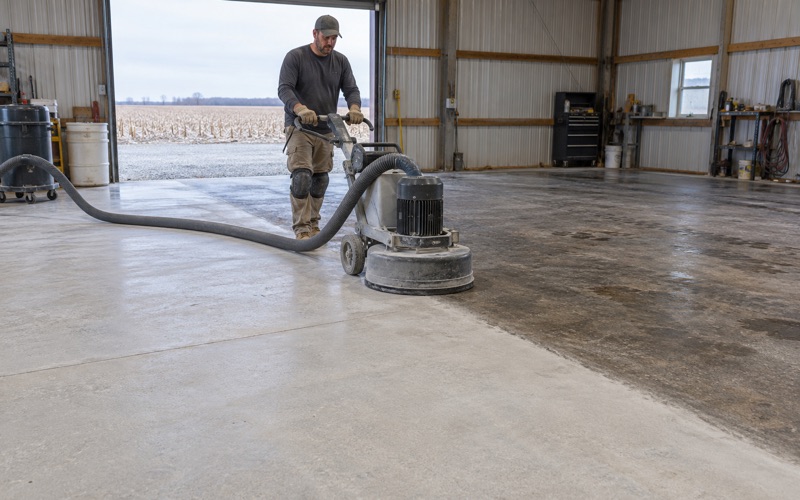
No slab gets a coating until a diamond grinder or a shot blaster has opened it, and we never acid etch. Moisture testing is written into the scope as its own line, whether the floor belongs to a garage, a basement, a farm shop or a warehouse. The proposal names the product, the system build and the finished thickness, so anyone can hold the finished floor up against the quote.
Before a price goes on paper, we walk the floor and read its cracks, joints, old coating and any embedded steel. When the concrete needs repair or replacement first, we say so plainly. Pricing is per square foot for the system we actually propose, and shop or warehouse work is scheduled around the hours the building has to keep running, overnight and weekend windows included.
The Hub City and a Plant Built Around Its Track
Where Two Main Lines Cross
Rochelle goes by the Hub City because the BNSF and Union Pacific lines intersect here, and the town grew up with freight moving through it. The city owns a short line of its own, the City of Rochelle Railroad, and city economic development news from 2012 named Burlington Junction Railway as its shortline operator. Rail is not background scenery in Rochelle; it is how the industrial park was laid out.
That history keeps adding pieces. The city reported more than 1.2 million dollars of projects on its railroad during 2014, and ground was broken for the Rochelle Intermodal Transload Center on November 9, 2022, described by the city as sitting in the heart of its industrial park. For a floor contractor, a rail-served park means a building can bring track to its door or straight inside, and we plan every walk-through with that possibility already on the list.
A Railcar Works With Track Throughout the Floor
The clearest example is the former Nippon Sharyo railcar plant at 1600 Ritchie Court. KBD Group, the design-build firm, describes Phase I with rail tracks on site and throughout the interior of the facility, and Phase II with interior rail construction and a total of 32 overhead cranes. KBD gives the two buildings a combined 912,037 square feet, while other published sources give different totals, which is why we name the source with any figure.
Shaw Local reported on December 26, 2019 that the two buildings sold for 18 million dollars, and that Nippon Sharyo had operated there from 2012, building about 120 railcars a year before announcing closure. A plant designed so that railcars could roll across its floor is a plant whose slab was poured around steel, and that shapes every coating decision made on it afterward.
From Railcars to Steel Pipe and Tube
On March 4, 2022, the City of Rochelle announced that Zekelman Industries was completing the redevelopment of both buildings for steel pipe and tube. Whether any of the interior rail remains in those floors today is something we have not determined, and we would not assume it either way. The change of use is on the record; the current floor layout is not.
We raise the site because it shows what the Hub City’s industrial floors can hold. When an owner or manager in Rochelle calls us about a rail-served building, we ask early whether track was ever set into the slab, whether it is still there, and whether any of it has been cut out. The answers decide how the coating ends, where it starts again, and what gets tested before anything is mixed.
Looking for epoxy-flooring closer to Campton Hills? See Campton Hills Epoxy-Flooring.
Where a Coating Meets an Embedded Rail
Why the Coating Stops at the Steel
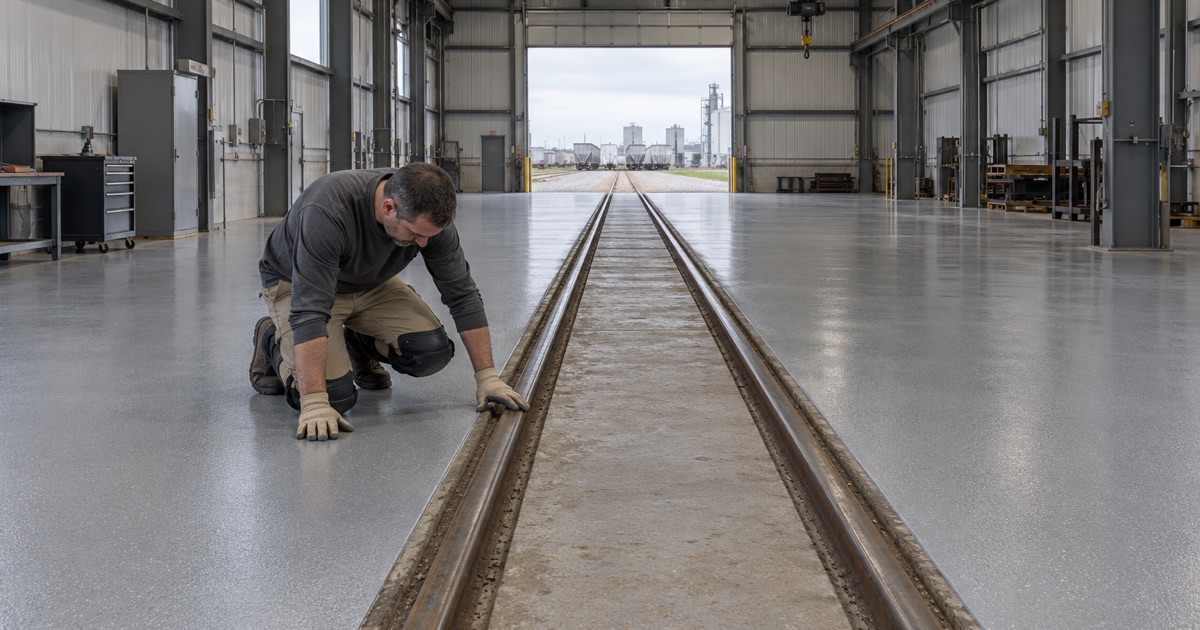
Our reasoning, rather than a published rule, is that the line where rail meets concrete behaves differently from the slab around it. Steel and concrete move at their own rates and carry cold differently, so a film stretched across that seam is being asked to bridge two materials that will not stay still together. A coating carried over the rail head tends to crack along that line first.
So we stop the system short of the rail rather than bridging it, and we seal the termination so water and debris cannot creep under the edge. The concrete at that edge is ground to the same profile as the rest of the floor, often in the ICRI CSP 3 to CSP 5 range for a 100% solids epoxy build, so the coating is fully bonded right up to where it ends.
Keeping the Flangeway Clear
The flangeway is the groove beside the rail where a wheel flange runs, and it has a job to do. Resin poured into it, or a quartz aggregate broadcast that rides up into it, narrows a space the wheel needs and gives grit somewhere to pack. We mask the rail head and the flangeway before priming and keep every coat and broadcast out of both.
That leaves a clean, sealed line along each rail instead of a ragged edge that chips the first time a car rolls through. A semi-rigid polyurea joint filler is one option we weigh where a termination needs some give, and we explain the choice in the proposal rather than leaving it to the day of the pour.
What We Can and Cannot Promise at the Rail
Resin floors are used around live rail in depot workshops elsewhere, typically on shotblasted concrete with grit in the finish. We have not read a published termination detail for resin at an embedded-rail flangeway, so we describe the principle and do not quote a standard that we cannot show a customer.
What we can promise is a termination we can explain, inspect and maintain. We read out warranty exclusions before the job is sold, moisture first, and the edge at an embedded rail is named in that conversation so nobody is surprised by what the warranty does and does not cover along the steel.
When Track Comes Out: Infill Strips of Newer Concrete
New Concrete Beside Old
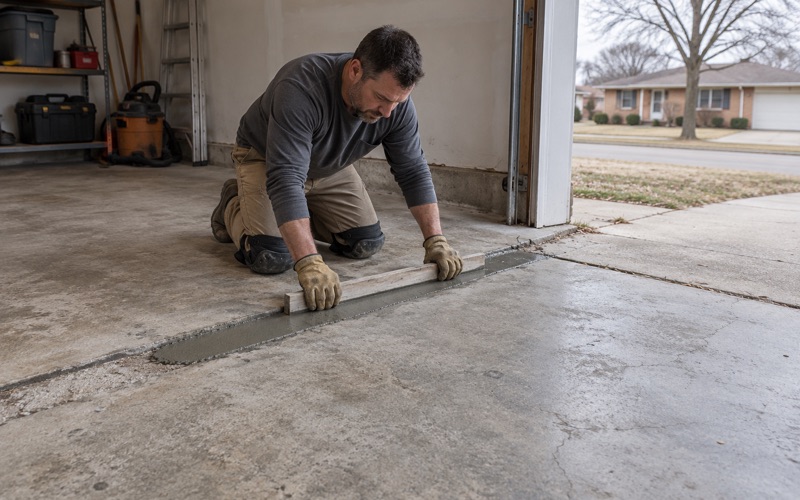
When interior track is pulled out of a slab, the trench left behind is filled with new concrete, and that strip is not the same material as the floor around it. It holds more water, it cures on its own clock, and its surface can finish harder or softer than the slab it sits beside. Our view is that it has to be treated as its own floor until testing says otherwise.
We test the infill and the original slab separately, using ASTM F2170 in-situ relative humidity probes in each and an ASTM F1869 calcium chloride test where it adds information. If the strip reads wet while the rest of the slab is ready, the schedule waits or the system changes to include a moisture-mitigation primer. One combined reading would hide exactly the problem we are looking for.
Grinding Two Slabs to One Profile
A new infill and a decades-old slab rarely grind the same way. We profile each until both reach the same surface texture, rather than running the grinder at one setting and hoping the softer concrete keeps up. The cold joints along both sides of each strip are opened, cleaned and filled before the primer goes down.
Those long seams are where a coating most often telegraphs a crack later. A joint filler set flush and ground smooth gives the coating a sound base across the seam. All grinding dust is collected at the grinder and bagged, and none of it is washed toward a floor drain or a storm inlet.
Permits and the Fifty Percent Line
Rochelle builds to the 2021 International Building Code, adopted by Ordinance 25-36 on June 23, 2025. The city’s amendments exempt painting, tiling, carpeting and similar finish work from a permit, and also repair of not more than 50 percent of a floor assembly where no fire-rated or structural component is touched. A coating on a sound slab is finish work.
Pulling rail and pouring infill can be something more, depending on its extent and on what the slab carries. We recommend a call to the City of Rochelle Community Development building division before track removal is scheduled, because the city fines work done without a required permit. Illinois issues no license for flooring or coatings work, so we also confirm the city’s registration, bond and insurance expectations before we book a date.
Rail at the Dock Door and the Transload Yard
Spur Doors and Winter Air
Where a rail spur runs to a building door, that door opens onto the weather, and a Rochelle winter pours cold air straight across the slab every time a car is moved. Curing is scheduled against slab temperature and the dew point spread at the surface, not against the calendar. When a door bay cannot hold temperature, we say so and plan around it rather than risk amine blush on a fresh coat.
The coating line stops at the door threshold the same way it stops at the rail, ground and sealed rather than feathered out. Tires and boots crossing that line track in calcium chloride brine and rock salt from the yard, so the edge is built to shed meltwater instead of letting it find a way underneath.
Crane Bays and Wheel Loads
Rail-served buildings often carry overhead cranes and heavy forklift traffic, and the floor under them takes concentrated, repeated loads. For those bays we typically propose a 100% solids epoxy body coat with a quartz aggregate broadcast and a polyaspartic or polyurea topcoat, or urethane cement where heat and impact are the bigger concern. The proposal states the build and the finished thickness either way.
Aisle striping, slip resistance and how the floor will be cleaned are settled before the first coat. Where a building has to keep shipping, we split the floor into sections and work them in sequence through nights and weekends so one bay is down while the rest of the plant keeps running.
VOC Limits Hold Statewide
Ogle and Lee counties are not part of the Chicago ozone nonattainment area, but that changes nothing about what we can apply. The Illinois Administrative Code, Part 223 Subpart C, sets VOC content limits statewide, 250 grams per liter for floor coatings and 340 grams per liter for industrial maintenance coatings, and those limits bind whoever applies the product.
Every coating we propose for a Rochelle floor sits within those limits, and the product named in the proposal can be checked against them. It is one more line in a quote meant to be read closely, from the moisture testing to the termination at the last foot of rail.
- 20+ Years of Floor Work
- Moisture Testing in Every Scope
- Written Proposals and Contracts