DeKalb IL Epoxy Flooring installs polyaspartic floor coating systems in DeKalb, IL, serving surrounding cities including Cortland, Sycamore, Genoa, Elburn and Rochelle. In our 20+ years of floor work, we have watched polyaspartic go from a specialty product to a common choice for garages and businesses that cannot wait days for a floor to cure.
Polyaspartic coatings cure fast, resist yellowing in sunlight and hold up to abrasion and chemicals. Those strengths make them an excellent topcoat and, on the right slab, a full floor system on their own. They do not change the basic rule of floor coating, though: the bond is only as good as the slab preparation under it.
Our proposals name the polyaspartic product, where it sits in the system and the finished thickness of the floor. If an epoxy base or a moisture-mitigation primer belongs under it, that is written down too, so you can see the whole build rather than a single brand name.
What a Polyaspartic Floor Coating Is
Polyaspartic Chemistry and the Polyurea Family
Polyaspartic coatings belong to the polyurea family, a group of resins known for fast reactions and tough, flexible films. Standard polyurea cures almost instantly, which makes it hard to apply by hand on a floor. Polyaspartic slows that reaction enough to roll and squeegee while keeping much of the speed.
The result is a coating that can be applied, broadcast and topcoated in a single day on many floors. It also tolerates a wider range of temperatures during installation than most epoxies. Those traits are why polyaspartic and polyurea topcoats have become standard in garage and light commercial work.
How Polyaspartic Compares With Epoxy
Epoxy is excellent at building thickness and soaking into a ground slab, which makes it a strong primer and base coat. It cures slowly and ambers in sunlight, though, so it is not the best choice for an exposed topcoat. Polyaspartic flips those traits, curing fast and staying clear, but building less thickness per coat.
That is why many of our systems combine the two, with a 100% solids epoxy base and broadcast under a polyaspartic topcoat. Others use polyaspartic throughout when speed matters most. We explain the trade-off on your floor rather than declaring one product the winner.
Chemical, Salt and Abrasion Resistance
A cured polyaspartic film holds up well against the things that wear a floor down: tire scuffs, dragged equipment, oil, gasoline and the calcium chloride brine that comes off a car in a DeKalb winter. Its tough, slightly flexible film resists scratching better than many standard epoxies. That is why it works so well as the wearing surface of a floor.
No coating is immune to everything, and the manufacturer’s chemical-resistance chart tells the real story for a given product. Brake fluid, some solvents and acids left standing can still mark a polyaspartic topcoat. We match the product to what your floor will actually see, and the warranty exclusions are read to you before the job is sold.
Where a Polyaspartic Floor Coating Fits
Residential Garages
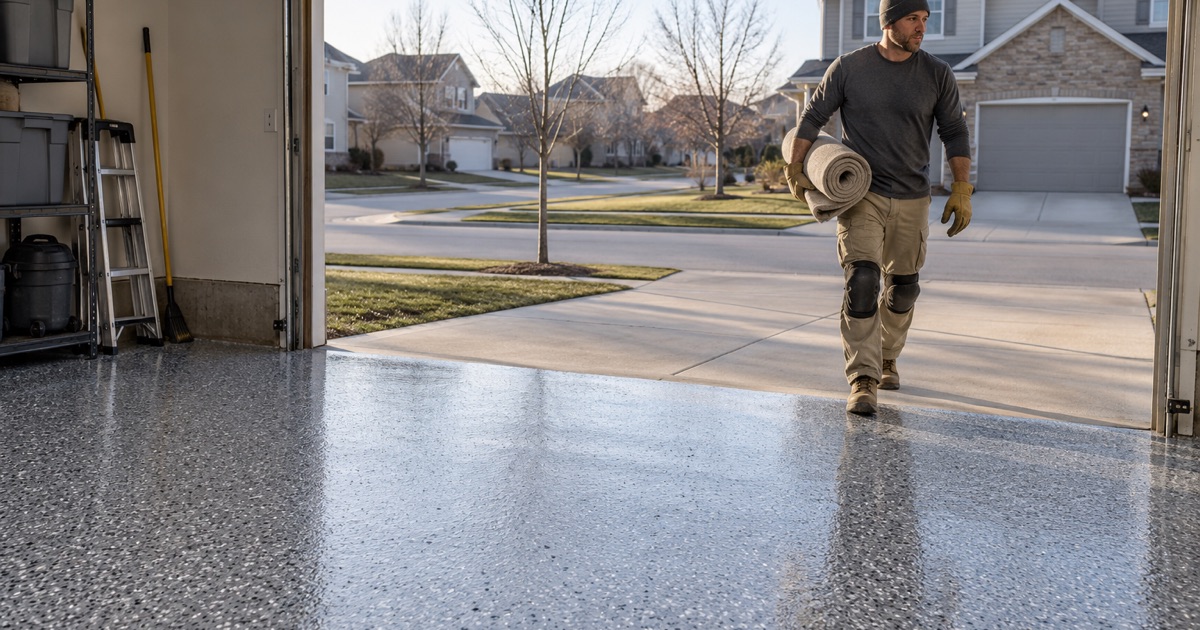
A garage floor faces sun through the open door, hot tires and salty slush through the winter. A polyaspartic topcoat resists the ultraviolet light that turns epoxy yellow and stands up well to abrasion from tires and boots. Paired with a flake broadcast, it gives a garage a durable, easily cleaned finish.
The fast cure also means less time out of your garage. Instead of moving cars and storage out for most of a week, many polyaspartic garage floors go down in one or two days. We still give the floor the cure time it needs before vehicles return.
Businesses That Need the Floor Back Quickly
Showrooms, retail spaces, restaurants and offices lose money every day a floor is closed. A polyaspartic system can be installed overnight or over a weekend in many spaces, and the business can reopen on schedule. That speed is often worth more than the higher material cost.
We plan commercial polyaspartic work around opening hours, coating in sections when part of a building must stay in use. The fast cure keeps the window short, and ventilation keeps odor under control while the coating sets.
Sunlit Floors and Color Stability
Any floor near large windows or an open overhead door gets enough ultraviolet light to yellow a standard epoxy over time. Polyaspartic is aliphatic, which means it resists that ambering and keeps colors and flake blends looking true. That matters most on light colors and metallic or decorative floors.
For sunlit floors, we specify a polyaspartic topcoat even when the base is epoxy. The topcoat protects the layers underneath from the light, so the whole floor keeps its color rather than taking on a yellow cast after a few summers.
Installing a Polyaspartic Coating Correctly
Preparation Still Decides the Bond
A fast-curing coating does not grip a poorly prepared slab any better than a slow one. Every slab we coat with polyaspartic is ground with diamond tooling or shot blasted to the profile the product requires. Sealers, paint, oil and the weak surface layer all come off before anything is applied.
The edges, the door track and the step into the house get the same grinding as the open floor. Those are the places a coating lifts first when preparation is rushed. Fast cure only helps if the bond underneath is sound.
Moisture Testing Under a Fast Floor
Polyaspartic coatings are not designed to hold back moisture rising through a slab. A garage or basement slab with no vapor retarder beneath it can push enough vapor to blister any film. We test with ASTM F1869 calcium chloride kits or ASTM F2170 probes before choosing the system.
When readings are high, the system includes a moisture-mitigation primer under the polyaspartic layers. That adds a step and a cure period, so the floor may no longer be a one-day job. We would rather tell you that up front than see a fast floor fail slowly.
Working Time, Temperature and Dew Point
Polyaspartic gives the crew a short working window once it is mixed, which is why it takes an experienced, coordinated team to apply well. Temperature and humidity change how fast it sets. We mix in small batches and work the floor in planned sections.
The slab temperature must stay safely above the dew point so moisture does not condense on the fresh film. We measure both before and during the job. If conditions are wrong, the work moves to a better day rather than going ahead in the wrong conditions.
Our Step-by-Step Polyaspartic Floor Coating Process
Step 1: Slab Inspection and Testing
We look at the slab, test it for moisture and check cracks, joints and old coatings. You choose the color, flake or finish, and the proposal lays out each layer and the timeline.
Step 2: Grinding and Repair
The floor is diamond ground with dust collection, and cracks and pits are filled and ground flush. The slab is vacuumed clean so the base coat goes onto sound concrete.
Step 3: Base, Broadcast and Topcoat
The primer or base coat goes down, followed by any flake or quartz broadcast. Once that sets, the polyaspartic topcoat seals the floor, often within the same day.
Step 4: Cure and Return to Use
We walk the finished floor with you and confirm when foot traffic and vehicles can return. You also get written care instructions for keeping the topcoat clean through the winter.
- 20+ Years of Floor Work
- Moisture Testing in Every Scope
- Written Proposals and Contracts