
DeKalb IL Epoxy Flooring grinds and finishes polished concrete floors in DeKalb, IL, serving surrounding cities including Cortland, Sycamore, Genoa, Elburn and Rochelle. With 20+ years of concrete floor work behind us, we treat polishing as a grinding job first and a finishing job second, because the look of the final floor is decided in the early, coarse passes.
Polished concrete puts the slab itself on display. Nothing is laid over the concrete to peel, blister or wear through, which makes it a durable, low-maintenance choice for warehouses, storefronts, offices and finished basements. It also means every flaw, patch and aggregate pattern in the slab becomes part of the finished floor.
We start every polished concrete job with a test area, so you see how your slab responds before you commit to a finish level. The proposal then names the exposure, the densifier, the guard and the final sheen, so what was quoted can be checked against what went down.
How a Concrete Floor Is Polished
Grinding and Honing in Stages
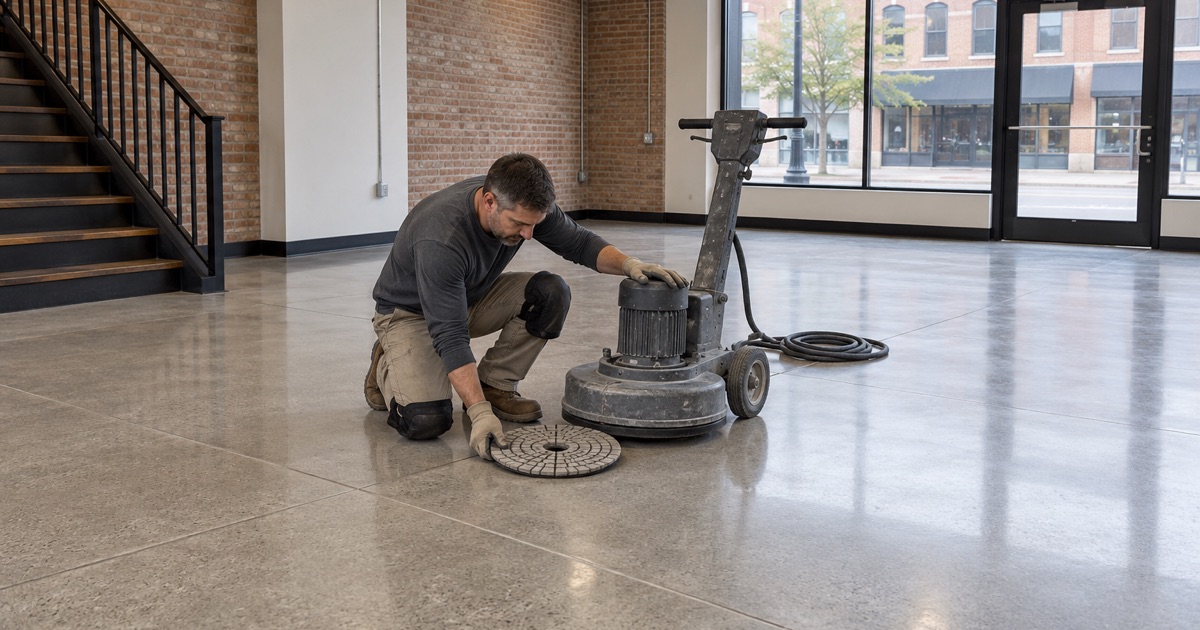
Polishing is a sequence of diamond grinding passes, starting with coarse metal-bond tooling that flattens the slab and opens the surface. Each later pass uses finer tooling that removes the scratches from the one before. The final resin-bond passes refine the surface until it begins to reflect light.
Skipping steps in that sequence leaves visible scratch patterns that show up as swirls in low-angle light. We check the floor between passes under a work light, because a missed scratch is easy to fix at the coarse stage and nearly impossible to remove at the end.
Lithium Silicate Densifier
Partway through the grinding sequence, we apply a lithium silicate densifier. It soaks into the concrete and reacts with the lime in the cement paste, hardening the surface so it takes a higher polish and resists wear. A densified floor also sheds less dust than raw concrete.
Lithium densifiers penetrate well and leave little residue, which keeps the polish consistent across the floor. We apply it evenly and give it time to react before the finer passes, since a rushed densifier step shows up later as soft, dull patches.
Guards, Sealers and the Final Sheen
After the last polishing pass, a penetrating guard or stain protector is applied and burnished into the surface. It helps the floor resist oil, coffee and other spills that would otherwise stain bare concrete. The guard is thin and does not create a peelable film the way a coating does.
The final sheen can range from a soft satin to a high, mirror-like gloss, depending on how far the polishing goes. Higher sheens look striking but show scuffs sooner in busy areas. We help you choose the level that suits the traffic and the look you want.
Aggregate Exposure, Color and Patterns
Cream, Salt-and-Pepper and Exposed Stone
How deep the grinding goes decides what the floor shows. A light grind leaves the cream finish, the smooth cement paste at the very top of the slab. Going a little deeper exposes fine sand for a salt-and-pepper look, and deeper still reveals the larger stone in the mix.
Every slab reveals its aggregate differently, depending on how it was poured and finished. That is why we grind a test area and show you what your slab holds before committing to a level. Some floors expose stone unevenly, and it is better to know that before the whole room is opened.
Dyes, Saw-Cut Lines and Borders
Concrete dyes can tint a polished floor in shades from warm browns to deep grays or brand colors. Dyes go in during the grinding sequence and are locked in by the densifier and guard. Color can be used across a whole floor or in bands and borders.
Shallow saw cuts can divide a floor into tile patterns, outline walkways or frame a logo. We lay out the cuts with you before any work begins, because a line cut into concrete is permanent. Careful layout turns plain concrete into a floor with a clear design.
Commercial Polished Concrete Floors
Warehouses, Retail and Offices
Warehouses and distribution floors along Interstate 88, including Park 88 and ChicagoWest Business Park, use polished concrete because it stands up to traffic and needs little upkeep. Retail and office spaces around DeKalb choose it for the clean, modern look. In each case, the bright surface reflects light, which can make large spaces feel brighter.
We schedule polishing in commercial spaces around the hours a building must stay open, working nights, weekends or in sections. Polishing creates very little odor compared with coatings, which helps when part of the building is still in use. Dust is collected at the grinder so the space stays clean.
Joints, Forklifts and Heavy Traffic
Industrial slabs have saw-cut control joints that take a hit every time a forklift crosses them. We fill those joints with a semi-rigid polyurea filler that supports the edges and grinds flush with the polished surface. That keeps joint edges from chipping and spalling under hard wheels.
Heavy traffic eventually dulls the shine in busy lanes, but the floor itself does not wear through like a coating. Periodic burnishing and a fresh coat of guard bring the sheen back. We explain the maintenance cycle before the job so the owner knows what keeping the floor looking good involves.
Residential Polished Concrete Floors
Basements and Lower Levels
A polished basement slab gives a lower level a finished, durable floor that does not mind a damp mop or a dropped weight. Because there is no film on top, the delamination problems a coating can have over a damp slab do not apply in the same way. Efflorescence, though, can still bloom through, so we look at the moisture and the source of any water first.
Polished concrete also works well with radiant heat and area rugs, and it suits workshops, home gyms and family rooms. We check the slab for old adhesive, paint and patches, which must be ground away before polishing can begin. The result depends on what the basement slab holds once it is opened.
New Homes and Additions
A new slab can be planned for polishing before it is poured, with the right mix, placement and finishing to make the best finished floor. The concrete still needs time to cure before polishing begins. We are happy to talk with a builder early so the slab is placed with the final floor in mind.
For additions, a polished floor can be matched to the look of an existing space or set apart as a feature. We test both slabs where needed, since new and old concrete rarely polish to the same tone.
Our Step-by-Step Polished Concrete Floors Process
Step 1: Test Area and Proposal
We grind a small test area to see how the slab responds and what aggregate it holds. You choose the exposure level, the color and the sheen with the real floor in front of you. The proposal then names each step and product.
Step 2: Grinding, Repairs and Densifier
The floor is ground with coarse tooling, cracks and joints are filled, and the densifier is applied. Dust is collected at the grinder throughout. Dyes, if chosen, go in at this stage.
Step 3: Polishing and Guard
Finer resin-bond passes refine the surface to the chosen sheen. The guard is then applied and burnished in, which gives the floor its first layer of stain protection.
Step 4: Walk-Through and Care Plan
We walk the finished floor with you under good light and touch up anything that needs it. You get the care routine in writing, including which cleaners to use and when burnishing will bring the sheen back, and the space goes back into use the same day.
- 20+ Years of Floor Work
- Moisture Testing in Every Scope
- Written Proposals and Contracts