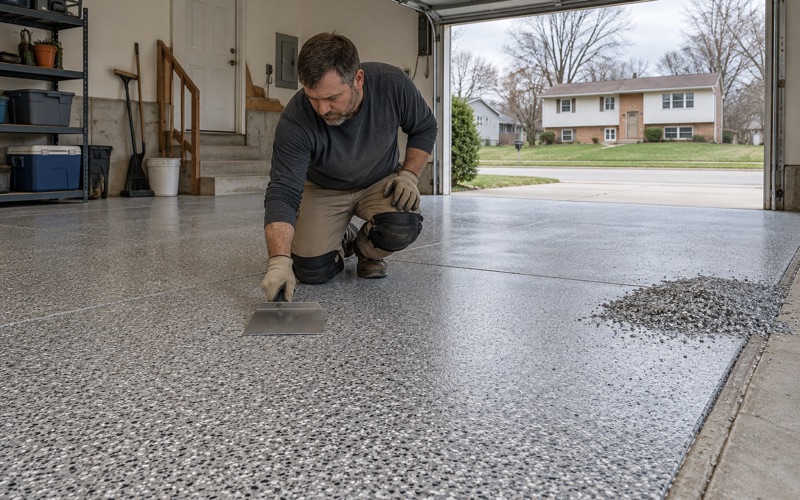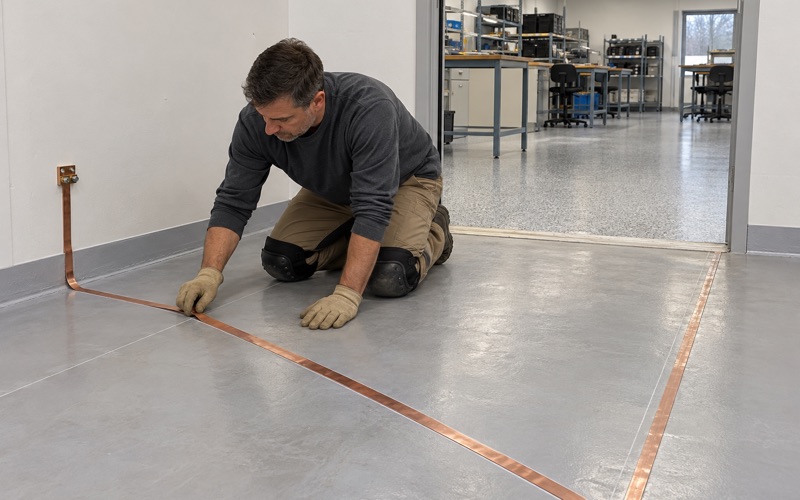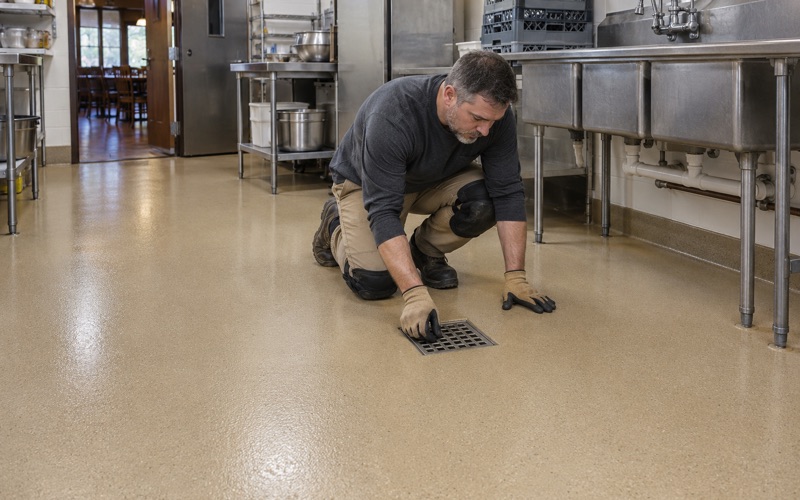
DeKalb IL Epoxy Flooring has more than 20 years behind it putting down epoxy flooring in Plano shops, garages and machine sheds, and in a steel-roofed building the first thing we inspect is often not the floor at all. It is the underside of the roof. A slab can be ground, primed and coated perfectly and still fail if water is falling on it from above while the resin cures.
That is the specific problem this page is about. Condensation from uninsulated roof steel lands on fresh epoxy as drops, leaves spots and a waxy film, and weakens the bond of whatever goes on next. Once the floor is in service, the same drip keeps one stripe of the slab wet through every cold snap.
Our order of work follows from that. We look at the roof, the ventilation and the heat source before we price the floor, and we tell you plainly when the roof has to be fixed first. A floor coating cannot stop condensation, so we never sell one as the answer to a dripping ceiling.
Steel Roofing Made on Eldamain Road, and Why It Can Rain Indoors
A roof panel plant inside the city limits
Steel roofing is not an abstraction here. Midwest Manufacturing, the manufacturing arm of Menards, runs a complex on Eldamain Road, and a facility record for Building 200 at 2619 Eldamain Road lists steel roofing sold as Pro-Rib, Pro-Snap and Multi-Tone, plus steel siding and trim, made as a private label for Menards. The same complex at 2681 Eldamain Road geocodes inside the city of Plano, in Little Rock Township of Kendall County.
We have no connection to Menards or Midwest Manufacturing and have never worked on their buildings. We mention the plant because it shows how close at hand ribbed roof steel is for anyone putting up a pole barn, a hobby shop or a detached garage around Plano, IL. Which local buildings carry those particular panels, and whether any of them drip, is not something we have surveyed.
Warm air, cold steel, falling water
Roof steel is thin and sheds heat quickly, so on a cold night its underside sits close to the outdoor temperature. A trade article from ABC Metal Roofing puts the result plainly: under the right temperature and humidity, moisture can condense on the underside of metal roofing, and the drips from ceilings come from warm air meeting the cooler roofline or walls.
Inside a shop, that warm and humid air has everyday sources. A running heater, a gas-fired unit in particular, a wet truck or tractor pulled in out of the snow, and people working all add water vapor to the room. Hansen Pole Buildings, a post-frame builder, notes that the vapor will condense on cooler roof steel even with ventilation.
Where the drips land on a shop slab
Condensate does not fall evenly. It runs along the ribs and purlins and lets go at laps, fasteners and low points, so a floor tends to show the pattern as rows of spots or a wet band under one bay. On bare concrete that can pass for a stain and nothing more, which is why many owners never notice it until a fresh coating records every drop.
Looking for epoxy-flooring closer to Sandwich? See Epoxy-Flooring Services in Sandwich.
What a Drip Does to Epoxy That Has Not Cured
Water spots in the first coat
Fresh epoxy is vulnerable for hours after it is rolled out. A drop that lands on a coat still in its working or early cure window can leave a crater, a cloudy ring or a dull spot that stays visible after the floor hardens. On a floor with a vinyl flake broadcast or quartz aggregate broadcast, the same spot may hold a patch of chips that never locked in.
Amine blush between coats
The less obvious damage is chemical. Sherwin-Williams describes amine blush as a reaction between water, carbon dioxide and the amine component of an epoxy, and notes that amines tend to absorb moisture from the air. The result is a greasy or waxy film on the surface that is easy to miss under shop lights.
That film matters because most shop systems go down in layers. Sherwin-Williams warns that amine blush can act as a bond breaker between the coating layers, so a topcoat applied over it may let go in sheets later. Their stated remedy is to wash with detergent in warm water, rinse and retest before any abrading, and that is the step we follow whenever we find it.
The drip line in daily service
Even a fully cured floor suffers under an active drip. The patch stays wet through each cold spell, collects grit and the road salt that tires carry in, and becomes the slickest stretch of floor in the building. A coating does not dry the air or warm the steel above it, so the wet patch keeps coming back until the roof is dealt with.
Drip Stop, Ventilation or Foam Before the Floor Job
Factory drip stop on new roof steel
If the building is still being planned, the cheapest fix is ordered with the roof. Hansen Pole Buildings recommends roof steel with an integral condensation control, sold as Dripstop, Condenstop or similar, applied at the factory. ABC Metal Roofing describes that fabric on the panel underside as a layer that traps and holds the moisture from condensation and releases it when conditions change.
A drip stop membrane is not a stand-alone answer. Hansen ties it to vented eave soffits and a vented ridge, so the moisture the fabric holds has somewhere to go. When an owner tells us a new shop is going up, we suggest raising drip stop and venting with the builder before the slab is even poured.
Closed-cell spray foam on an existing roof
A steel roof that is already on cannot easily get a factory membrane after the fact. For that case Hansen’s guidance is that the only practical fix is two inches of closed-cell spray foam applied directly to the underside of the roof steel. That is insulation work for an insulation contractor, not a flooring crew, and we schedule the floor after the foam is finished.
Changes to the panels themselves belong to a different trade again. Plano’s permit pages ask for an Illinois State Roofing License on roofing work, so any repair or replacement of the roof goes to a roofer who holds one. We do not touch the roof.
Keeping the building dry through the cure
With the roof under control, the shop still has to stop making moisture while the floor cures. The vehicles stay out, a gas-fired heater that vents into the room stays off, and nobody hoses anything down. We schedule the cure against slab temperature rather than the calendar, and an unheated machine shed may simply have to wait for spring.
During the cure window we keep checking the ceiling. If it beads, we stop and wait rather than roll the next coat over a damp surface, because a delay of a day costs far less than grinding off a failed topcoat.
Coating a Post-Frame Shop Slab in Plano, IL
Opening and testing the slab
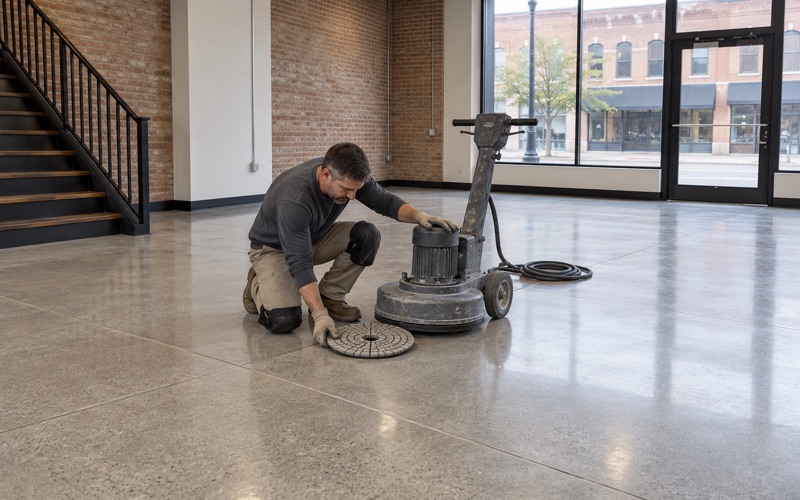
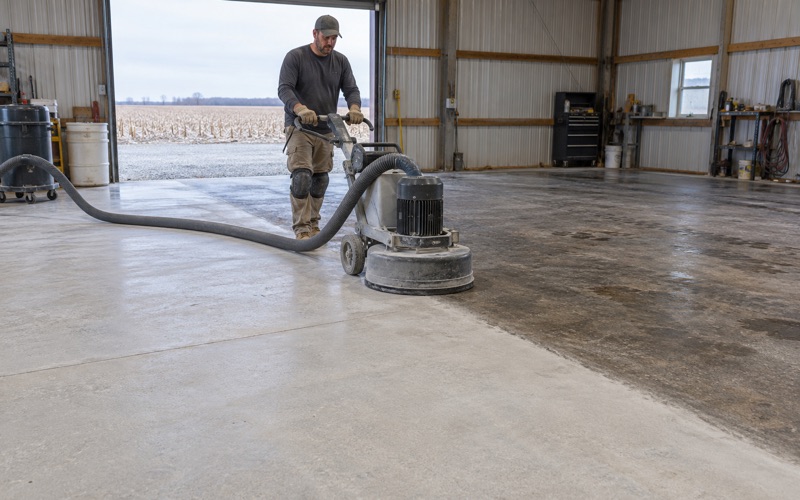
Once the ceiling stays dry, the floor work starts the same way every time. We open the concrete with diamond grinding or shot blasting to a measured ICRI CSP profile, and we never acid etch. Dust is collected at the grinder and kept away from floor drains and outdoor storm inlets.
Moisture coming up from below is a separate question from water falling from above, and we test for it as a line item. Depending on the slab, that may mean an ASTM F2170 in-situ relative humidity probe, an ASTM F1869 calcium chloride test or a simple ASTM D4263 plastic sheet test. If the readings call for it, a moisture-mitigation primer goes into the written scope before any color does.
Choosing the system for a shop
A machine shed or hobby shop usually gets a 100% solids epoxy base with a broadcast and a polyaspartic or polyurea topcoat that resists hot tire pickup and the calcium chloride brine winter equipment drags inside. We read the cracks and joints before pricing, and control joints in a shop slab usually get a semi-rigid polyurea joint filler. If a slab needs repair or replacement before it can be coated, we say so.
The proposal names the product, the system build and the finished thickness, so what went down can be checked against what was quoted. Warranty exclusions are read to you before you sign, with moisture first on the list, and the price is per square foot for that exact system. Shops that have to keep running can be booked around working hours, including overnight and weekend windows.
Permits, paperwork and who signs off
Plano’s building, planning and zoning office is at City Hall, 17 East Main Street, and it works from the 2018 IBC and IRC as amended plus the city’s own Minimum Construction Standards. The small-projects list covers decks, fences, sheds, pools, roofs and windows, and whether a floor coating alone needs a permit is not stated, so we call the office at 630-552-8275 rather than guess. A new shed in Lakewood Springs or Churchill Farms also needs HOA sign-off with its permit, which is one more reason to plan the roof and the floor together.
Illinois licenses no general, flooring or coatings contractor, and the city’s pages describe no local registration for this kind of work, so we confirm the current rules before a job is scheduled. On a home job you get a written contract and the Home Repair: Know Your Consumer Rights pamphlet before work starts, as the Illinois Home Repair and Remodeling Act requires.
Garages in newer neighborhoods
Most residential floors here are not shops at all. Of Plano’s housing, 49.1 percent was built from 2000 through 2009, so the typical attached garage is a 2000s slab where the questions are usually salt, moisture from below and hot tires rather than roof drip. Single-family attached units are common too, and more of them are rented than owner-occupied, so we confirm early whether the person booking the job is the owner who can approve it.
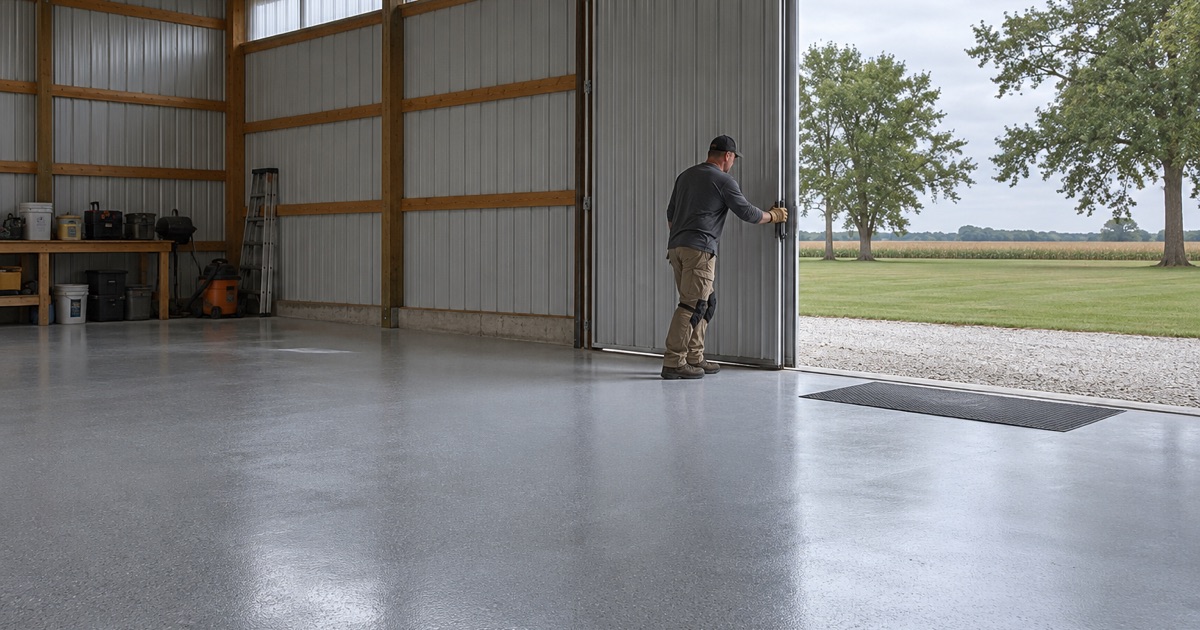
For a detached garage or shed under bare roof steel, though, everything above applies in full. Look up before you look down, fix the roof first, and coat the floor once the ceiling stays dry.
- 20+ Years of Floor Work
- Moisture Testing in Every Scope
- Written Proposals and Contracts