DeKalb IL Epoxy Flooring installs epoxy flooring in Pingree Grove with more than 20 years in the trade behind it, and the question we hear last on almost every job is the one that decides how the floor looks five years later. How should it be cleaned? A resin coating is sealed and nonporous, so whatever goes onto it either gets rinsed away or stays on top.
Most of the trouble we see on older coated floors is not wear through the topcoat. It is a dull, tacky or slick layer of cleaner that was never rinsed off, built up one mopping at a time until the floor no longer looks or feels like the one that was installed. That layer is avoidable, and preventing it costs little more than a second bucket of clean water.
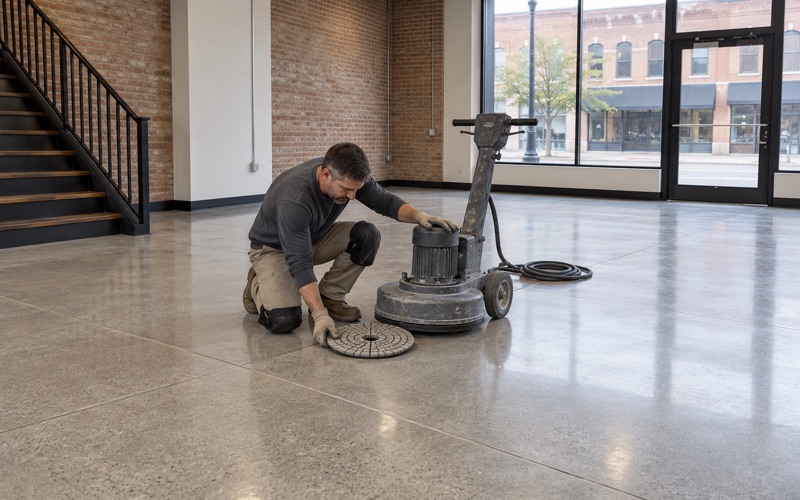
So alongside the grinding, the moisture test and the system build, we explain a short cleaning routine written around the product we actually put down. Our proposal names that product, the system and the finished thickness, so the care instructions can match the floor rather than a generic label. Below is why that routine matters here, and what it looks like in a garage or basement.
The Village’s Own Rule: Non-Residual Cleaning Products
What the village asks of its custodial contractor
In March 2025 the Village of Pingree Grove put its custodial services out for proposal, covering the Municipal Center at 555 Reinking Road and the Police Department at 1 Police Plaza. One line in that request matters to anyone who owns a sealed floor: all surface cleaning is to use non-residual germicidal cleaning products.
That is a contract term for the village’s own buildings, not a code that reaches homes or private businesses, and we read nothing more into it. We have not seen the floors inside those buildings or the products used on them. What the line does show is a building owner choosing cleaners by what they leave behind, which is exactly the right test for a resin floor.
One building, many kinds of floor
Kluber’s design-build description puts the combined village hall and public works facility at 28,000 square feet, completed in the summer of 2019. Under one roof it holds public works offices, locker rooms, toilet rooms, a break and meeting room, a wash-down laundry room and service wash bays for vehicles, with a storage mezzanine overlooking the bays.
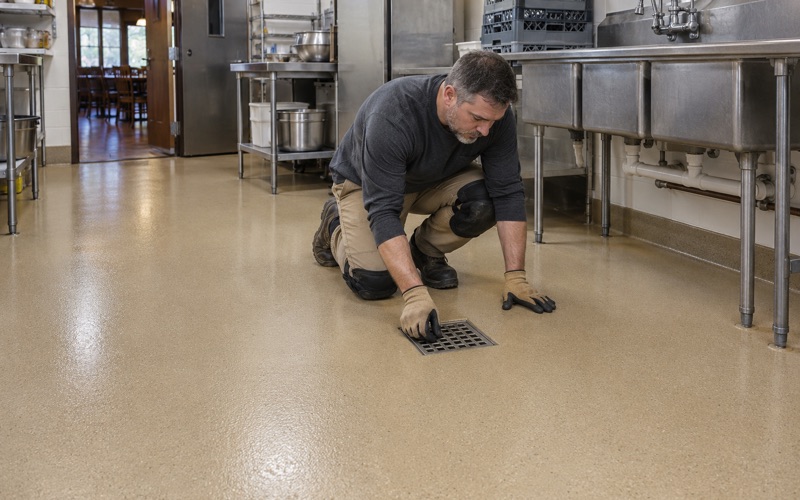
That mix is a fair sample of the floors owners ask us to coat: an office corridor that sees street shoes, a locker room that stays damp, a laundry where water reaches the floor every shift and a bay where a hose runs across the concrete. Each of those floors gets cleaned with something, every day or every week. A single non-residual rule across all of them is simpler than a separate product for each room, and it suits every one of them.
A young village with young floors
Pingree Grove counted 124 residents at the 2000 census, 4,532 at the 2010 count and 10,365 at the 2020 count. Nine homes out of ten were built in 2000 or later, so most garage floors here are still builder-finished concrete or carry a first coating rather than a worn-out one.
For an owner, that changes the job. A first coating on a young slab is a chance to start the cleaning routine correctly instead of correcting years of buildup later. It also means the habits set in the first winter are the ones that decide how the floor ages.
Looking for epoxy-flooring closer to Plano? See Epoxy-Flooring in Plano.
What Residue Does to a Sealed Resin Floor
Concrete absorbs, a coating does not
Bare concrete is porous, so a cleaner left behind partly soaks into it and partly washes out over time. A 100% solids epoxy base under a polyaspartic or polyurea topcoat is the opposite: the surface is sealed, and anything that dries on it stays exactly where it dried.
That is why a coated floor rewards the right routine more than bare concrete does. Spills wipe up and road brine rinses away cleanly. The same sealed surface also holds every film of soap, polish or leave-on spray that nobody rinsed.
What the manufacturer warns about buildup
Stonhard, a resinous flooring manufacturer, put it plainly in a 2022 article on cleaning these floors: “The wrong cleaning product, one that leaves a residue, can change the texture and the appearance of your floor.” The same article warns that this buildup can make the floor slippery.
On a garage floor that usually looks like a haze that will not buff out, a flake broadcast that seems to have lost its color, or a surface that feels faintly sticky underfoot. Dirt clings to the film, the owner scrubs harder with the same product, and the layer thickens. None of that is a coating failure, and most of it comes off with a neutral cleaner and patient rinsing.
Residual disinfectants are a different kind of product
Some disinfectants are designed to stay on a surface and keep working for days or weeks after they are applied, and the user-applied versions do it by leaving a film behind. That is a genuine feature on the surfaces they are made for. On a resin floor it is the same kind of film the manufacturer warns about, which is why the village’s word, non-residual, is the useful one.
None of this is advice to stop disinfecting. Where a floor needs a germicide, use one labeled for that surface and follow the label. Then rinse, so the product does its work and does not stay on the coating.
Neutral Cleaner, Rinse, Pick Up the Water
The routine we explain at handover
Sweep or dust-mop first, because grit is what scratches a topcoat. Then mop or scrub with a pH-neutral cleaner diluted the way its label says, not stronger, since extra concentrate is just extra residue.
Follow with a clean-water rinse from a second bucket, so the rinse water is not simply diluted cleaner. Change that water as soon as it turns gray. On a broadcast texture, a soft deck brush reaches the low spots that a flat mop rides over.
Rinse after disinfecting, too
When a germicide is part of the routine, treat it as a separate step with its own rinse. Apply it to a floor that is already clean, let it stand for the time its label gives, then rinse with clean water. A disinfectant mixed into a strong cleaning solution and left to dry is how many of the films we find on older floors got there.
Keeping the steps apart also makes problems easier to trace. If a haze appears, the owner knows which product put it there. That is far easier than guessing between three bottles mixed in one bucket.
Pick up the water instead of letting it dry
Water left to evaporate on a sealed floor leaves behind whatever it carried, from cleaner to minerals. Stonhard’s article makes the same point about equipment: scrubbers take more water off the floor, while a mopped floor takes longer to dry and can raise safety issues.
In a commercial bay, laundry or locker room, an auto-scrubber that lays down solution and vacuums it back up in one pass is the cleanest answer. In a home garage, a floor squeegee pushed toward the overhead door does the same job for the price of a broom. Either way, the floor dries from clean water, not from cleaner.
Products to keep off the coating
Skip anything sold as mop and shine, floor polish or a one-step clean and protect, because those are designed to leave a layer behind. The same goes for oil soaps and leave-on sprays.
Strong solvents and harsh acids belong on the list too, unless the coating maker names them as safe. Because our proposal names the exact coating, its maker’s care sheet is easy to find and says what the finish tolerates. When a product is not on that sheet, test it on a corner first and rinse it off.
The Same Rule in a Pingree Grove Garage or Basement
Winter salt is the residue to rinse first
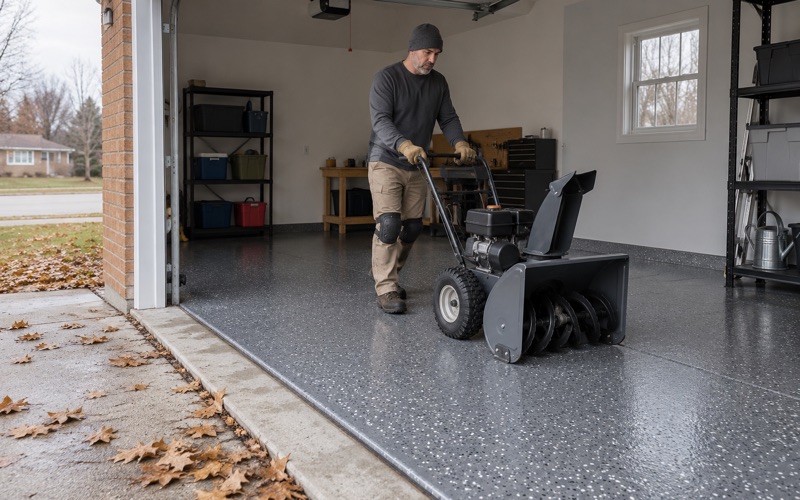
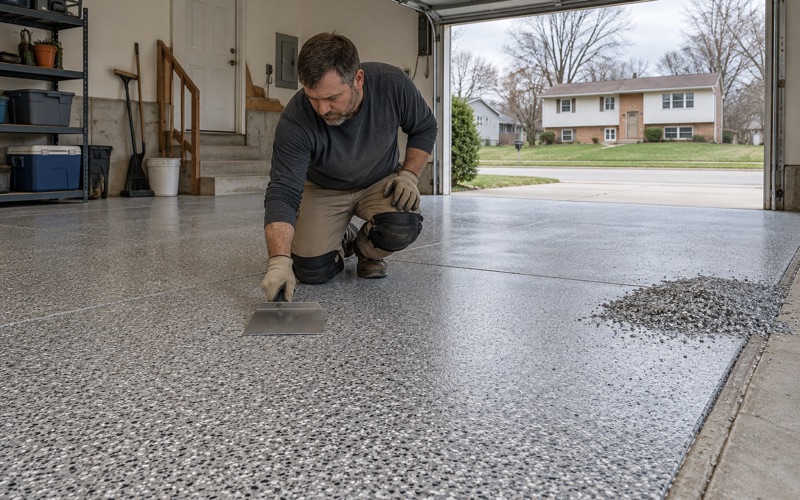
Through a northern Illinois winter, the heaviest cleaning load on a garage floor here is the calcium chloride brine and rock salt that ride in on the tires from Kane County roads. We build garage floors with that brine in mind, but the white crust it leaves when it dries is itself a residue.
Rinse it while it is still wet when you can, push the water out with a squeegee, and give the whole floor a neutral wash on a mild day. Brine that dries and re-wets all winter leaves a cloudy film that is hard to tell from cleaner buildup. The treatment for both is the same rinse.
Attached homes and shared aprons
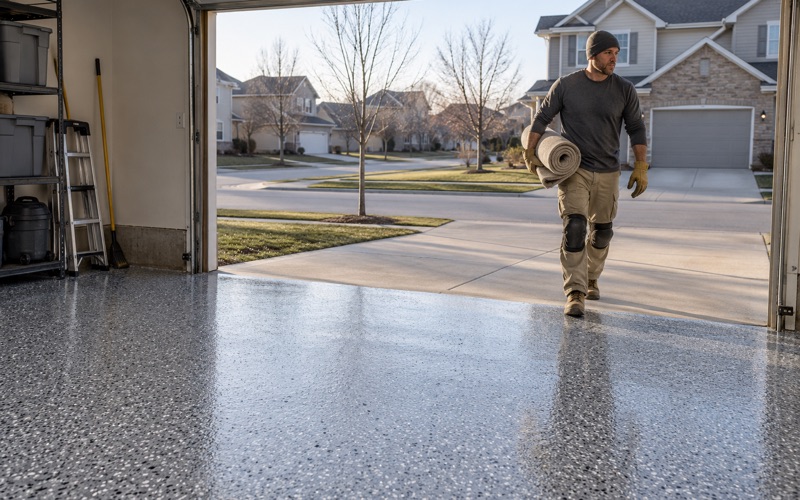
Nearly every home here is owner-occupied, and about four in ten are single-family attached units. In an attached home, rinse water from one garage can run onto a shared apron or driveway, and exterior areas usually fall under an association’s rules.
That is a document to read before the first spring wash-out, not an assumption. A squeegee and a bucket keep most of the water inside the garage, where it can be picked up rather than sent across a neighbor’s concrete.
Basements and utility rooms
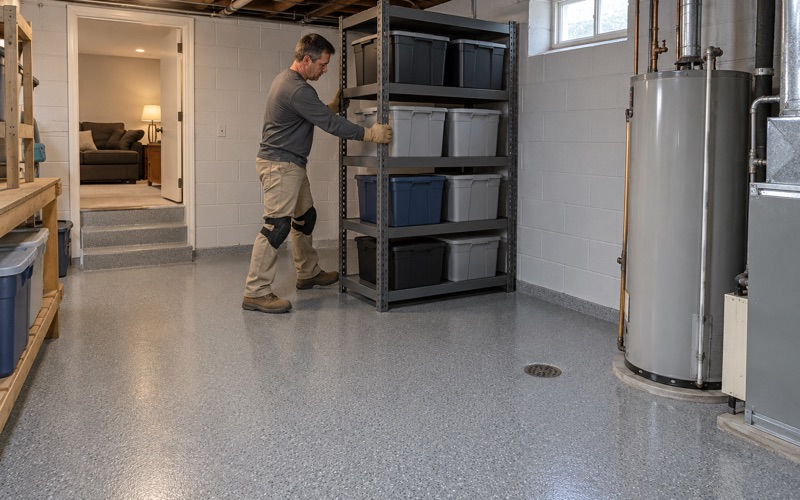
Inside the house, a coated basement or utility room gets the same treatment with far less water, since there is often no floor drain and no reason to flood the slab. A damp mop with neutral cleaner, followed by a damp mop with plain water, is enough for most weeks.
We still start every basement job with a moisture test, because a coating is not waterproofing and a slab that is wet from below will show it no matter how it is cleaned. Once the slab tests dry and the coat is down, the routine is what keeps the finish looking the way it did the day we left.
Before the first wash
A new coating needs its full cure before any cleaner touches it, and we set that schedule by slab temperature and dew point rather than by the calendar. Each owner gets two dates from us: when the floor can take traffic, and when it can take its first wash.
Before a job is scheduled, we confirm the village’s contractor registration requirements, which the village routes through SAFEbuilt for residential work. Every home job also gets a written contract and the state’s Home Repair: Know Your Consumer Rights pamphlet before work starts, as the Illinois Home Repair and Remodeling Act requires.
- 20+ Years of Floor Work
- Moisture Testing in Every Scope
- Written Proposals and Contracts