DeKalb IL Epoxy Flooring has put more than 20 years into epoxy flooring in Oswego and across northern Illinois, and on jobs here the calendar gets one more check than it does on most of our floors. Before we book the coats that carry solvent, we look at the air quality outlook. That habit comes from where this village sits on a federal air map, not from any rule about garage floors.
Nothing about it restricts which coating you can choose. It changes when certain steps happen and which products earn a place on the shortlist, and we put both of those decisions in writing on the proposal. A customer should know the plan for an alert day before the first bucket is opened, not after the crew has already left for the morning.
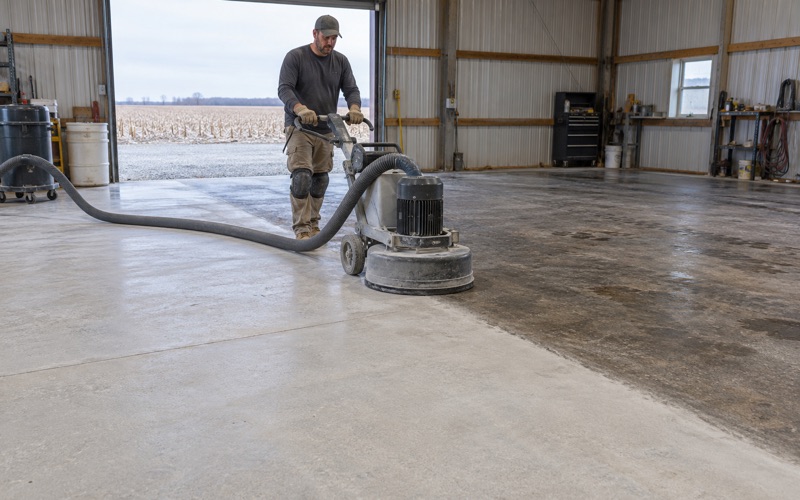
The rest of the job starts the way every floor of ours does. We open the slab with a diamond grinder or shot blaster and never acid etch, read the cracks, joints and old coating before pricing, and name the product, the system build and the finished thickness so the floor that goes down can be checked against the quote.
The one Kendall County township inside the Chicago ozone area
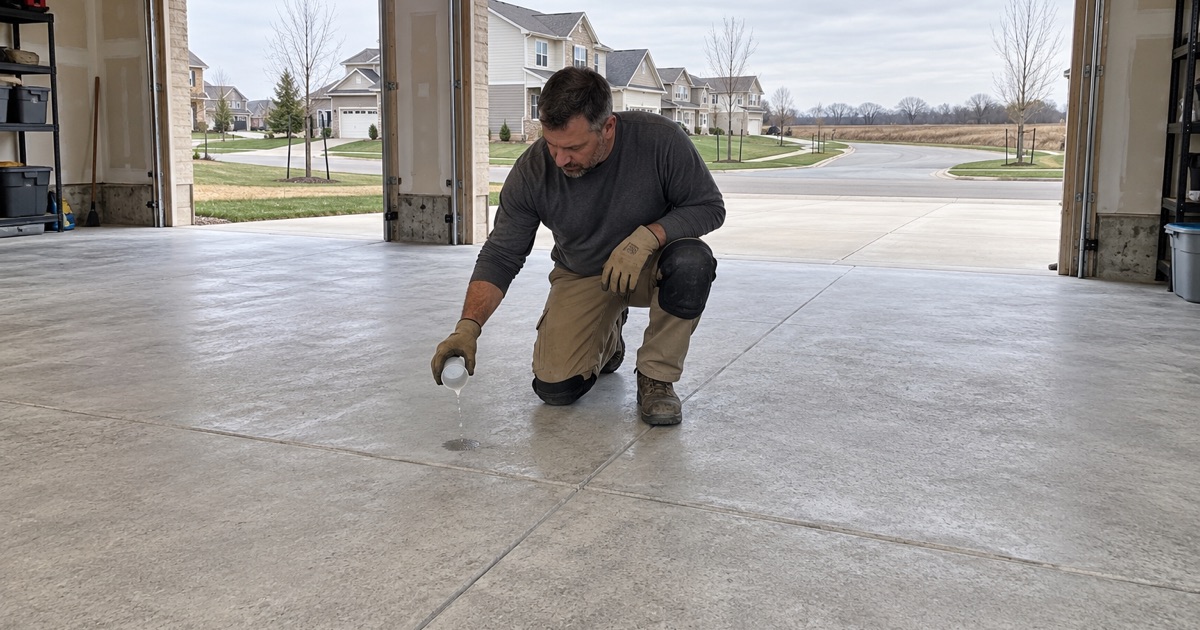
Most of Kendall County sits outside the federal ozone boundary drawn around Chicago. Oswego is the exception, and the reason is a single line on an EPA listing.
Oswego Township and the Green Book listing
The EPA Green Book lists the Chicago, IL-IN-WI area under the 2015 8-hour ozone standard and classifies it as Serious nonattainment. Six Illinois counties are listed whole, while Kendall County appears only as a partial listing that covers Oswego Township and nothing else. That listing was current as of September 30, 2026.
The village spreads across Oswego, Bristol and Wheatland townships, so the line does not wrap neatly around the municipal boundary. The Bristol Township part of the village is outside the area, and the rest of the county’s townships are outside it too. For most homes and shops near the old village center, though, the address falls inside Oswego Township.
What nonattainment means and what it does not
Nonattainment describes the air, not the job. It shapes the regional air plan and the rules written for stationary sources such as plants and large industrial operations. It does not ban a coating, and it does not put an environmental permit on a homeowner’s garage floor.
What it does mean is that summer ozone here counts toward a regional problem the state is still working to fix. Volatile organic compounds that flash off solvent-borne coatings are one of the ingredients ozone forms from. That is why public notices ask for voluntary restraint with paints and solvents on the worst days.
Garages that are now two or three decades old
Oswego is the largest municipality in Kendall County, and its housing is young. Census estimates put 45.1 percent of housing units at 2000 to 2009 and another 25.5 percent at 1990 to 1999, so 70.6 percent of the stock dates from those two decades. About 87.9 percent of homes are owner-occupied, with 71.6 percent detached and 18.4 percent attached single-family.
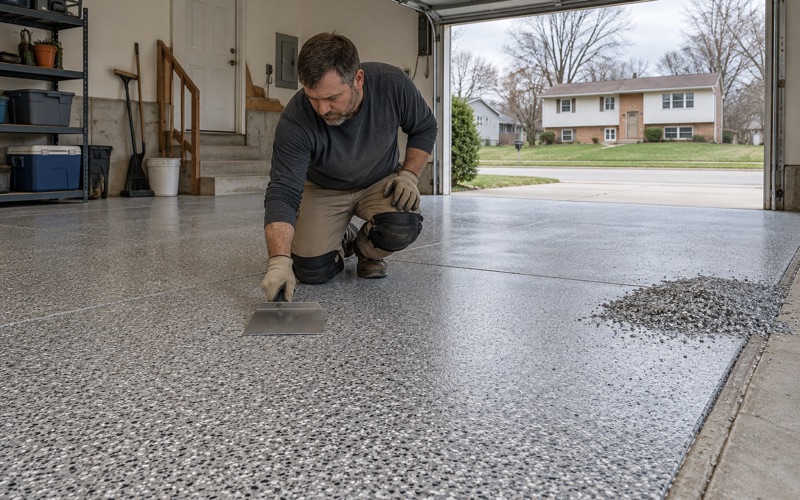
That adds up to a great many attached garages on slabs now twenty to thirty years old, owned by the people who park on them. Those slabs have taken years of salt and tire traffic, and they usually need real grinding and joint work before a coating will bond. They are also the floors where an alert-day scheduling choice actually lands.
Looking for epoxy-flooring closer to Algonquin? See Algonquin Epoxy-Flooring.
What an air-pollution action day asks of a painter
An air-pollution action day is a public notice, not a work stoppage. It asks residents and businesses to cut back on activities that add to ozone while levels are forecast to run high.
The wording on the notices
A Cook County action-day notice asked the public to reduce ozone by avoiding the use of oil base paints and solvents, along with charcoal lighter fluid and excessive home energy use. Participants in the Partners for Clean Air program were asked to start their own planned measures. The request was voluntary, and it named paint and solvent use directly.
These days are not rare events from the past. On May 27, 2026, the Illinois EPA issued an air quality alert covering most of northeastern Illinois, with ozone expected to be the primary pollutant of concern. Residents were urged to reduce pollution and were pointed to the federal AirNow site for current readings.
Why oil-based paints and solvents are singled out
Oil-based paints and solvents release volatile organic compounds as they dry and as tools are cleaned. A solvent-borne primer, a solvent-thinned urethane topcoat and a rag soaked in thinner all fall into that group. On an action day, those are exactly the products the notice is asking people to set aside.
A single garage floor is not a major emission source, and we will not pretend otherwise. But a two-car system can use several gallons of coating, and the notice asks for the kind of voluntary delay a well-built schedule can absorb. If moving a coat one day costs nothing in quality, there is no reason not to move it.
Scheduling solvent-borne coats around alert days
The practical work is sorting each step of the system into two groups. Some steps can run on any day, and a few should wait for a day without an alert.
Which steps carry solvent
Not every step of a floor system is a solvent step. Diamond grinding and shot blasting make dust, which we collect at the machine and never wash toward a floor drain, and a 100% solids epoxy base coat is built without added solvent. Some moisture-mitigation primers, solvent-borne urethanes and cleanup products carry far more.
So the planning happens step by step rather than for the job as a whole. Grinding, crack filling and the base coat can usually proceed whatever the forecast says. Only the coats that carry meaningful solvent need to land on a day when no alert has been posted.
Moving a coat without stretching the job
Shifting a topcoat by a day is usually simple, because the base coat has a recoat window set by the manufacturer. We plan the sequence so a one-day move stays inside that window rather than forcing an extra round of sanding and cleaning. The proposal shows which coats are flexible and which are not.
If an alert is posted midway through a job and the window would close, we tell you plainly and lay out the choice. One option is to wait and re-prepare the surface, which adds labor. The other is to finish with a lower-solvent product that is compatible with the system already on the floor.
Shops and flex space at Kendall Point
Commercial floors change the math. The established industrial park at the US-34 and US-30 intersection includes 195 Kendall Point Drive, a multi-tenant flex building of about 32,130 square feet with 20-foot ceilings and four drive-in doors.
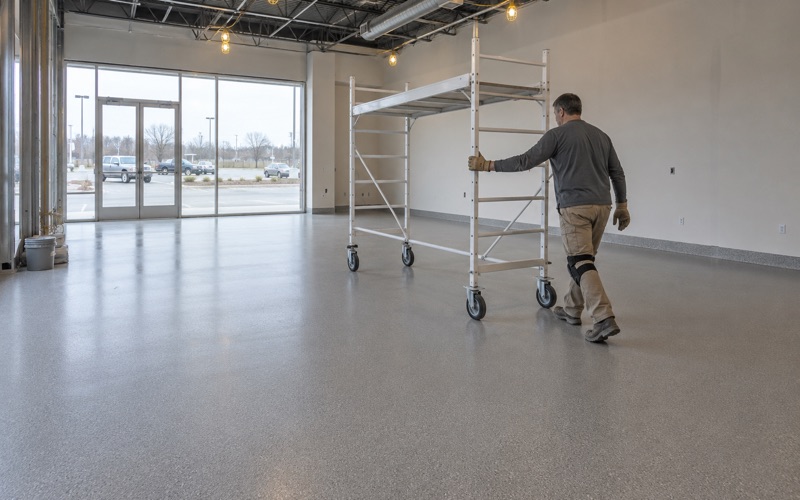
Tenants in a building like that rarely close for a week, so we already schedule shop and warehouse floors around overnight and weekend windows. On an Oswego job we choose the work window and the product together. A low-solvent topcoat can keep an off-hours window open even if an alert is posted for that day.
Water-based, high-solids and the 250 g/L rule
The simplest way to keep an alert day from mattering is to choose products that carry little solvent to begin with. That choice still has to sit inside the state limit, which never changes.
Low-VOC options for Oswego garages
Water-based epoxy primers and sealers, 100% solids epoxy and high-solids polyaspartic topcoats are all used on residential garage floors. Each one trades something, whether that is working time, film build per coat or material cost. We walk through those trade-offs before the proposal is final, not after the first coat is down.
We quote VOC content only from the manufacturer’s product data sheet for the exact product named on the proposal. If a contractor calls a coating harmless to the air without showing that number, ask for the sheet. The figure on it is the one that matters.
The statewide limit stays constant
Illinois sets VOC limits for architectural coatings under Part 223 of the Illinois Administrative Code, and floor coatings are capped at 250 grams per liter. That limit applies statewide and binds the installer as well as the manufacturer. It reads the same on either side of the Oswego Township line.
So the ozone listing does not make any product legal or illegal here. It makes timing and product choice worth a short extra conversation, and that is all. Everything we apply already sits within the Illinois limit whether or not an alert is in effect.
Moisture, salt and the warranty come first
A low-VOC product still fails on a wet slab. Moisture testing, whether an ASTM F1869 calcium chloride test or ASTM F2170 in-situ probes, is a listed line item in our scope, and warranty exclusions are read out before the job is sold, with moisture named first.
Oswego garages also take calcium chloride brine and rock salt every winter. A topcoat chosen for its low solvent content still has to stand up to that brine, so we will not pick a product that is easier on the air if it cannot hold up through a northern Illinois winter.
Permits, contracts and paperwork
Beginning October 1, 2024, the Village of Oswego adopted the 2021 International Residential Code, along with the 2021 IBC and IFC and local amendments, through its Building & Permits Department. A new garage needs an application, a plat of survey and sealed plans, while coating an existing slab is a different scope. Illinois licenses no flooring or coatings contractor, so we confirm the village’s own registration, bond and insurance rules before a job is scheduled.
Every home job gets a written contract and the Home Repair: Know Your Consumer Rights pamphlet before work starts, as the Illinois Home Repair and Remodeling Act requires. Pricing is per square foot for the system actually proposed. The schedule, including any day held back for an alert, is part of that written agreement.
- 20+ Years of Floor Work
- Moisture Testing in Every Scope
- Written Proposals and Contracts