DeKalb IL Epoxy Flooring has been putting down epoxy flooring in North Aurora and the surrounding Fox Valley for more than 20 years, and most of what we coat here is the home garage. A good garage floor depends on two things: the slab work under the coating, and what happens on the other side of the garage door while the coating cures.
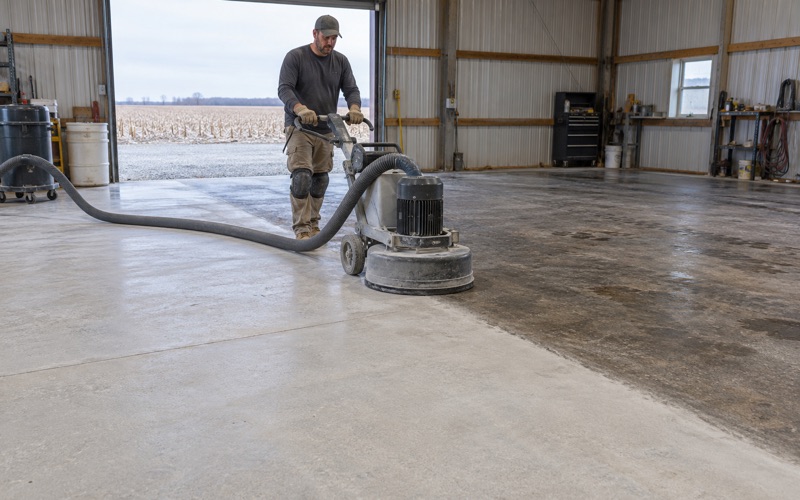
The slab work is where we start. Every floor is opened with a diamond grinder or a shot blaster, never acid, and moisture testing is written into the scope as its own line item. The proposal names the product, the system build and the finished thickness, so the floor that goes down can be checked against the floor that was quoted.
The other side of the door is the driveway. When a fresh driveway sealcoat and a fresh floor coating are booked without anyone comparing dates, black sealer tends to end up on the new floor. This page explains how we put the two jobs in order so that does not happen.
An Asphalt Plant on Butterfield Road and a Shared Season
Paving is a local trade here
North Aurora has its own asphalt plant. Geneva Construction, listed in the village’s business registration as Superior Asphalt Materials, gives its address as 214 Butterfield Road, and the EPA’s facility database lists the asphalt plant next door at 216 Butterfield. The address sits inside the village limits, in the Aurora Township part of town.
We have no business relationship with that company, and we do not pave or seal driveways. The plant matters to a floor job for a simpler reason. Paving and sealing are an everyday local trade, and a driveway crew may well be working outside the same month we are working inside the garage.
Driveway season and floor season overlap
Driveway sealcoat goes down in warm, dry months, and that is also when most garage floors get coated. Homeowners tend to look at both after a winter of salt and slush, and plenty of them book both for the same stretch of summer.
That overlap is where the trouble starts. Two contractors who never speak to each other each hand the homeowner a date. Nobody asks which fresh surface the car will have to cross first.
Why so many North Aurora garages face both jobs
Half of the homes in North Aurora were built in 2000 or later, including 2,642 built between 2000 and 2009. Those garage slabs are roughly 15 to 25 years old, which is about when an owner starts thinking about a coating.
The driveways poured with those houses are the same age. A house that needs a floor coating often needs its driveway resealed in the same year. The village also has more than a thousand attached single-family homes, and a townhome garage faces the same scheduling question as a detached one.
Looking for epoxy-flooring closer to St. Charles? See Epoxy-Flooring Services in St. Charles.
What 24 Hours Before Tires Means at the Garage Door
What one sealer maker actually says
Most residential driveway sealers are asphalt emulsions. The technical sheet for one common product, SealMaster MasterSeal Ultra, says to allow the final coat to dry for 24 hours before opening the pavement to vehicle traffic. The same sheet says the sealer is not to be applied when the temperature is expected to drop below 50 degrees during application or for at least 24 hours afterward.
Those are one manufacturer’s figures, not a universal rule, and the driveway contractor’s own product sheet governs their job. We treat them as the minimum we plan around. A sealcoat that has not had its full 24 hours is not ready for a car, however dry the surface looks.
How black sealer gets inside
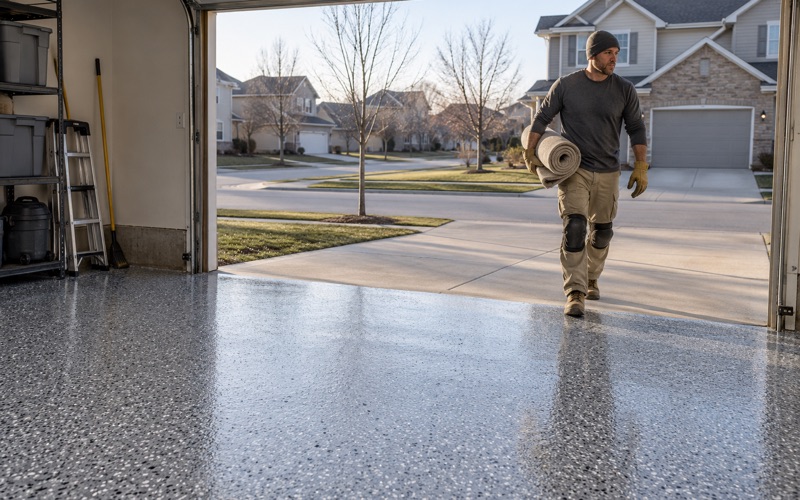
The garage door threshold is the spot where the two jobs meet. A tire that rolls across a sealcoat too early picks up black sealer and carries it straight through the open door. The first thing it touches inside is the new floor.
On a light gray finish or a vinyl flake broadcast, a black tire track shows about as clearly as any mark can. Shoes, a lawn mower and a child’s bike carry it in the same way. This is a stain tracked in from the driveway, not a failure of the coating, and it is avoidable with a calendar.
Why a cool spell moves the date
The 50-degree limit is a scheduling fact, not a forecast. If the driveway crew loses several days to a cool spell, their job slides later on the calendar.
A floor that was booked to follow the driveway with room to spare can suddenly land right on top of it. That is why we ask for the actual finish date of the driveway, not the planned one, before we lock in our start. When the driveway date moves, we move with it.
Which Job Goes First, and How We Protect the Threshold
Seal the driveway first, then coat the floor
Our preferred order is driveway first. The sealer goes down, the car stays off it for its full cure time, and only after that do we begin grinding the garage slab.
By the time the car comes back across the driveway after the floor has cured, there is nothing soft left out there to carry. We ask which sealer was used and on what day the last coat went down. Our start date is set after that maker’s traffic window has passed.
Coat the floor first, then keep the car out
The other order works too, with some discipline. We coat the garage first and let it cure, and the car stays out of the garage until the driveway has been sealed and has had its full time before tires.
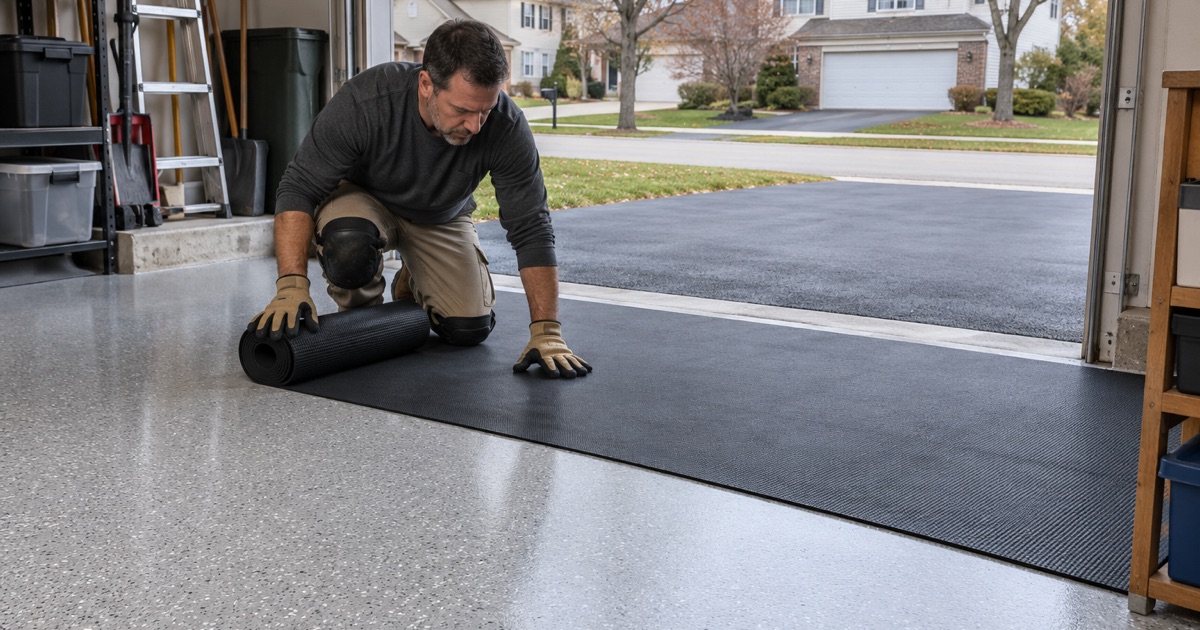
During that stretch the threshold stays covered with a clean runner, and a mat at the door catches shoes. We tell you how long the system we proposed needs before tires, since that depends on whether the build is a 100% solids epoxy base or a faster polyaspartic topcoat. The car can park on the street for a day or two; a stained floor stays stained.
Never on the same weekend
What we will not do is book the floor and the driveway for the same weekend. Two fresh surfaces side by side leave the car nowhere to go, and one impatient trip from the street into the garage spoils both.
If you already have a driveway date when we come out for the estimate, tell us. If you do not, we will suggest which order fits your summer and leave a clear gap between the two jobs.
What we check before the date is set
The estimate visit is also when we read the slab itself. We look at cracks, control joints and any old coating, and we say plainly when a slab needs repair or replacement before it can be coated.
Warranty exclusions are read out before the job is sold, with moisture named first. Tracked driveway sealer is one more exclusion we explain at that point. The price is quoted per square foot for the system we are proposing, not a national figure for an average garage.
Coal Tar, Asphalt Emulsion and What Illinois Is Weighing
Two families of driveway sealer
Driveway sealers fall into two broad families: asphalt emulsions like the product named above, and coal tar sealants. Either one, tracked across a threshold before it has cured, leaves a dark mark on a new coating.
Which sealer goes on the driveway is a decision for the homeowner and the driveway contractor. Our part is to ask what was used and when. The answer shapes our schedule, nothing more.
The coal tar bill in Springfield
Illinois has looked at coal tar sealants several times. House Bill 2487, introduced in the 104th General Assembly, would bar the sale of coal tar sealants for driveways and parking areas from October 1, 2026 and their application from October 1, 2027, and would let local governments adopt the rule by reference.
Earlier bills on the same subject did not pass. We have not confirmed whether this one has advanced, so we treat it as a proposal rather than a rule. We also found no North Aurora ordinance on driveway sealants.
What the floor coating does and does not do
A garage floor coating protects the concrete under it, not the driveway outside, and it is no substitute for a driveway sealer. It does nothing for the asphalt, and the driveway still needs its own care.
What the coating does do is give the garage a surface built for the calcium chloride brine and rock salt that come in on tires every winter. Most of that protection comes from the grinding and the system build. A clean, untracked start matters too.
Permits and paperwork in the village
The Village of North Aurora’s Building and Zoning Division, at Village Hall on 25 East State Street, lists flooring among the projects that do not need a permit. It also states that contractor registration is not required, while driveways appear on its list of projects that do need one.
We confirm those village rules again before a job is scheduled, since they can change. Every home job still gets a written contract and the Home Repair: Know Your Consumer Rights pamphlet before work starts, as the Illinois Home Repair and Remodeling Act requires. Grinding dust is collected at the grinder, so the driveway outside stays as clean as the floor inside.
- 20+ Years of Floor Work
- Moisture Testing in Every Scope
- Written Proposals and Contracts