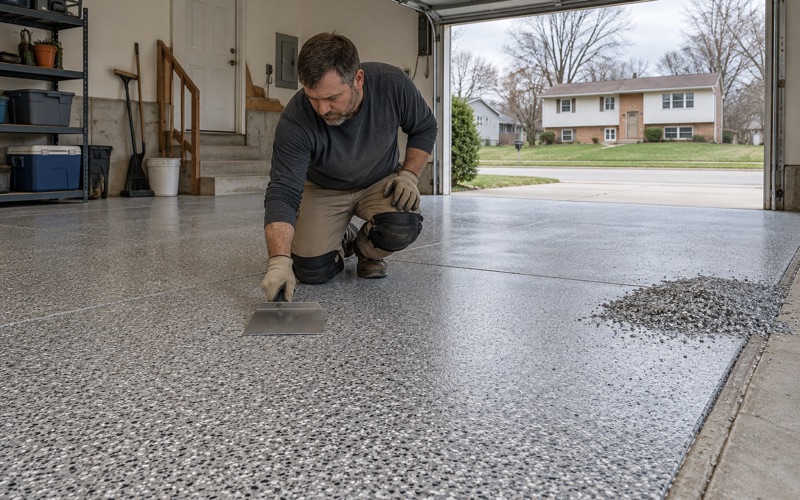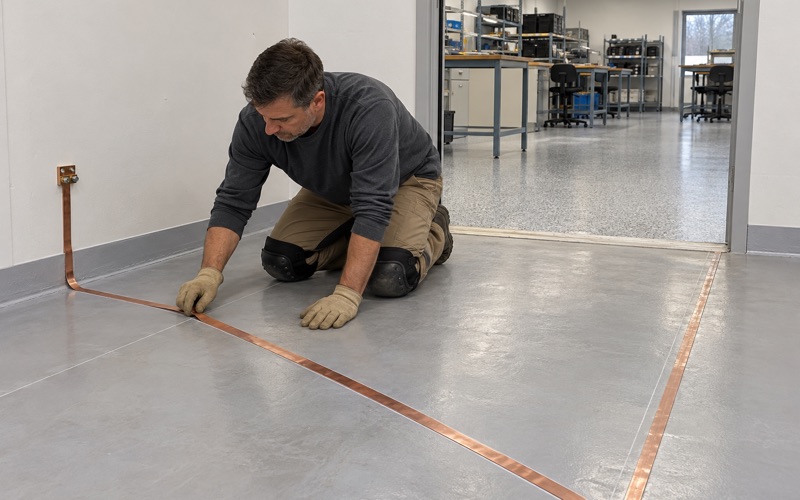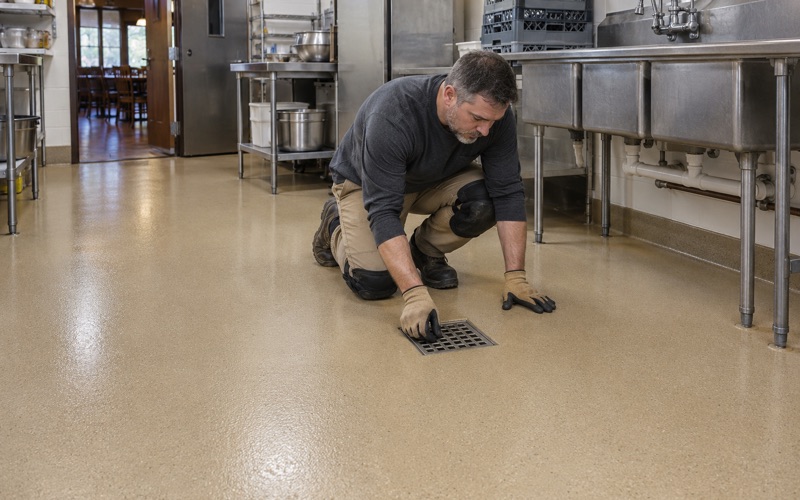
DeKalb IL Epoxy Flooring brings more than 20 years of work to epoxy flooring in Montgomery garages, and on a newer slab the first thing we want to know is what was mixed into the concrete. Some garage floors carry a flat steel grid near their middle, while others carry countless short synthetic fibers spread through the whole pour. Those fibers sit quietly in bare concrete and only cause trouble once the surface is opened for a coating.
That narrow problem is what this page covers. A fiber-reinforced slab that has been ground grows a fuzz of raised strands, and a primer rolled over them locks every one in place, where a thin coat lets them print through as a rough, hairy texture. Clearing them is a separate step that needs its own time on the schedule.
So we price it openly. We grind a small test area before the quote is final, look at what the grinder exposed, and write a fiber-removal step into the scope when the slab calls for it. A slab that turns out to hold wire fabric simply skips that line.
Montgomery’s Garage-Slab Rule: Wire Fabric or Fiber Mesh
What Ordinance 2038 changed
On September 25, 2023, the Village of Montgomery passed Ordinance 2038, which repealed and replaced Chapter 6 of its code and moved the village from the 2015 model codes to the 2021 editions of the IBC, IRC, IPMC and IEBC, with local amendments. The village describes the updates as effective at the start of 2024.
One of those amendments rewrites the general slab section of the residential code, R506.1. It raises the minimum slab thickness from 3.5 inches to 4 inches and adds a sentence aimed squarely at garages.
Two ways to reinforce the same four inches
The added sentence says that concrete slab on-ground floors for garage floors shall include a minimum of 6x6-10x10 welded wire fabric embedded in the mid cross section of the slab or fiber mesh reinforcing. That small word, or, matters to anyone who coats the floor later. Welded wire fabric is a flat grid of steel set at the middle of the pour, while fiber mesh is a dose of short synthetic fibers blended into the concrete before it is placed.
Both satisfy the village rule, and the code does not favor one over the other. A builder chooses, and nothing on a finished, broom-swept garage floor announces which choice was made.
Why so many local garages are worth checking
The housing stock here is young. Census figures count 3,978 of Montgomery’s 7,507 housing units as built from 2000 through 2009, and 70.5 percent of all units date from 2000 or later, so a large share of the garage floors we see are newer slabs.
How those slabs were reinforced is not on record anywhere we can read, and the 2023 wording is today’s rule rather than a description of what was poured two decades ago. We do not assume every garage here holds fiber, and we do not assume none do. We expect to meet both kinds and check each floor on its own.
Looking for epoxy-flooring closer to Yorkville? See Epoxy-Flooring in Yorkville.
What Grinding Does to a Fiber-Reinforced Garage Floor
The fibers stand up
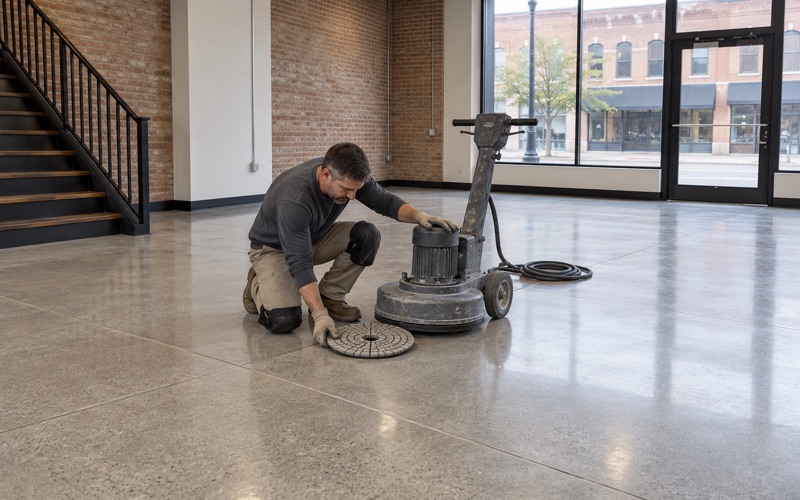
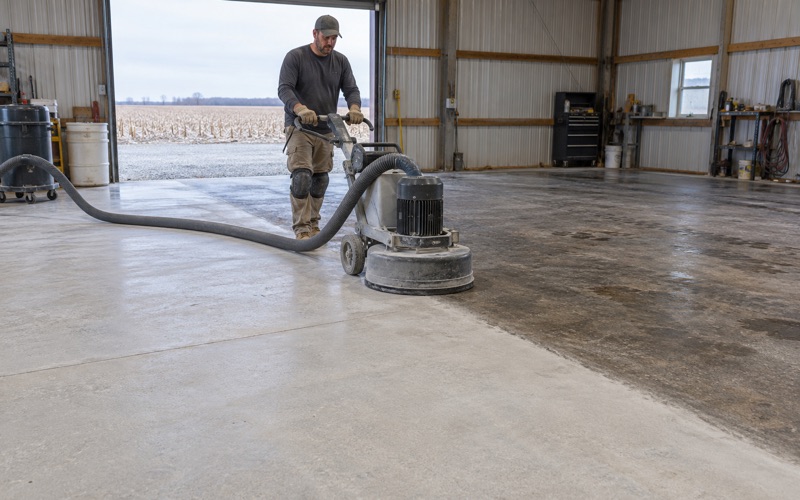
Diamond grinding and shot blasting work by removing the weak top skin of the concrete and exposing sound material underneath. On a fiber-reinforced slab, that same cut slices through the fibers lying near the surface and leaves their ends loose. CoatingsPro reported in December 2022 that synthetic fibers are not fully removed from the surface by shot blasting.
What is left looks like a light fuzz across the floor. It is easy to miss under overhead lights and obvious once a flashlight beam skims the surface at a low angle.
Why they print through a thin coat
A primer or first coat of epoxy wets each standing fiber and stiffens it where it stands. In a thin system the coat is not deep enough to bury the strands, so they show at the surface as raised hairs that catch dirt and break up the gloss.
Sanding the cured coat afterward is a poor fix, because each fiber is now glued to the slab below it. The time to deal with them is before anything wet touches the floor.
Wire fabric behaves differently
Welded wire fabric placed at the mid cross section of a 4-inch slab sits about 2 inches down, well below the thin layer a grinder takes off. A slab built that way grinds like plain concrete, provided the steel stayed where it was set when the concrete was poured.
That is why the reinforcement choice matters to a coating crew and almost never to the homeowner. Both types do their structural job, but only one adds a step to our prep.
Scrape, Cut or Flame: Clearing Fibers Before the Primer
The sequence the trade uses
NTMA Technical Bulletin G-2, Preparation for Fiber Concrete, names exposed glass or plastic fibers as the main concern on these floors. Its sequence is to shot blast the slab, then scrape, cut or burn off the exposed fibers with a flame gun, broom and vacuum, and only then prime and install the epoxy system.
We follow that order. Scraping and cutting suit a light scatter of strands, and a careful pass with a burner handles a dense field of them the way CoatingsPro described, by melting off the exposed fiber before any epoxy goes down.
Dust and the final vacuum pass
Every pass makes debris, and we handle it the way we handle grinding dust. It is collected at the machine and vacuumed from the slab, and none of it is washed toward a floor drain or out the garage door to a storm inlet.
The last vacuum pass is the one that counts. Loose fiber ends left lying on the floor become part of the primer coat just as surely as standing ones, so we check the surface again in raking light before the first can is opened.
Testing and building the system
Fiber removal is one line in the scope, not the whole of it. Moisture testing is its own item, with an in-situ relative humidity probe under ASTM F2170 or a calcium chloride test under ASTM F1869 depending on the slab, and a moisture-mitigation primer is added when the readings ask for one.
A typical garage system we quote is a 100% solids epoxy base, a vinyl flake broadcast and a polyaspartic topcoat that resists hot tire pickup and the calcium chloride brine winter tires carry inside. Products are chosen within the VOC limits of Illinois Administrative Code Part 223, and the proposal names the product, the system build and the finished thickness.
Curing is scheduled by slab temperature and dew point rather than the calendar. The nearest long-term weather record, the Aurora station inside Aurora, averages 134.1 days a year at or below 32 degrees, so an unheated garage may have to wait for spring.
A Test Patch, the 2021 Codes and Who Signs Off in Montgomery
What the test patch tells us
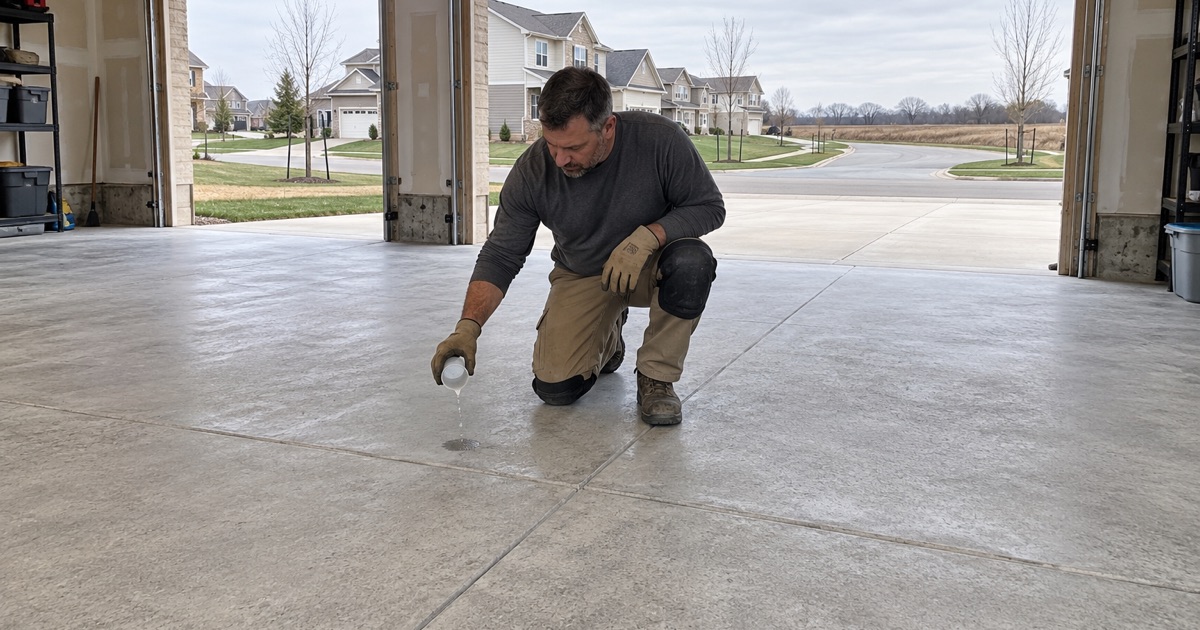
Since nothing on record says which reinforcement a given garage carries, we find out at the slab. We grind a small patch, usually somewhere out of sight, and look closely at what the cut exposed.
Raised strands mean a fiber-removal step goes into the price, and a clean patch means it does not. While we are there we read the cracks, joints and any old coating, and we say plainly when a slab needs repair or replacement before it can be coated.
Kane, Kendall and both banks of the Fox River
Montgomery, IL is a village of 20,262 people as of the 2020 census, roughly 45 miles southwest of Chicago, and it straddles the Fox River. Census Reporter places 52.6 percent of it in Kane County and 47.4 percent in Kendall County, and village forms are notarized for both counties.
The township changes across that line as well. Village Hall geocodes to Aurora Township, while The Grid at Route 31, the former Caterpillar plant now leased to several industrial tenants, sits in Oswego Township on the Kendall side, yet the village’s own Building Division handles permits on both sides.
Permits, basement finishing and contractor rules
Ordinance 2038 deletes several model-code exemptions from permits, and the village permits page lists basement finishing among projects that need a permit before work begins, with rough framing, insulation and final inspections. Whether a garage floor coating alone needs one is not stated, so we ask the Building Division at 331-212-9023 before we schedule.
The same page says all construction must be done by a contractor licensed to do work in the Village of Montgomery. Illinois issues no state license for flooring or coatings work, so we confirm the village’s license, bond and insurance terms before a date is set.
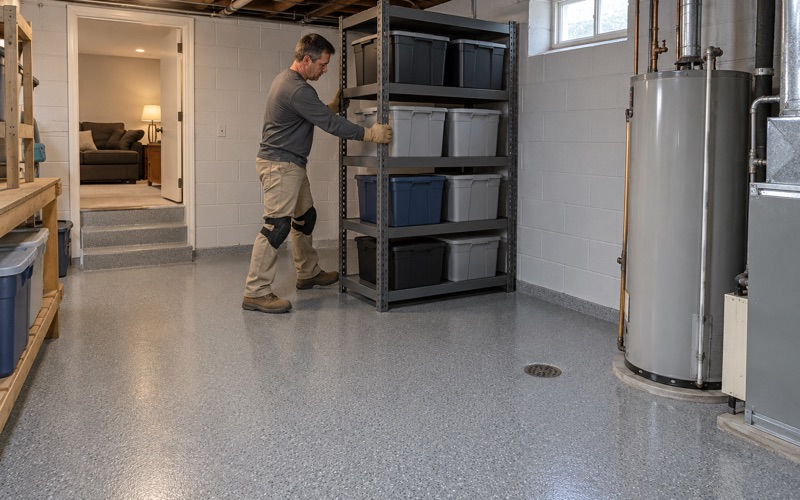
Basement floors start with where any water is coming from, because a coating does not stop water moving through a slab. On every home job you receive a written contract and the Home Repair: Know Your Consumer Rights pamphlet before work starts, as the Illinois Home Repair and Remodeling Act requires, and warranty exclusions are read out before you sign, moisture first. Prices are per square foot for the exact system on the proposal.
- 20+ Years of Floor Work
- Moisture Testing in Every Scope
- Written Proposals and Contracts