DeKalb IL Epoxy Flooring has spent more than 20 years on epoxy flooring in Marengo and across northern Illinois, and much of that work starts on a slab someone else poured for a different job. We open every floor with a diamond grinder or shot blaster, test it for moisture as part of the quoted scope, and write down the product, the system build and the finished thickness so the result can be checked against the proposal. Acid etching is not part of how we prepare concrete.
The questions we ask on a Marengo walkthrough are about the duty ahead of the floor rather than the one behind it. What will roll across it, what will be spilled on it, and how will the crew clean it at the end of a shift? Those answers choose the coating, and the slab assessment decides whether it can be coated at all.
That applies to a large plant changing owners and to a two-car garage alike. The sections below cover how a reused building gets assessed, how a system is matched to its new work, and what changes for homeowners and small shops inside the city.
Forklift Builders and a Label Plant That Changed Hands
A City That Lists a Forklift Maker
Marengo is a McHenry County city of 7,568 people at the 2020 census, set on the Kishwaukee River roughly 30 miles east of Rockford. Its own economic development page names Mitsubishi Logisnext Americas as a forklift manufacturer among local employers, alongside Thomson Linear and Engineered Polymer Solutions. The city describes itself as an ideal location for transportation, warehouse and logistics operations.
None of those companies is a customer of ours, and we have no relationship with any of them. We mention them because they describe the kind of town Marengo is. Industrial buildings here are bought, emptied and fitted out for new purposes, and the floor inside each one has to be reconsidered every time that happens.
201 North Prospect Street
In April 2017, the property at 201 North Prospect Street sold to UniCarriers Americas Corp., according to a commercial real estate report published that month. The building covers 121,153 square feet on 18 acres, with six exterior docks and two drive-in doors, and it had formerly been a bag-making and label-printing facility.
The sale report does not say what the buyer planned to do with the building, and we have not read what it is used for today. What the record does show is a familiar pattern: a plant built around one process passing to an owner in a different line of work.
Why a Floor Is Not Inherited
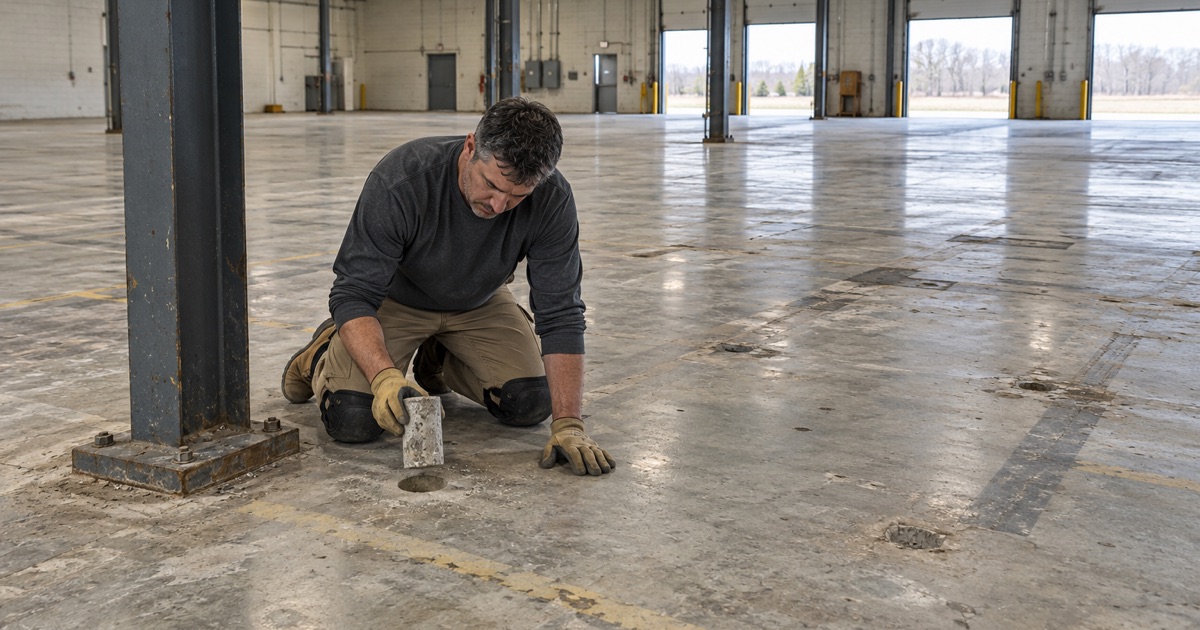
A floor that served bag-making and label-printing was chosen, maintained and worn for that business. Whatever coating or sealer the last owner left, and whatever the slab absorbed underneath it, reflects years of a different duty.
When a building changes owners and purpose, we treat the floor as something to assess fresh rather than carry over. The next owner’s traffic, chemicals and cleaning routine become the specification, and the old surface is only a starting condition.
Looking for epoxy-flooring closer to Belvidere? See Epoxy-Flooring in Belvidere.
Assessing a Slab That Served Another Business
Opening the Surface Mechanically
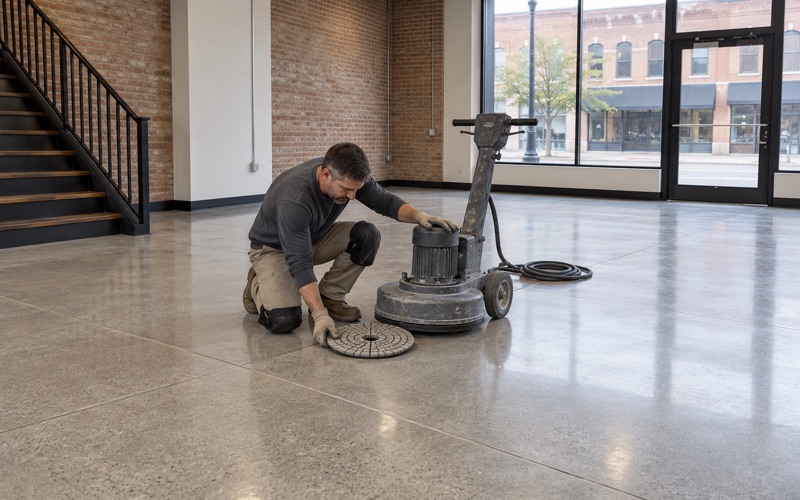
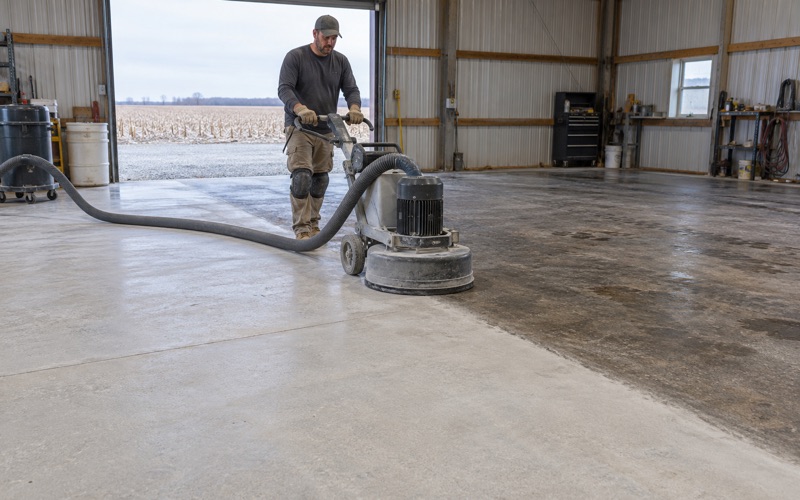
Every assessment ends in surface preparation, and ours is always mechanical. A diamond grinder or shot blaster removes old coatings, sealers and contamination and opens the concrete to the ICRI concrete surface profile the new system calls for. We never acid etch, because acid cannot strip an old film and leaves no measurable profile.
Grinding dust is captured at the grinder by a vacuum system rather than swept or hosed toward a floor drain. On an industrial site with paved yards and storm inlets outside the doors, that also keeps the dust out of the stormwater.
Moisture Is Measured Before Anything Is Chosen
Moisture testing is a line item in our scope on every slab, from a warehouse bay to a home garage. We use ASTM F2170 in-situ relative humidity probes and ASTM F1869 calcium chloride vapor emission tests, with a quick ASTM D4263 plastic sheet test where a first read is useful.
An older industrial slab may have been poured without an under-slab vapor retarder meeting ASTM E1745, and nothing applied on top can change that. When readings run high, a moisture-mitigation primer goes into the proposal before the topcoat does. Warranty exclusions are read aloud before the job is sold, with moisture named first.
Cracks, Joints and the Repair Conversation
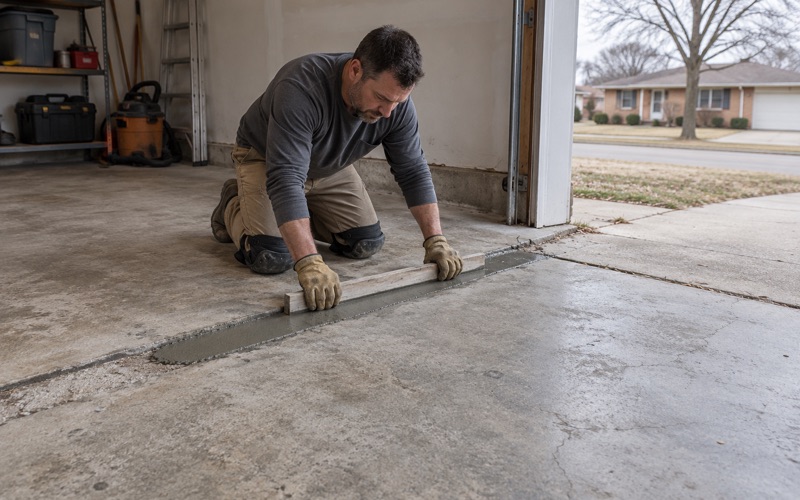
We walk the cracks, saw-cut joints and patched areas before quoting, and we read the old coating for where it has lifted and why. Moving cracks and joints get a semi-rigid polyurea joint filler matched to how that slab behaves.
Some slabs are not ready to coat. When sections are heaving, spalling or broken through, we say plainly that repair or replacement comes first, because a new system over a failing slab only fails at a later date.
Choosing the Floor for the New Duty, Not the Old One
Starting From Traffic, Spills and Cleaning
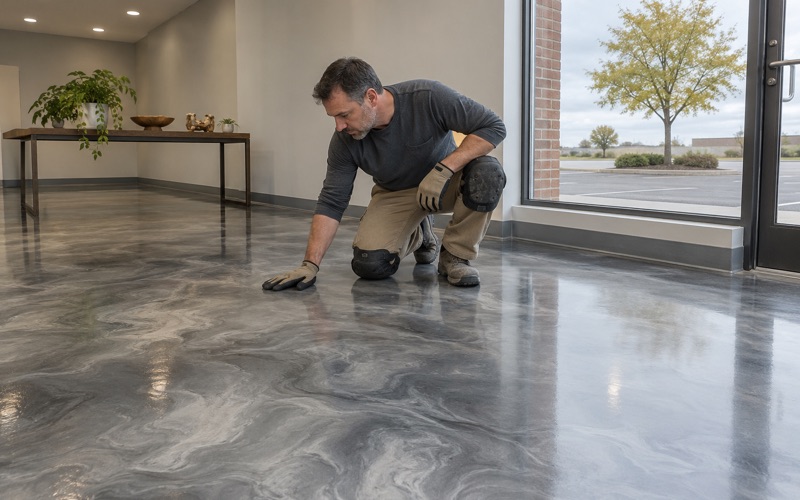
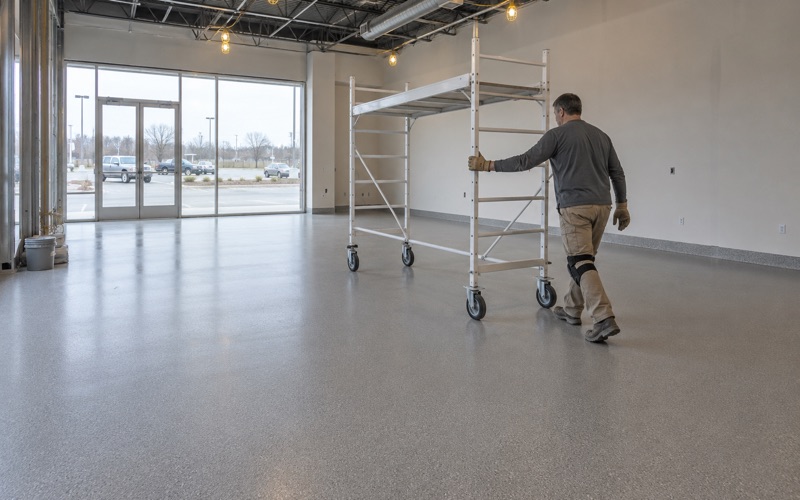
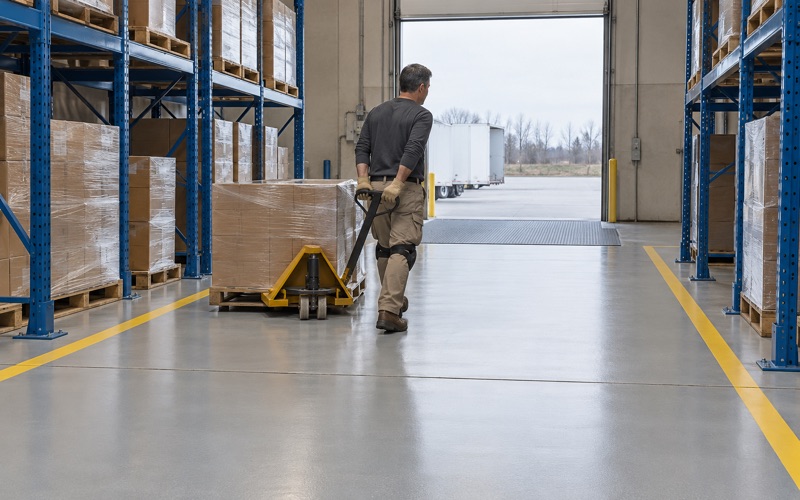
A system is chosen by asking what the floor will do next. Heavy rolling traffic and abrasion point toward a thick 100% solids epoxy build, often with a quartz aggregate broadcast for texture and wear. Hot washdowns and thermal shock lean toward urethane cement, and an area that has to return to service quickly may suit a polyaspartic or polyurea topcoat.
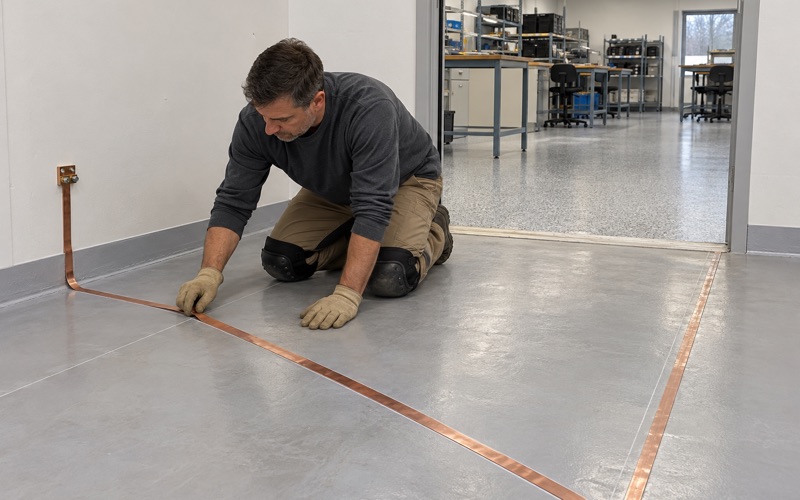
Electronics and controls work can call for static-dissipative or ESD flooring held within a stated resistance range. Cleaning matters as much as traffic, because a floor scrubbed by a ride-on machine every night needs a different texture than one swept once a week.
A Proposal You Can Check
Every proposal we write names the product, the system build layer by layer, and the finished thickness. Prices are quoted per square foot for that exact system rather than lifted from a national average.
That paperwork lets a facility manager or a new owner’s engineer compare what was quoted against what was installed. It also makes any change of plan visible, because a substitution has to be written down.
Coatings Within the Illinois VOC Limit
All of McHenry County sits inside the Chicago ozone nonattainment area under the 2015 standard. Illinois rules in Title 35 of the Illinois Administrative Code, Part 223 Subpart C, cap floor coatings at 250 grams per liter of VOC and industrial maintenance coatings at 340 grams per liter. Those limits bind whoever applies the product, so we choose systems that meet them rather than leaving compliance to the label.
Scheduling Around a Running Building
A plant or warehouse rarely shuts down for a floor. We phase the work bay by bay and use overnight and weekend windows so the parts of the building that have to keep running can keep running.
Curing is planned around slab temperature and the dew point spread at the surface, not a date on the calendar. That matters most near overhead doors, where cold air reaches the floor every time a door opens.
Smaller Reuses: Shops, Garages and Storefronts in Marengo
Garages Under the 2021 Codes
The Marengo Building Department works from the 2021 International Residential Code and the 2021 International Building Code, with local amendments in Chapter 150 of the city code. A garage is filed on an accessory structure permit, and the fee schedule lists $175 for a garage without electric service and $225 with it.
Project questions go to the Building Department at 815-568-7112, extension 211. Illinois issues no license for flooring or coating contractors, and the city’s application list shows no contractor registration form, so we confirm current registration, bond and insurance rules with the city before a job is scheduled.
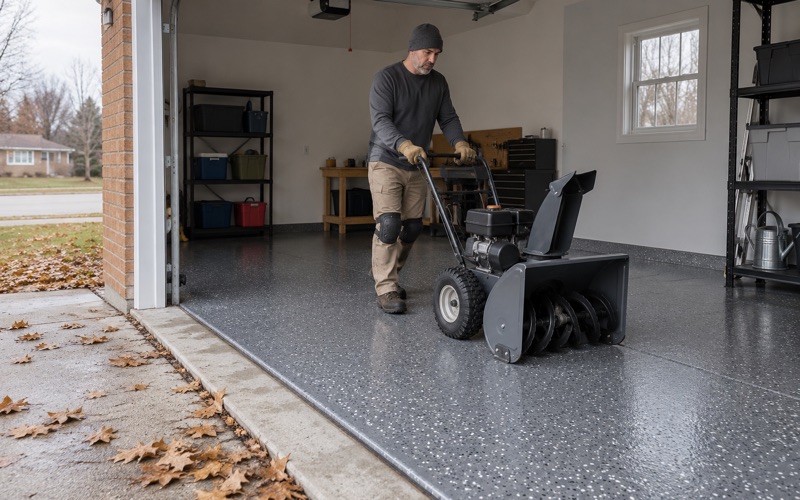
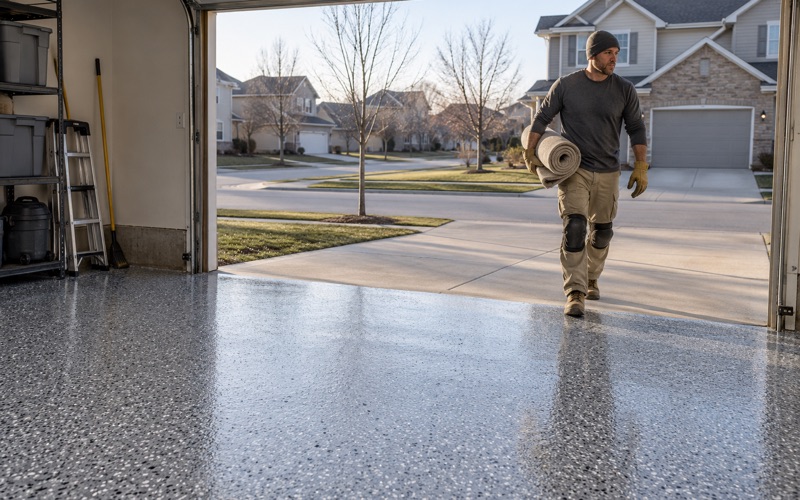
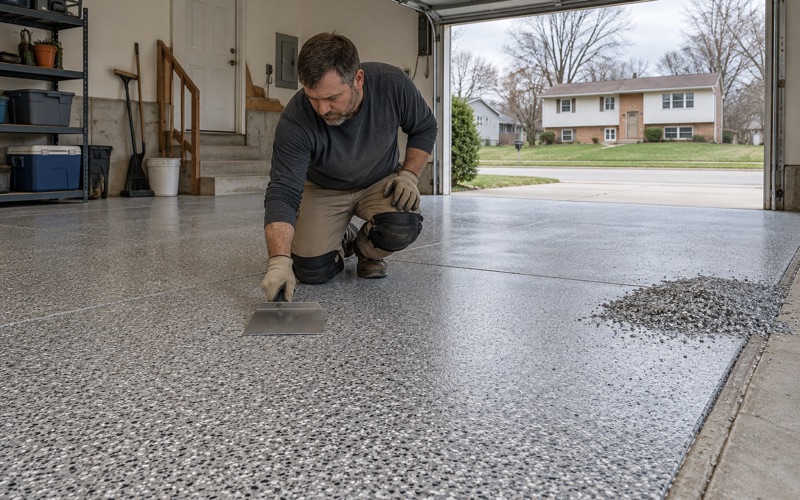
Garage floors in Marengo take calcium chloride brine and rock salt every winter, carried in on tires and left to sit in puddles. We build garage systems for that exposure, typically a 100% solids epoxy base with a vinyl flake broadcast and a polyaspartic topcoat that stands up to deicer staining.
Older Houses and Rented Homes
About 21.6 percent of Marengo’s housing units were built in 1939 or earlier, and 36.9 percent of occupied homes are rented. Older basements and garages often show patched slabs, old paint and no vapor retarder underneath, so the moisture test carries real weight.
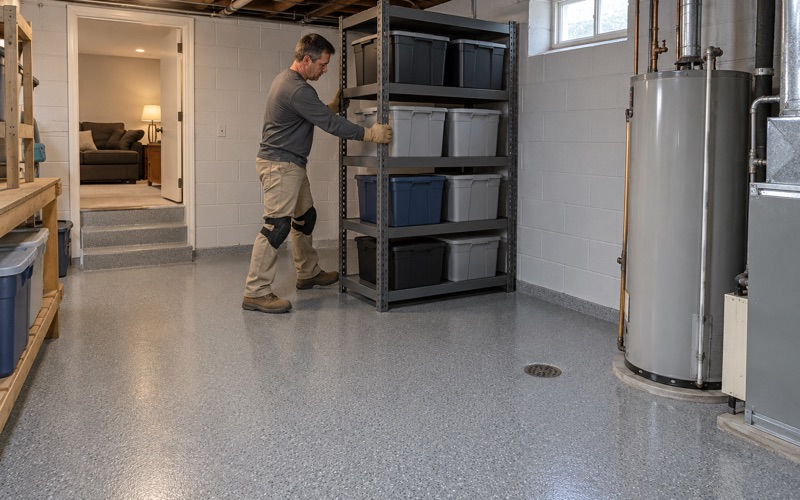
Every home job gets a written contract and the state’s Home Repair: Know Your Consumer Rights pamphlet before work starts, as the Illinois Home Repair and Remodeling Act requires. In a basement we start with where the water comes from and say plainly that a coating is not waterproofing. We also never sell a floor coating as radon reduction, since that work takes a state radon mitigation license.
Storefronts and Food Businesses
A storefront moving from retail to a cafe or a small food business is a change of duty just like a plant sale, on a smaller scale. Food plan review for a business inside the city appears to fall to the McHenry County Department of Health, since our research turned up no city program.
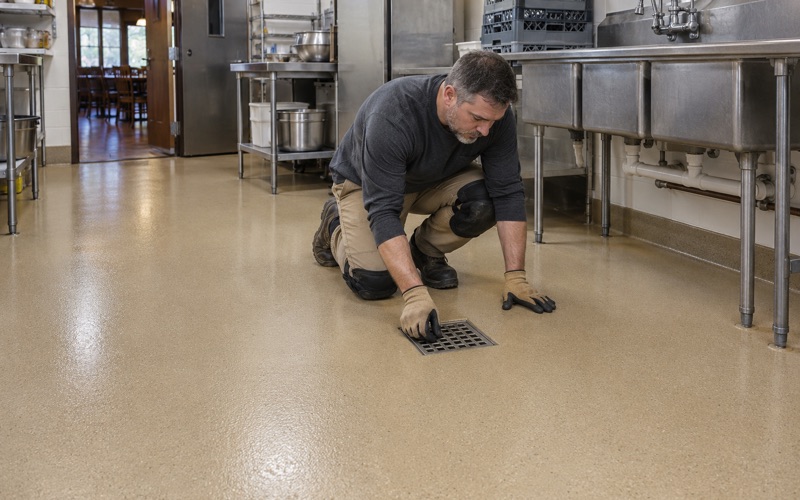
We specify kitchen and prep floors for that review before the permit is issued, including coved floor-to-wall junctures of the kind FDA Food Code 6-201.13 describes. Confirming the county’s current floor requirements is part of our scope rather than something left to the owner.
Cold Slabs and Patient Curing
We could not find a climate normals station for the city itself, so the nearest records bracket it. DeKalb averages 140.6 nights a year at or below 32 degrees, and Elgin averages 139.2.
An unheated garage or machine shed in Marengo may have to wait for spring before a coating can cure properly. When the slab is too cold or too close to the dew point, we say so and schedule the job for when the concrete is ready.
- 20+ Years of Floor Work
- Moisture Testing in Every Scope
- Written Proposals and Contracts