DeKalb IL Epoxy Flooring has spent more than 20 years putting epoxy flooring in Hampshire garages, basements and shops, and every one of those jobs starts with the same question: how much moisture is moving up through the slab? We answer it with a test, written into the scope as its own line, before a product is chosen or a price is set.
That order matters because a coating bonds to concrete, and concrete gives off moisture from below. A floor that looks dry on a Tuesday afternoon can be pushing vapor against the underside of a fresh 100% solids epoxy layer within weeks, and that is when blisters and lifting edges show up. We would rather measure it first than explain it later.
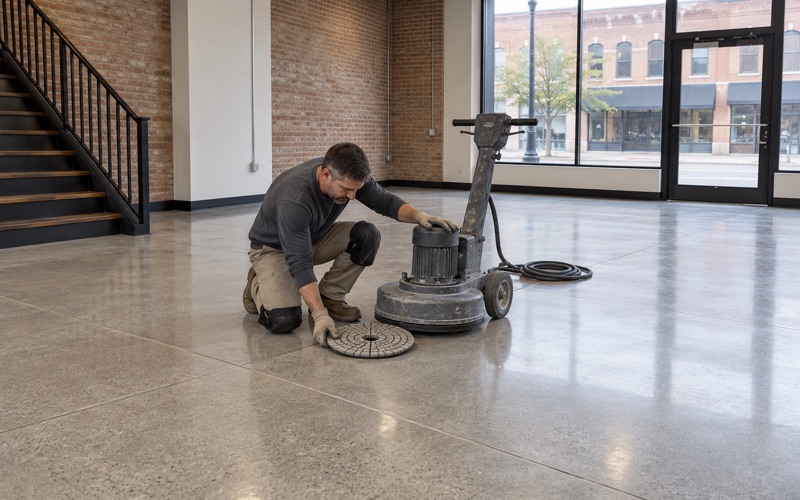
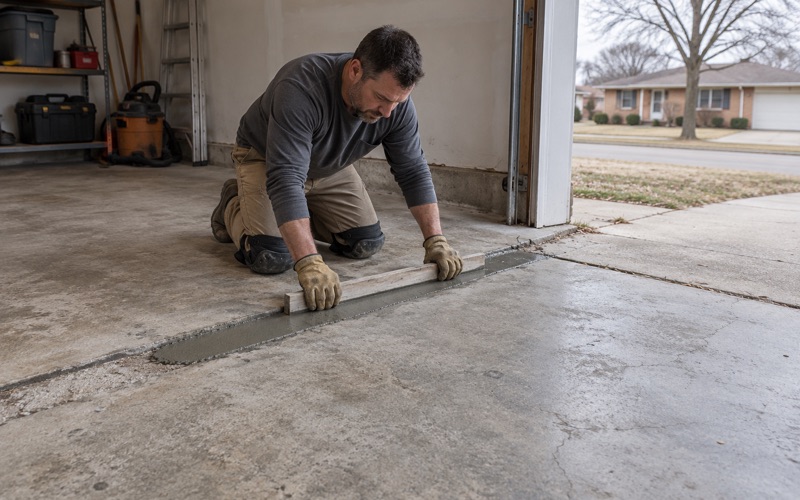
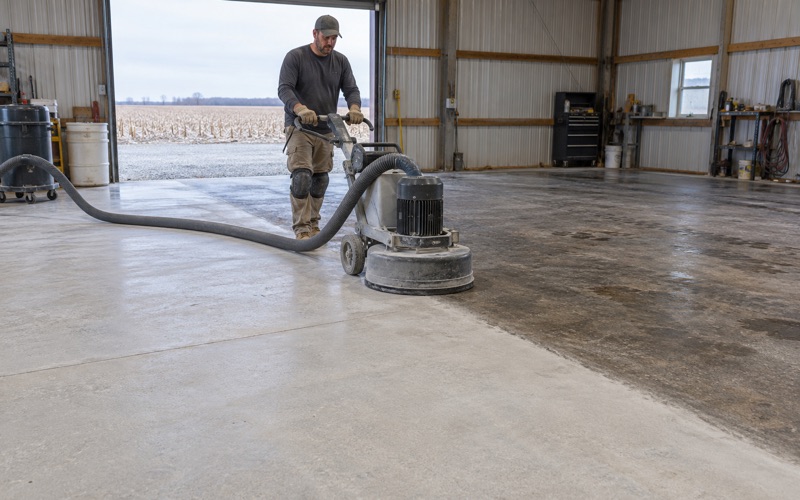
Our work on a Hampshire slab follows a set sequence. We open the surface with a diamond grinder or shot blaster, never acid, read the cracks and joints, test for moisture, and only then write a proposal that names the product, the system build and the finished thickness, so you can check what went down against what was quoted.
A Vapor Barrier Maker on Industrial Drive
W. R. MEADOWS Calls Hampshire Home
Hampshire has an unusual neighbor for anyone who thinks about concrete moisture. W. R. MEADOWS, a construction products company co-founded in 1926 by W. R. “Bob” Meadows and Edna Meadows, lists its corporate headquarters at 300 Industrial Drive. That address sits inside the village limits, in Hampshire Township of Kane County, and the company’s press releases carry a Hampshire, IL dateline.
We mention it for one reason. We have no business relationship with W. R. MEADOWS and we do not install its products, but one of the things it makes is the clearest way we know to explain why we test every slab before we coat it.
PERMINATOR and What It Is Built For
PERMINATOR is the company’s underslab vapor barrier, sold in 10 mil and 15 mil thicknesses. The maker states that both meet ASTM E1745 Class A, B and C, the standard that classifies plastic vapor retarders placed in contact with soil or granular fill beneath a concrete slab. For the 15 mil sheet, the company publishes a perm rating of 0.0063.
Notice what that standard covers. ASTM E1745 is about a sheet of material under the concrete, not a finish on top of it, and the maker’s own product page says nothing about floor coatings. That is the line we keep in view whenever we talk about moisture with a Hampshire homeowner.
A Village Pouring a Lot of New Concrete
Kane County Connects reported in May 2025 that Hampshire’s building permits jumped from 49 during 2021 to 167 during 2024, alongside the largest one-year population growth of any Illinois municipality over 1,000 residents. Census housing data already showed 66.6 percent of the village’s homes built in 2000 or later.
Every one of those homes sits on slabs poured by someone, on a day nobody living there now watched. Whether a vapor retarder went under any particular garage or basement is not something the village’s permit guidelines or a builder’s sales page can tell us, so we do not guess in either direction.
Looking for epoxy-flooring closer to Sugar Grove? See Epoxy-Flooring Services in Sugar Grove.
What Goes Under a Slab Before the Pour, and Why It Stays There
Laid on the Tamped Base
PERMINATOR’s installation instructions describe a job that happens entirely before the pour. The earth or granular material beneath the slab base is leveled and tamped or rolled, then the sheet is unrolled with its long dimension parallel to the direction of the pour. The instructions cite ASTM E1643 as the installation standard.
That means the barrier goes down while the forms are still empty and the base is still exposed. Once the concrete truck arrives and the slab is finished, the sheet is sealed beneath the concrete, and the chance to add, move or repair it has passed for the life of that floor.
Lapped, Taped and Collared
The same instructions call for seams overlapped at least six inches and taped, a taped perimeter termination, an X cut and a collar around every pipe penetration, and any holes patched with tape or an overlapping piece before concrete goes down. Each step is about continuity, because a vapor retarder only does its job where it is unbroken.
A careful crew treats those details as the difference between a barrier and a torn sheet of plastic. A rushed one can leave gaps around plumbing stubs or along the edges, and nothing on the finished surface reveals which kind of day that crew had.
Why Nothing Applied from Above Adds One
This is the point we make plainly with every customer. A barrier under a slab is part of how the slab was built, and nothing applied to the top surface puts one there afterward. Grinding, sealing or coating changes the surface you walk on; it does not change what lies beneath the concrete.
So an epoxy, polyaspartic or polyurea floor is not a vapor barrier, and we never sell one as such. A coating is a wear surface that has to survive whatever moisture the slab delivers to it, which is exactly why we measure that moisture instead of assuming a number.
Testing a Hampshire Garage or Basement Slab Before We Coat It
Three-Car Garages and Full Basements
Hampshire’s newest subdivisions lean toward bigger slabs. Prairie Ridge, a Ryan Homes community in the village, is marketed with three-car garages and full basements included, and the village’s housing is 83.3 percent owner-occupied, so many of the floors we see belong to owners planning to stay a while.
A three-car garage slab and a basement slab under the same roof can behave very differently. The garage takes salt brine and road grime off the tires, while the basement sits lower, often near a sump pit, with soil against its underside. We test each one separately rather than letting a single reading speak for the whole house.
The Tests We Run on an Unknown Underside
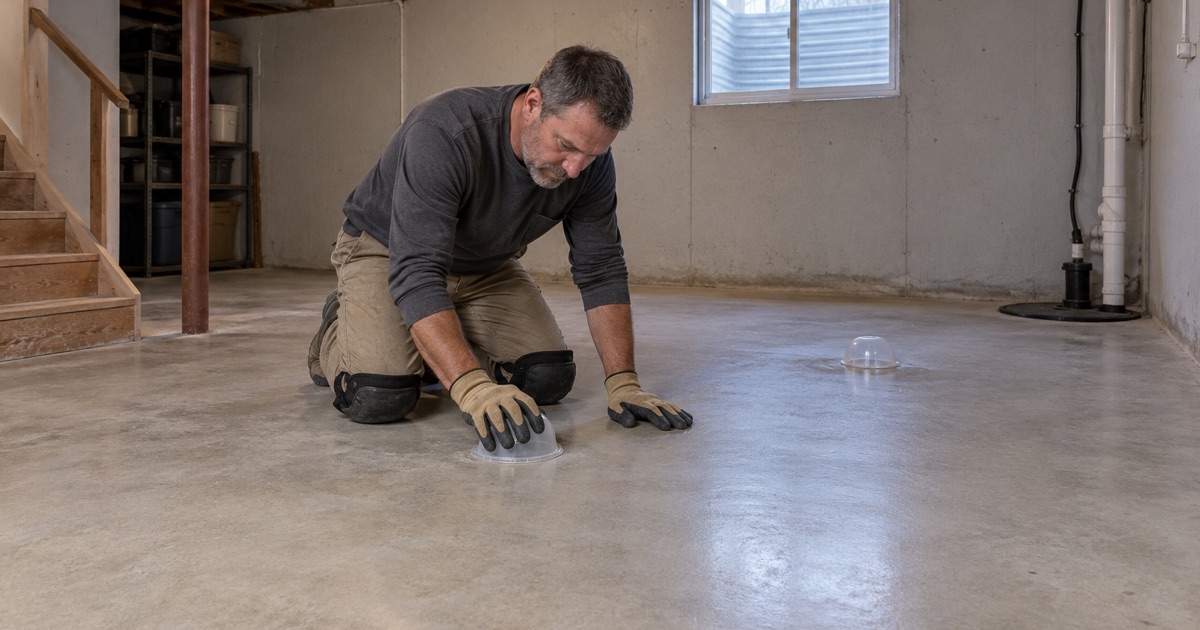
Our first look is often an ASTM D4263 plastic sheet test, which shows whether moisture collects under a taped square of plastic. It is a quick screen rather than a measurement, so on most coating jobs we follow it with ASTM F2170 in-situ relative humidity probes set into drilled holes, or an ASTM F1869 calcium chloride test of the vapor emission rate at the surface.
The relative humidity probes matter most when the underside is a mystery, because they read conditions inside the slab rather than only at its face. We record the readings, the test locations and the date, and they go into the proposal so you can see why we recommended the system we did.
Moisture Testing as a Line Item
We list moisture testing as its own priced line in the scope on every garage and basement job. It is not an upsell offered after a floor has already blistered, and it is not something we skip because a house is new and the concrete looks clean.
Testing also shapes the warranty conversation. Moisture is the first exclusion we read out before a job is sold, and a written reading gives both of us something concrete to point to if a question ever comes up later.
Choosing the Coating System the Slab’s Moisture Allows
When the Readings Come Back Low
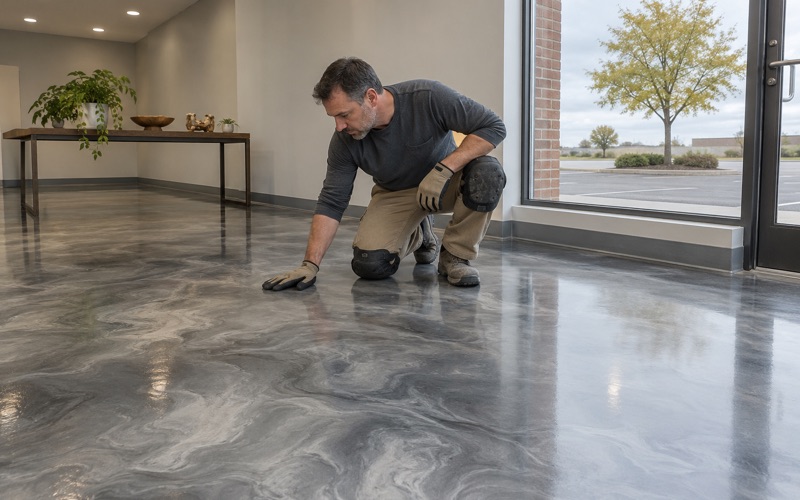
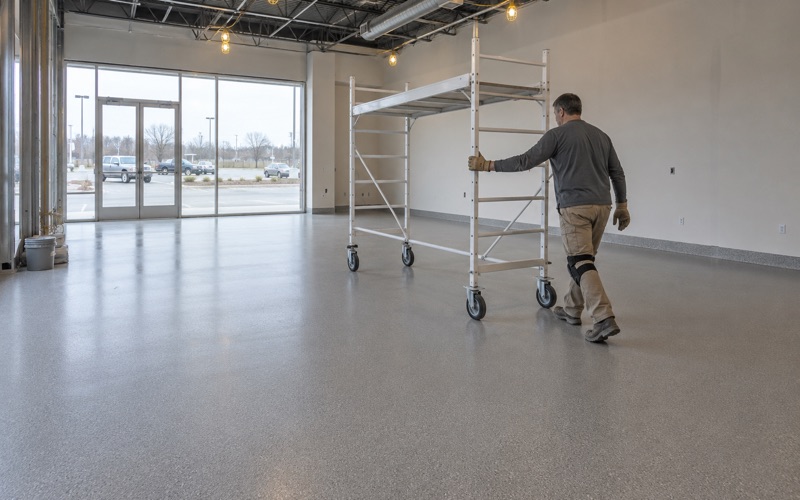
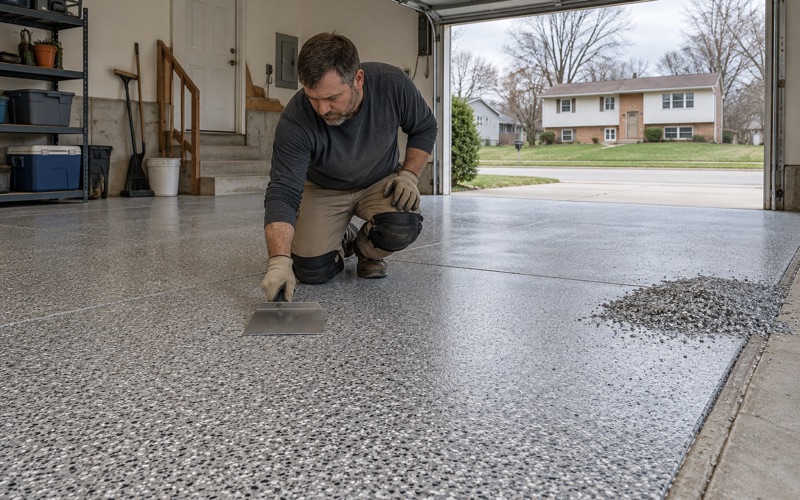
A slab that tests within the manufacturer’s published limits opens up the full range. For a Hampshire garage that usually means a 100% solids epoxy base with a vinyl flake or quartz aggregate broadcast and a polyaspartic or polyurea topcoat, built to resist hot tire pickup and the calcium chloride and rock salt that winter driving tracks in.
Before any of that, the surface is opened to a measured ICRI CSP profile with a diamond grinder or shot blaster, and cracks and control joints get a semi-rigid polyurea joint filler where they need one. Grinding dust is collected at the machine and never rinsed toward a floor drain.
When the Readings Come Back High
Higher readings narrow the choices rather than end the conversation. Some systems, urethane cement among them, are formulated to tolerate more moisture than a standard epoxy, and we compare the measured numbers against each product’s published limits before recommending one.
Sometimes the honest answer is that the slab is not a good candidate yet, or that a basement needs its water source dealt with first, since a coating does not stop water entry. We would rather say that before a contract is signed than after a floor starts to lift.
What Hampshire’s Rules Do and Do Not Say
The Village of Hampshire contracts its building department to SAFEbuilt and does not require contractor registration, and its January 2026 Small Project Permit Guidelines list no coating or floor-finish item. Illinois issues no license for flooring or coatings work, so we confirm the village’s current requirements, plus bond and insurance expectations, before a job goes on the calendar.
Two state rules do apply to every home floor. The Illinois Home Repair and Remodeling Act means each job gets a written contract and the Home Repair: Know Your Consumer Rights pamphlet before work starts, and the floor coatings we choose stay within the Illinois VOC limit for that category, which binds the installer as well as the manufacturer.
- 20+ Years of Floor Work
- Moisture Testing in Every Scope
- Written Proposals and Contracts