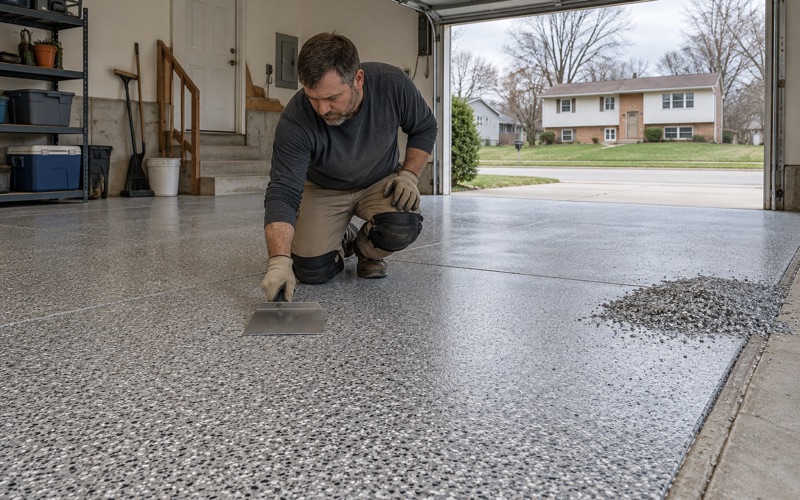
DeKalb IL Epoxy Flooring has put more than 20 years into concrete coatings, and epoxy flooring in Gilberts brings us a question most garage jobs never raise. Some of the floors we are asked about here sit under horse owners who keep brush-on hoof products on a shelf. The coating has to suit how the slab is really used, and that means asking where those products get opened, where they drip and what gets used to wipe them up.
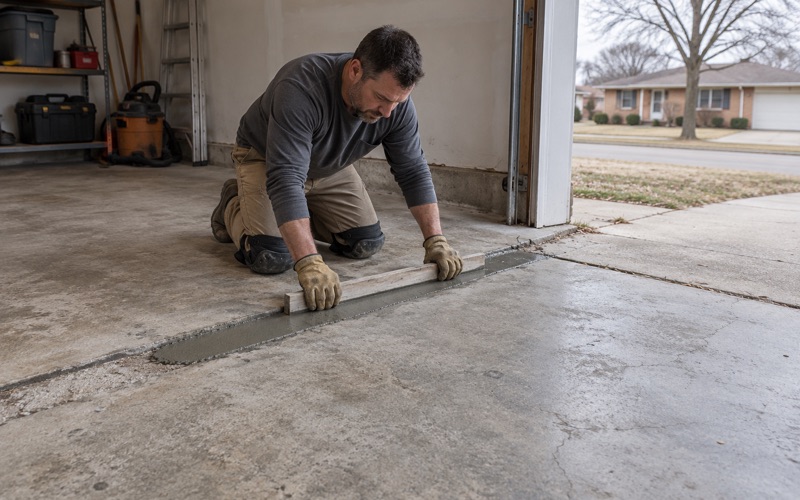
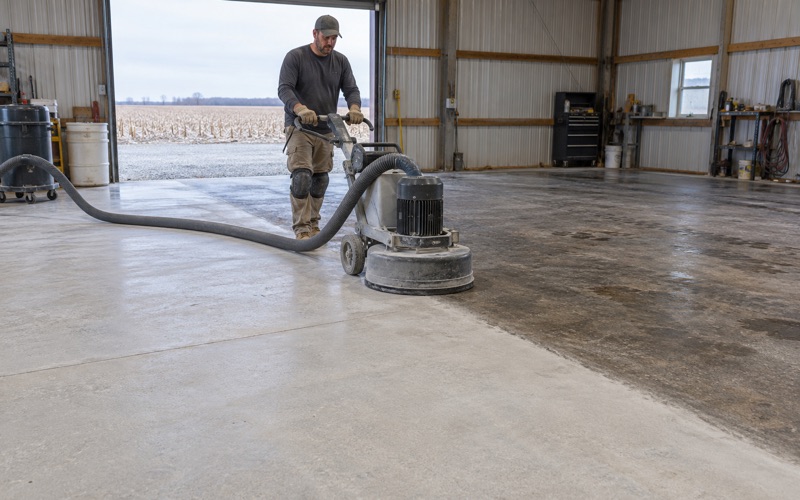
The groundwork does not change from one floor to the next. We open every slab with a diamond grinder or a shot blaster rather than acid, write moisture testing into the scope as its own line, and read the cracks, joints and any old coating before we put a price on anything. If the slab needs repair or replacement first, we say so before a quote goes out.
What changes is the plan for one small part of the floor. A grooming spot where hoof dressing is brushed on and then cleaned off with a solvent is a different job than the rest of the slab, and we treat it that way from the first walk-through.
A Stable on Powers Road and the Spot Where Hoof Care Happens
A Gilberts-Address Horse Stable
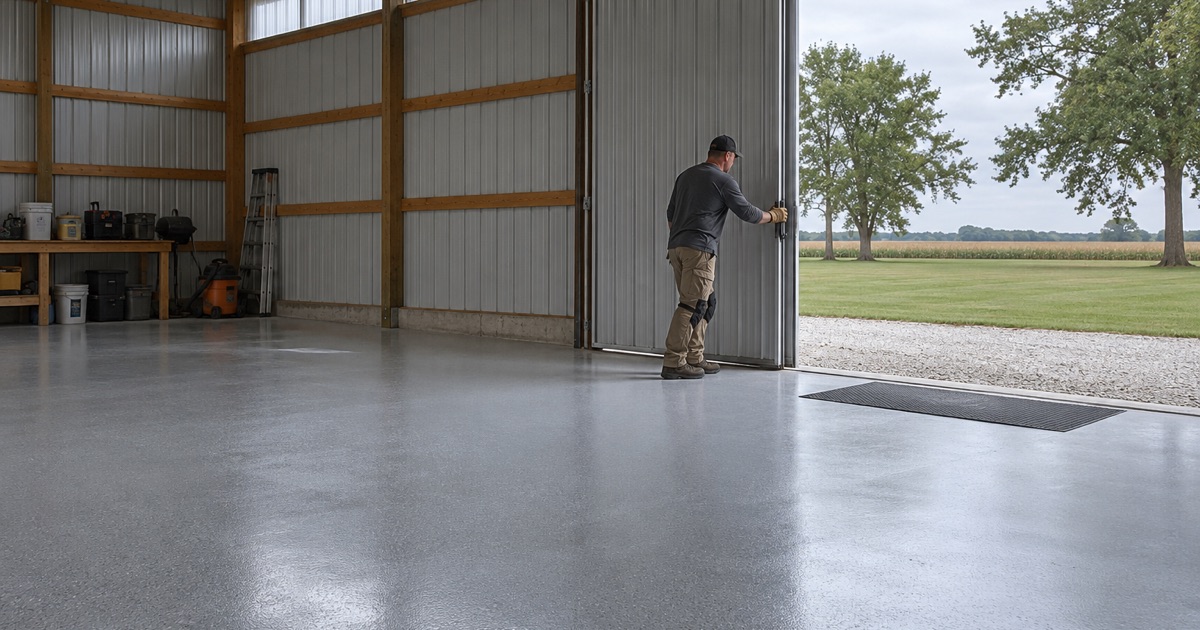
Indian Hills Training Center, on Powers Road with a Gilberts mailing address, boards and trains horses. An equine directory describes a premier equestrian center in Gilberts under new ownership and management. We have not seen its floors, its grooming area or the products it keeps, and it is not a customer of ours.
We bring it up for a simpler reason. A working stable with a Gilberts address is a reminder that horse care is part of life around this village, and that some of the people who call us about a barn, a shop or a garage are doing hoof care on that slab.
The Cross-Ties Collect the Drips
In most barns, hoof care happens in one place. A horse stands at the cross-ties or in a grooming stall, a hoof is picked up and cleaned, and a dressing is brushed on. Whatever runs off the brush or the hoof lands on the same few square feet of floor, week after week.
That makes the drip predictable, which is useful. Instead of guessing where a floor will take abuse, we can point to the exact spot and plan for it before any coating goes down.
Why One Spot Gets Its Own Plan
A brush-on thrush dressing behaves differently from road salt or a dropped tool. It is a colored liquid that can soak into bare concrete, and on a coated floor it gets cleaned off with a solvent rather than soap and water. So the question for this spot is not only what the coating can take but what someone will use to clean it.
Looking for epoxy-flooring closer to Batavia? See Epoxy-Flooring Services in Batavia.
What the Kopertox Label Says About Surfaces and Flame
Copper Naphthenate at 37.5 Percent
One common thrush dressing is Kopertox, made by Zoetis. As its label is reproduced by a tack retailer, the active ingredient reads as copper naphthenate at 37.5 percent, and the directions say to apply it to the hoof with a narrow paint brush. We quote the label here only for what it says about surfaces and flame, not for how or when to use it on a horse.
A dressing that strong and that dark can leave a mark where it lands. On bare concrete, a drip is likely to soak in and stain green. On a coated floor, it sits on the surface until someone wipes it away, which brings up the next line on the label.
Cleanup With Fuel Oil or Lighter Fluid
The label says the product is easily removed from hands, clothing and surfaces with light grade fuel oil or any type of lighter fluid. That is the maker’s own answer to a drip, and many people will reach for exactly what it names. A rag soaked in lighter fluid will end up rubbing the floor at the cross-ties.
That changes how we choose a topcoat for this spot. A finish that looks good under a car tire still has to be checked against repeated wiping with a hydrocarbon solvent, because that is the cleaning this floor will actually see.
Avoid Fire, Flame, Sparks or Heaters
The same label tells the user to work in a well-ventilated place, avoid breathing the vapor and avoid fire, flame, sparks or heaters. That warning belongs to the dressing, and the cleanup solvents it names carry their own fire risks. Put the two together and the hoof-care spot is a place where open flame and space heaters do not belong.
No coating changes that. A floor we install does not make a barn or a garage fire-safe, and we will not describe any finish as fireproof. What we can do is plan the floor and the area around it so the label’s warning is easy to follow.
Planning the Hoof-Care Spot: Mat, Topcoat, Rags and No Heater
A Rubber Mat Under the Hoof
The simplest protection is a rubber mat or a drip board set where the hoof is held during dressing. It catches most of what runs off the brush, and it can be carried outside and cleaned away from the coated floor. That keeps the solvent off the coating more often than not.
We size the mat area into the plan so it does not shift every week. Where the cross-ties are fixed, the drip zone is fixed too, and we can mark it on the drawing before we start.
A Topcoat Checked Against Solvent Wiping
For the drip zone, we choose a topcoat with the label’s cleanup in mind. A 100% solids epoxy base with a polyaspartic or polyurea topcoat is a common build, and we check the specific product’s data against fuel oil and solvent wiping before we propose it. No coating is solvent-proof, so the goal is a finish that holds up to occasional careful cleaning rather than daily scrubbing.
The proposal names the product, the system build and the finished thickness. If we suggest a different topcoat at the grooming spot than on the rest of the floor, the paperwork shows both, so you can check what went down against what was quoted.
Rags Go Outside
A solvent rag left in a corner is a hazard in its own right. We ask clients to use the solvent sparingly, wipe the drip and take the rag outside rather than leaving it in a bin near the cross-ties. That habit protects the coating and keeps solvent vapor out of the aisle.
A small, clear spot outside the door for rags and the dressing bottle makes that easy to keep up. It also keeps the bottle from being knocked over onto the new floor.
Keep Heaters Out of the Aisle
Many barns and shops run a portable heater through the cold months. At the hoof-care spot, the label’s warning means no heater nearby while dressing or solvent is out. We plan the heated zone of a building away from the cross-ties so the two never share space.
For questions about heaters or fire safety in an outbuilding, the Rutland-Dundee Fire Protection District on Higgins Road serves Gilberts. We do not give fire-code advice; we plan the floor so it fits the rules you are already following.
Hoof Products in a Home Barn or a Gilberts Garage
Home Barns and Garage Shelves
Not every horse owner boards at a large stable. Some keep a horse at home, and many keep hoof products, brushes and solvents on a garage shelf. The same plan applies there: know where the dressing gets opened, put a mat under it, choose a topcoat with solvent wiping in mind and keep heaters away from that corner.
Gilberts housing is mostly newer, with 74.0 percent of units built between 2000 and 2019 and 94.8 percent of occupied homes owner-occupied. Many of those garages are attached, which makes the no-heater rule even more important where the garage shares a wall with the house.
Prep, Moisture and Cure
Whatever the building, the slab comes first. We test moisture with methods such as ASTM F1869 calcium chloride testing or ASTM F2170 relative humidity probes, and we read the warranty exclusions out loud before the job is sold, with moisture named first. A coating is not waterproofing, and we will not sell one as radon reduction, which in Illinois takes a state radon mitigation license.
Curing is scheduled against slab temperature and the dew point at the surface, not the calendar. An unheated barn or machine shed in Gilberts may simply have to wait for spring, and we would rather say that up front. Grinding dust is collected at the grinder and never washed toward a floor drain.
Registering With the Village of Gilberts
The Village of Gilberts asks every contractor working inside its limits to register and to supply a certificate of insurance and a surety bond of at least 3,000 dollars. Illinois issues no state license for flooring or coatings work, so we confirm the village’s registration, bond and insurance before a job is scheduled. Whether a floor coating needs a permit is a question for Community Development at Village Hall, 87 Galligan Road, and we ask rather than assume.
Contracts, VOC Limits and Pricing
Every home job gets a written contract and the Home Repair: Know Your Consumer Rights pamphlet before work starts, as the Illinois Home Repair and Remodeling Act requires. Kane County sits in the Chicago area ozone nonattainment area, and the floor coatings we choose stay within the Illinois limit on VOC content, which binds the installer as well as the manufacturer.
Prices are quoted per square foot for the system we actually propose, including any different topcoat at the grooming spot. A barn aisle, a garage with a hoof-care corner and a plain two-car floor each get their own number, worked out from the slab in front of us.
- 20+ Years of Floor Work
- Moisture Testing in Every Scope
- Written Proposals and Contracts