DeKalb IL Epoxy Flooring has put down epoxy flooring in Genoa and across DeKalb County for more than 20 years, and the part of the job we guard most closely here is the topcoat. A polyurethane or polyaspartic finish is the layer people see and walk on, and it is also the layer most easily spoiled by a little water at the wrong moment.
Our work on a Genoa garage, basement or shop floor follows one order. We open the slab mechanically, test it for moisture, build the base coats, and only then decide whether an isocyanate-cured topcoat belongs on it. Each of those steps is written into the proposal with the product, the system build and the finished thickness, so the floor that goes down can be checked against the floor that was quoted.
The sections below explain why moisture and isocyanate do not mix, what that means for storing and opening a two-part kit in a cold month, and how we decide which finish a given Genoa floor should get.
Polyurethane Made in Genoa, and the Reaction Behind It
A polyurethane maker on Derby Line Road
Genoa is home to J6 Polymers, a company on Derby Line Road that blends two-component polyurethane systems and says all of its products are manufactured at its Genoa facility. Its lines include engineered foam systems and precision blending for aerospace, military and defense customers. J6 Polymers makes foams and polyurethane systems, not floor coatings, and it has no connection to our business.
We bring it up because its published product information explains the chemistry of our topcoats more plainly than most floor literature does. A floor contractor working in Genoa has a local manufacturer spelling out, in writing, exactly what water does to an isocyanate.
How a water-blown foam rises
One J6 Polymers bulletin describes JFoam BX-1600 as a two-component water-blown polyurethane foam system. One side is a polymeric MDI, an isocyanate, and the other is a polyol blend that contains water. When the two are mixed, the water reacts with the isocyanate and gives off carbon dioxide, and that gas is what lifts the foam.
In a foam, the gas is the whole point. The manufacturer wants those bubbles, controls how fast they form, and builds a product around them. The same bulletin lists a cream time of 55 seconds and a tack-free time of 145 seconds at 77 degrees, which shows how quickly the reaction moves once it starts.
Why a foam bulletin matters to a floor
Polyurethane and polyaspartic floor topcoats are also cured through an isocyanate. The difference is that a floor finish is supposed to be a dense, clear, unbroken film, so any carbon dioxide made inside it is a defect rather than a feature. The chemistry that a foam maker uses on purpose is the chemistry we spend the whole job trying to keep out of a floor.
That is the angle we take on every Genoa topcoat. Water reaching the isocyanate side, whether from the slab, the air or an opened container, starts the same reaction the foam relies on.
Looking for epoxy-flooring closer to Elburn? See Epoxy-Flooring in Elburn.
When That Reaction Happens in a Floor Topcoat
Bubbles and pinholes
When moisture meets an isocyanate-cured topcoat during cure, the gas it produces has nowhere to go but up through the wet film. Small bubbles form and either stay trapped or break at the surface and leave pinholes. On a flake or quartz broadcast floor the pinholes can hide for a while, but they collect dirt and give tire contaminants a way into the film.
A US patent on floor coating compositions describes this directly: water reacts with the polyisocyanate and generates carbon dioxide that can cause foaming and blistering. That is the failure we are working to prevent, and it is not something a second coat reliably fixes.
Down-gloss and a dull film
The other symptom is a finish that cures dull or hazy instead of glossy. Incorez, a company that makes moisture scavengers for polyaspartic ester floor coatings, says moisture reacts with the isocyanate component and speeds up the cure. Its scavenger is sold specifically to prevent bubbling and down-glossing caused by high moisture, whether that moisture sits on the substrate or comes from the atmosphere.
Down-gloss is often blamed on a bad batch or a sloppy roller. More often, in our experience, the topcoat simply met water while it was curing. A faster, uneven cure also shortens working time, which leaves lap marks where one pass meets the next.
Where the water comes from
There are three sources, and we check all of them. The slab can push vapor up from below, especially an older slab poured without a vapor retarder. The air can carry enough humidity to start the reaction at the surface of a fresh coat.
The third source is the kit itself. An opened container of isocyanate pulls moisture out of the air, and a component stored in a cold truck or garage can come out of storage in poor shape. That one is entirely within our control, which is why the next section exists.
Storing and Opening Two-Part Kits Through a Northern Illinois Winter
The storage band a polyurethane maker publishes
The JFoam BX-1600 bulletin tells users to avoid moisture contamination during storage, handling and processing, and to store both the polyol and isocyanate components from 65 to 85 degrees. It warns that the isocyanate side should not be exposed to lower temperatures because freezing may occur, and it gives a shelf life of 12 months unopened.
That is a foam product, not a floor product, but the handling discipline transfers directly. Our floor kits are kept warm and sealed between jobs, not left overnight in an unheated garage, pole shed or truck bed through a DeKalb County winter. The nearest climate normals station, in DeKalb, averages 140.6 nights a year at or below freezing.
Opening a kit only when it is going down
We open topcoat components at the floor, not in the driveway an hour ahead. Lids go back on partial containers right away, and a container that has been opened and left exposed for a long stretch does not go onto a customer’s finished floor.
We also mix only what a crew can lay down inside the working time. A large batch sitting in a bucket keeps reacting with the air while the roller works through the first half, and the last section of the floor pays for it.
Scheduling the cure around slab temperature
A kit that was stored correctly can still be ruined by a cold slab. We schedule curing against the slab’s own temperature and the dew point spread at its surface, not against the calendar. When the slab is too cold, or close enough to the dew point that water can condense on it, the topcoat waits.
Some unheated garages and machine sheds simply have to wait for spring, and we say so plainly when that is the case. A delayed floor is an inconvenience. A topcoat that foamed against a cold, damp surface is a floor that has to be ground off and redone.
Testing the Slab and Choosing the Finish in Genoa
Moisture testing is part of the scope
Moisture testing is a line item on every proposal we write, whether the floor is a Genoa garage, a basement or a shop. Depending on the slab, that can mean an ASTM D4263 plastic sheet test as a first look, ASTM F1869 calcium chloride testing for moisture vapor emission, or ASTM F2170 in-situ relative humidity probes set into the concrete.
The results decide the build. A slab that tests dry can take a standard 100% solids epoxy base and an isocyanate-cured topcoat. A slab that tests wet may need a moisture-mitigation primer first, or a different system, and we would rather tell you that before the job than explain a blister after it. Moisture is the first exclusion we read out when we go over the warranty.
Grinding, not acid etching
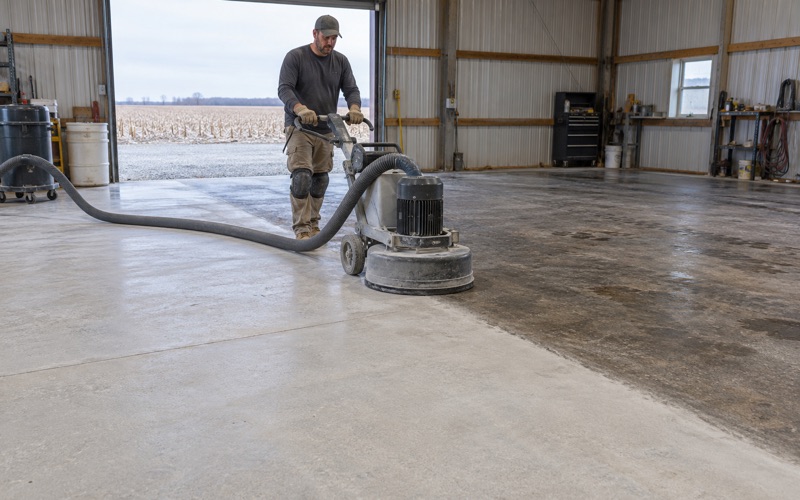
Every slab we coat is opened with a diamond grinder or shot blaster to an ICRI CSP profile that suits the system. We do not acid etch. Etching puts water and acid onto the slab right before coating, which works against everything this page has described.
Grinding dust is collected at the grinder and never washed toward a floor drain or storm inlet. Before we quote, we also read the cracks, joints and any old coating, and we say plainly when a slab needs repair or replacement before it can take a finish.
When an isocyanate-cured topcoat is the right finish
A polyaspartic or polyurethane topcoat earns its place on a garage floor that sees calcium chloride brine and rock salt every winter, on a floor that needs better color stability in daylight than epoxy alone, and on a job where a faster return to service matters. It is not automatically the right answer on a damp basement slab, where a coating is not waterproofing and the water source has to be dealt with first.
We pick the finish within the Illinois VOC limits set in the Illinois Administrative Code, Title 35, Part 223, Subpart C, which bind the installer as well as the manufacturer. Prices are quoted per square foot for the system actually proposed, not from a national per-garage figure.
Genoa homes and the paperwork
Genoa’s housing came in two large waves: 646 units built from 1950 through 1969 and 837 built from 1990 through 2009, with 262 more dating to 1939 or earlier. Those older slabs are the ones most likely to have gone down without a vapor retarder, which is why the moisture test matters most on them.
Illinois issues no state license for flooring or coatings work, so we confirm the City of Genoa’s own contractor registration, bond and insurance rules before scheduling. The city has adopted the 2021 International Building Code, with other adopted codes listed in Title 9 of its municipal code. Every home job also gets a written contract and the Home Repair: Know Your Consumer Rights pamphlet before work starts, as the Illinois Home Repair and Remodeling Act requires.
- 20+ Years of Floor Work
- Moisture Testing in Every Scope
- Written Proposals and Contracts