
DeKalb IL Epoxy Flooring installs ESD flooring in DeKalb, IL, serving surrounding cities including Cortland, Sycamore, Genoa, Elburn and Rochelle. Static-dissipative and conductive floors are precision systems, and our 20+ years of floor work have taught us that an ESD floor is only as reliable as its grounding, its preparation and the testing that proves it works.
Static discharge can damage sensitive electronic components without any visible spark, and the damage may not show up until a product fails in the field. An ESD floor gives that charge a controlled path to ground. It is used in electronics assembly, server rooms, laboratories and other spaces where static control matters.
Every ESD proposal names the system, the grounding layout, the resistance range it is built to meet and how it will be tested. After installation, you receive the test readings and a plan of where they were taken.
What ESD Flooring Does
Static Charge and Sensitive Electronics
People build up static charge simply by walking, especially in dry winter air when indoor humidity drops. When a charged person or cart touches a sensitive component, that charge can discharge through it. The component may fail immediately or be weakened enough to fail later.
An ESD floor drains that charge away in a controlled way as people and equipment move across it. Combined with proper footwear, it keeps charge from building up to damaging levels.
Conductive Versus Static-Dissipative Floors
Conductive floors have low electrical resistance and drain charge quickly. Static-dissipative floors have higher resistance, which slows the discharge and makes it more controlled. Each is defined by the resistance range it is built and tested to meet.
The right type depends on the devices being handled and on your company’s static control program. We build to the static-dissipative and ESD flooring resistance range your program specifies rather than a generic figure.
The Floor as Part of a System
An ESD floor works together with ESD footwear or heel grounders, grounded workbenches, wrist straps and handling procedures. A worker in ordinary shoes is insulated from the floor, so the floor cannot drain their charge. The system only works when every part is in place.
We talk through your existing program before specifying the floor. That makes sure the floor’s resistance fits with the footwear and equipment your team already uses.
How an ESD Floor Is Built
Slab Preparation and Moisture Testing
The conductive layers of an ESD floor have to bond to sound concrete across the whole room, so the slab is diamond ground or shot blasted to the profile the system calls for. Old coatings, adhesive and sealers are removed completely, and cracks and joints are filled and ground flush. Dust is collected at the grinder rather than left to settle in a clean space.
We also test the slab with ASTM F1869 calcium chloride kits or ASTM F2170 probes before any layer goes down. Moisture rising through a slab can blister a coating, and a blister in an ESD floor breaks the electrical path as well as the surface. If readings are high, a moisture-mitigation primer compatible with the conductive system goes down first.
Grounding Points and Copper Strips
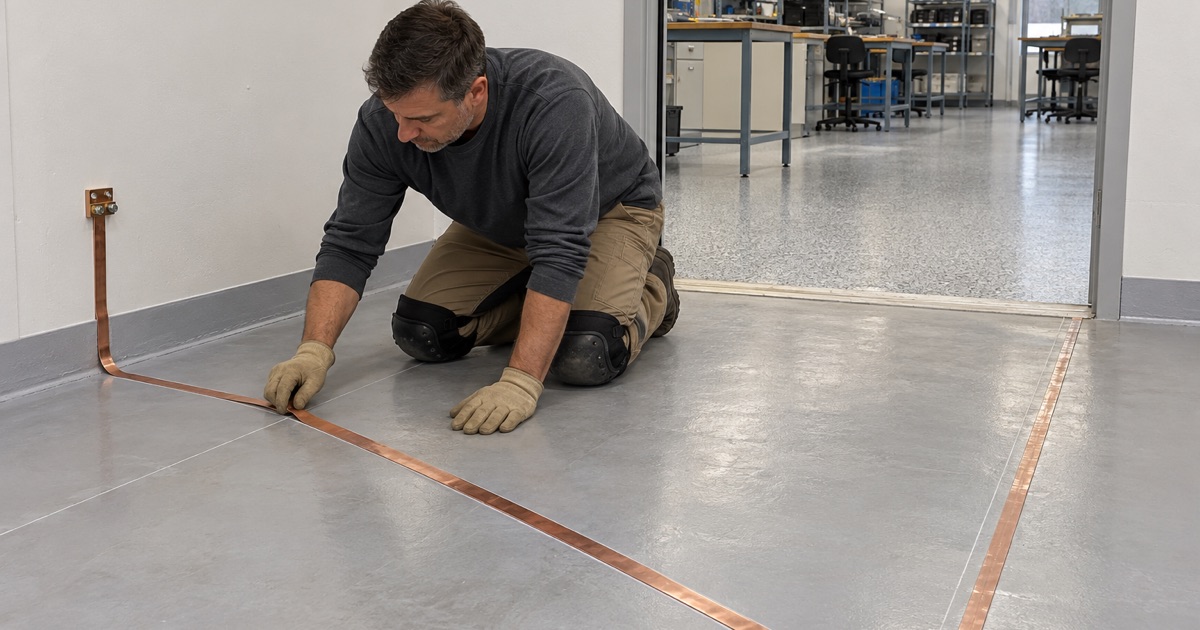
An ESD floor needs a path from the coating to the building’s ground. Copper grounding strips are laid on the prepared slab under the conductive layers, and they connect to grounding points tied into the building ground. The layout is planned so every area of the floor has a short path to ground.
We mark the grounding locations on a floor plan before installation. That plan becomes part of the documentation you keep with the floor.
Conductive Primer Layer
A conductive primer goes down over the ground slab and the copper strips. It spreads the electrical path across the whole floor, so charge reaching the surface anywhere can find its way to a grounding point. Even coverage is critical, since a gap can leave an isolated area.
The primer is applied at a controlled thickness and allowed to cure before the topcoat. We check continuity between grounding points before moving on.
Static-Dissipative Topcoat
The topcoat contains conductive materials that set the floor’s final resistance. It is the surface people walk on, so it also has to stand up to carts, chairs and cleaning. Thickness and mixing are controlled closely, since both affect the electrical properties.
Topcoats are available in several colors, and many facilities use color to mark ESD protected areas. Safety lines can be added to mark walkways and zones.
Testing and Maintaining an ESD Floor
Resistance Testing After Installation
Once the floor has cured, we test resistance to ground and point-to-point at locations across the room with a calibrated meter. Each reading is recorded against the floor plan. Areas that fall outside the specified range are investigated and corrected before handover.
You receive the full set of readings with the documentation. That gives your quality team a baseline for future audits.
Cleaning and Ongoing Testing
Waxes, polishes and some cleaners can leave an insulating film that changes the floor’s resistance. ESD floors should be cleaned only with products approved for static control surfaces. We provide written cleaning instructions with the floor.
Most facilities test their floors regularly as part of their ESD program. If readings drift, cleaning residue is often the cause, and a deep clean usually restores the floor.
Where ESD Floors Are Used
Electronics Assembly and Server Rooms
Electronics assembly, repair benches and testing areas handle components that can be damaged by static discharge. Server rooms and data closets protect equipment that runs critical systems. In both, an ESD floor is a basic part of protecting the work.
Laboratories and Specialized Spaces
Laboratories, research spaces and some manufacturing areas around DeKalb and along Interstate 88 also use static control floors. We work around the facility’s schedule, often overnight or on weekends, so production or research can continue. As with every floor, the slab is ground and tested for moisture before any layer goes down.
- 20+ Years of Floor Work
- Moisture Testing in Every Scope
- Written Proposals and Contracts