DeKalb IL Epoxy Flooring has more than 20 years behind it, and on epoxy flooring in Elburn the question we answer most often is not which flake color to pick. It is whether a fairly new garage or basement slab will actually hold a coating. On a floor poured in the last few decades, the answer usually turns on what sits on top of the concrete rather than on the concrete itself.
A slab can look spotless and still carry a thin film that keeps resin from gripping. We find that out with simple checks before we quote, then open the surface with a diamond grinder or shot blaster so the primer reaches bare concrete. We never acid etch, and every proposal names the product, the system build and the finished thickness, so you can hold us to what was quoted.
What follows is how that plays out on Elburn floors: what can be left behind when a house is built, how a water-drop test reads it, why grinding removes it when acid will not, and how we decide a new slab is ready for its first coat.
Elburn Station and a Village Still Pouring Slabs
A young housing stock
Elburn is a village in Kane County, and its homes are young by almost any measure. Census estimates count 2,731 housing units, and 1,396 of them, or 51.1 percent, were built in 2000 or later. Roughly three out of four went up in 1990 or after.
That lines up with the village’s own history. Elburn was largely rural until large tract home developments began arriving during the 1990s, and Metra service reached the village in January 2006, when Elburn replaced Geneva as the western end of the UP-West line. Close to nine out of ten households here own their home, and most of those owners live in a detached house, the kind that usually comes with a garage floor of its own.
Construction that has not stopped
Elburn Station is the clearest example of a village still building. The village describes it as a 505-acre master-planned community developed by Shodeen Homes, with Units 1 and 2 complete. The Village Board approved final plans for Unit 3 on January 5, 2026, and for Unit 4 on March 2, 2026.
Board minutes from March 16, 2026 record D.R. Horton presenting plans for 188 lots across Units 3 and 4, described as a potential acquisition from Shodeen rather than a closed sale. For anyone coating floors, the practical point is simple. Brand-new slabs will keep arriving in Elburn for years, and new concrete brings its own preparation questions.
Why new does not mean ready
Owners of a new house often assume the garage is the easiest floor to coat because it has no oil stains, no old paint and no salt damage yet. Fresh concrete does have fewer problems of that kind. What it can carry instead is something older slabs have usually worn through: a curing compound or clear sealer put down while the concrete was placed or finished, which nobody mentions at closing and which is invisible on a gray floor.
Looking for epoxy-flooring closer to Rochelle? See Epoxy-Flooring Services in Rochelle.
What a Builder Can Leave on a New Garage Floor
Curing compounds and clear sealers
Concrete crews often spray a curing compound on a fresh slab to slow the loss of water while the concrete gains strength, and some floors get a clear sealer before a house is handed over. Both products do their own job well. That job, though, is to sit on the surface and close it up, which is the opposite of what an epoxy primer needs.
We have not read any Elburn builder’s curing or sealing practice, and we do not assume one. Plenty of new slabs carry no film at all. A recently poured slab is simply where we expect to find one most often, so we check every floor rather than guess.
What the coating makers say
Product data sheets are blunt about it. The Sikafloor-264 data sheet calls for removing laitance, form oils and “any other contaminants which may prohibit a good bond,” and it asks for mechanical preparation to an ICRI CSP 3-4 profile. A polyaspartic maker’s data sheet asks for concrete that is free of wax, loose coatings or curing compounds.
Industry guidance adds a wrinkle. ACI 302.1R-15 advises getting a compatibility letter from the curing compound’s maker before that compound is used on a floor that will later receive a finish. A homeowner who bought a finished house almost never has that letter, which is one more reason we treat the surface as unknown until it has been tested.
The dense troweled top
Even without a film, a machine-troweled garage slab tends to have a tight, glassy top layer. It is smooth underfoot and easy to sweep, but it gives a primer very little to hold. We treat that finish as something to open up whether or not anything was ever sprayed on it.
The Water-Drop Test, Then the Grinder
Reading a drop of water
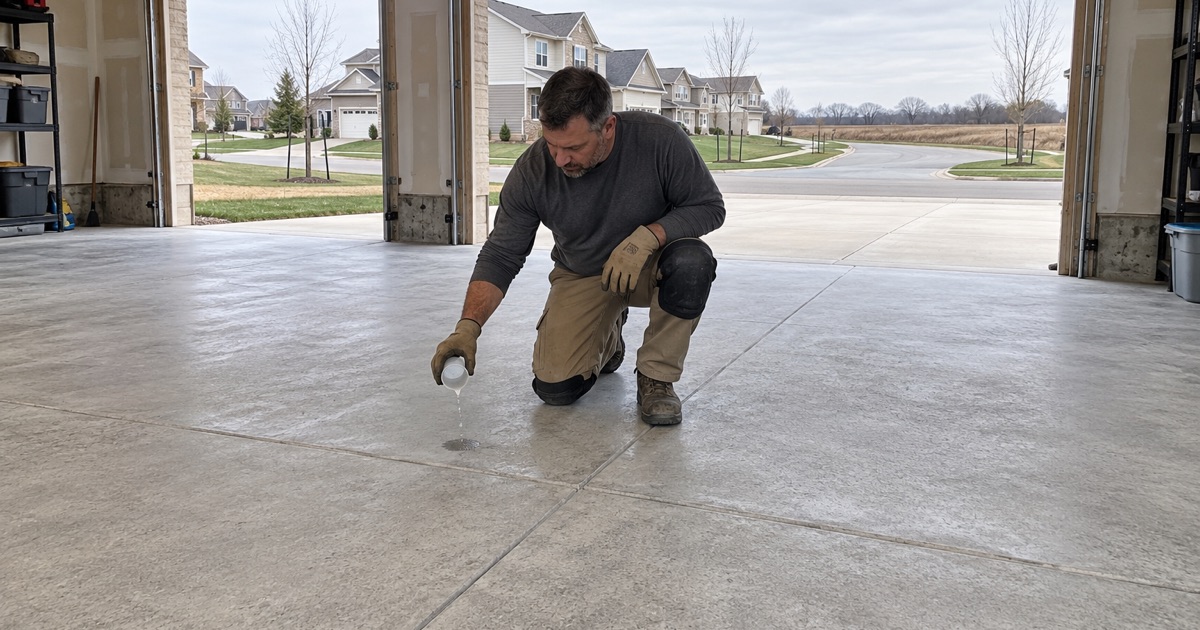
The first check is the cheapest one we own. We set drops of water on several spots across the floor, near the overhead door, in the middle and along the walls, and watch what they do. On open, uncoated concrete the water darkens the surface and soaks in fairly quickly.
If the drops sit up in beads, spread without darkening the concrete, or soak in at one end of the garage and not the other, something is closing the surface. That tells us a curing film, a sealer or a very dense trowel finish is present. It does not tell us which one, and it does not need to, because the fix is the same for all three.
Why acid will not take it off
Acid etching was sold for years as the standard garage floor prep, and on a sealed or cured slab it does very little. The acid cannot reach concrete through a film that sheds water, so it reacts only where the surface was already open and leaves the rest untouched. The floor looks prepared and is not, and that patchy bond is where peeling starts.
Grinding to a real profile
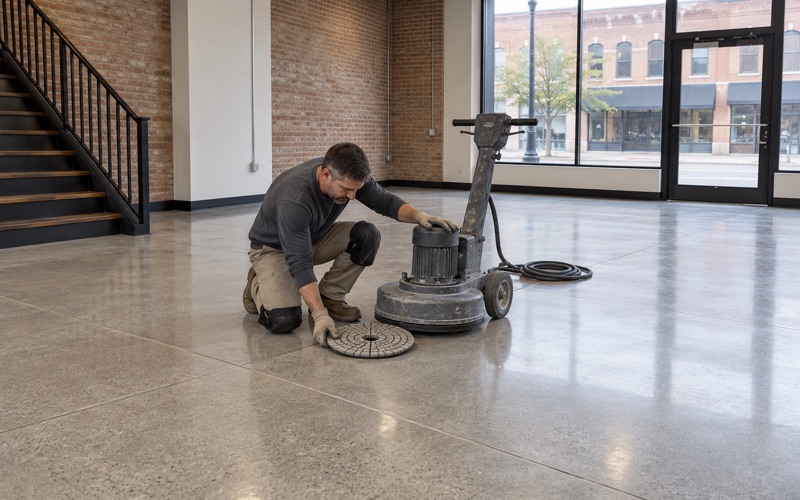
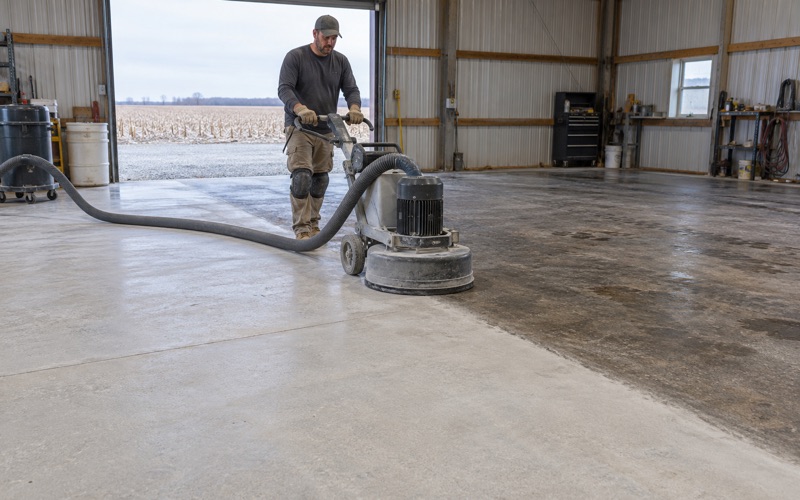
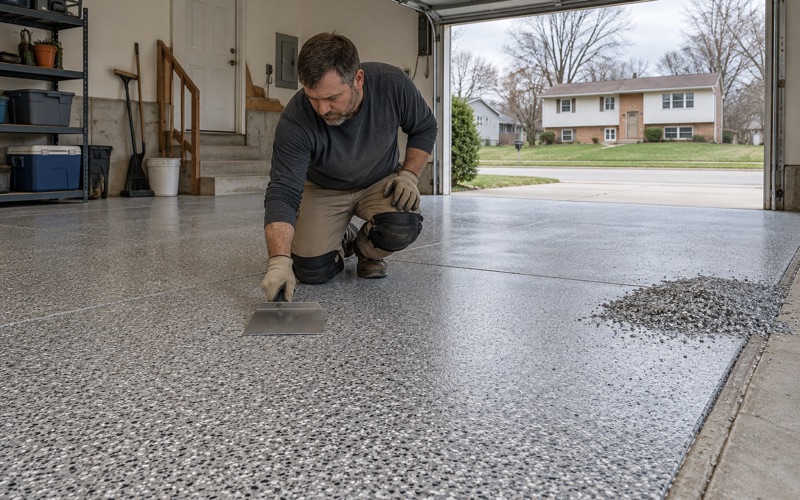
We open the slab mechanically, with a diamond grinder on most garages and basements and a shot blaster on larger open floors. The cut takes off the film and the hard top layer together and leaves the CSP 3-4 texture the coating makers ask for. Primer then soaks into the concrete rather than resting on a skin that can let go.
After grinding we repeat the water-drop test on the same spots. Every drop should now darken the concrete and disappear, and any area that still beads gets another pass before primer goes down. Dust is pulled into a vacuum at the grinder head, so nothing gets hosed out the garage door toward a storm inlet.
When a New Elburn Slab Is Ready for Its First Coat
The checks that clear a slab
A clean water-drop result is the main gate on a newer Elburn floor, but it is not the only one. Moisture testing is a line item in every scope we write, and on a basement we want to know where any water is coming from before we talk about coating. A coating sits on top of a slab and does not fix drainage, and we say so before you sign.
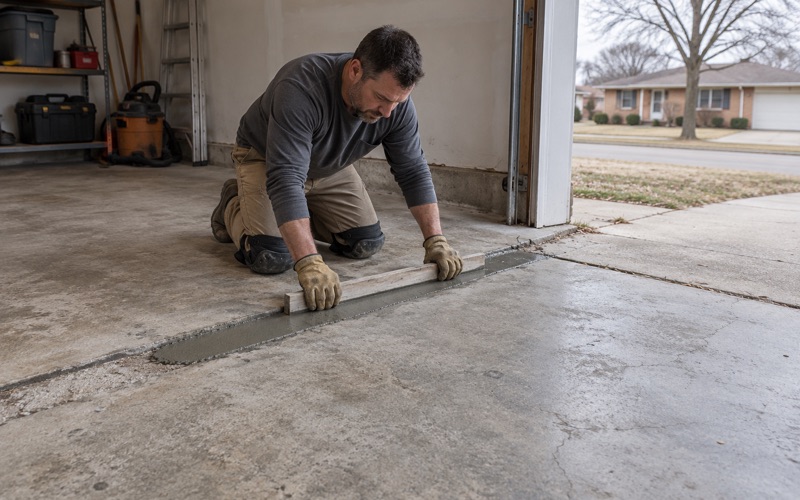
We also read the control joints and any cracks before quoting, and we fill joints with a semi-rigid polyurea filler where the system calls for it. If a slab needs repair before it can hold a coating, the quote says that plainly rather than coating over the problem.
Building the system
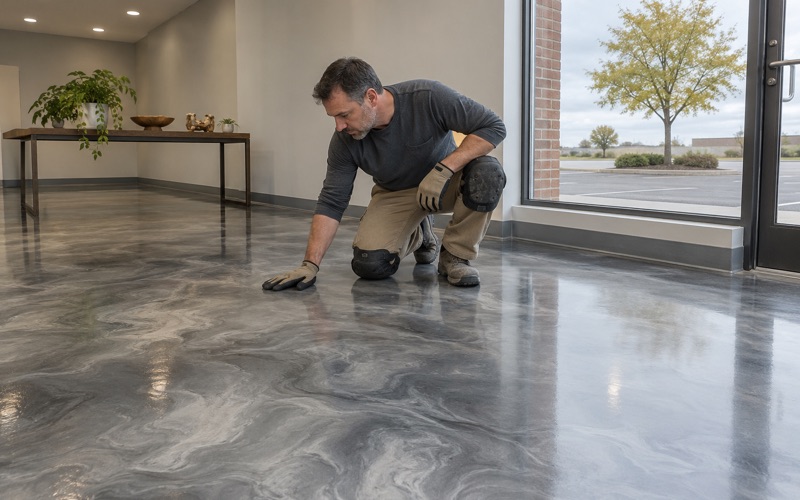
Once the surface is open and clean, a typical Elburn garage gets a 100% solids epoxy base, a vinyl flake broadcast and a polyaspartic topcoat that resists hot tire pickup. Northern Illinois winters bring calcium chloride brine and rock salt in on the tires, so the build is chosen to stand up to both. Every product stays within the Illinois VOC limit for floor coatings, 250 grams per liter, a rule that binds the installer as well as the manufacturer.
Pricing is per square foot for the exact system on the proposal, not a national per-garage number. The written proposal lists the products, the coats and the finished thickness. Warranty exclusions, with moisture named first, are read out before the job is sold.
Permits, paperwork and commercial floors
We have not determined whether the Village of Elburn requires a permit for a floor coating, or which residential code edition it has adopted, so we check with the Building & Zoning Department at 630-365-5061 before a job is scheduled. Home jobs get a written contract and the Home Repair: Know Your Consumer Rights pamphlet before work begins, as the Illinois Home Repair and Remodeling Act requires.
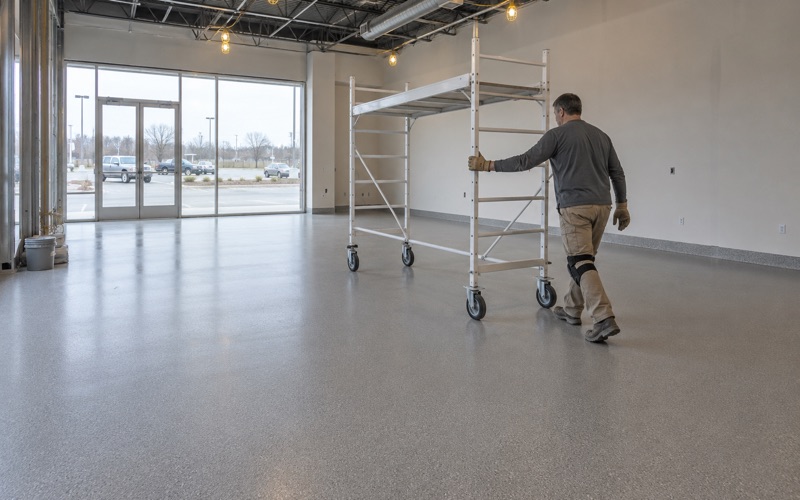
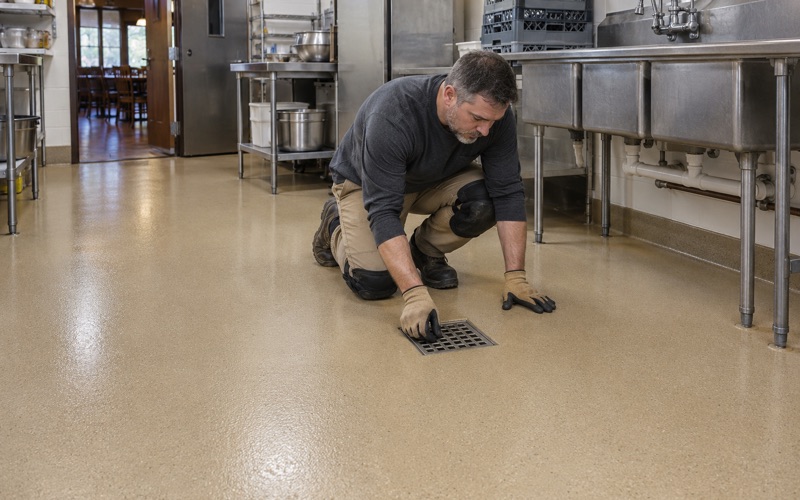
Commercial work brings other reviewers. Plan review in Elburn also passes through the Elburn & Countryside Fire Protection District, which enforces the 2021 International Fire Code and International Building Code. A restaurant or other food business answers to the Kane County Health Department, whose construction manual lists seamless poured epoxy at a minimum of 3/16 inch thick and requires specific approval for poured monolithic floors in kitchens. We specify those floors for that review and schedule the work around the hours the business has to stay open.
- 20+ Years of Floor Work
- Moisture Testing in Every Scope
- Written Proposals and Contracts