
DeKalb IL Epoxy Flooring handles concrete floor repair in DeKalb, IL, serving surrounding cities including Cortland, Sycamore, Genoa, Elburn and Rochelle. Over 20+ years of preparing slabs for coatings, we have learned to read cracks, spalls and old patches before quoting anything, because the damage in a floor tells you what the slab has been through and what it will do next.
A concrete floor in northern Illinois takes freeze-thaw cycles, deicing salt, heavy vehicles and shifting soil. Some of the damage that causes is cosmetic, some is structural, and some keeps moving after it is patched. Knowing which is which is the difference between a repair that holds and one that fails within a season.
We repair floors on their own and as the first step of a coating job. Either way, we are honest when a slab is past repair. If the right answer is new concrete, we say so plainly rather than selling a coating over a floor that will not hold it.
Reading the Damage in a Concrete Floor
Shrinkage Cracks, Settlement Cracks and Moving Cracks
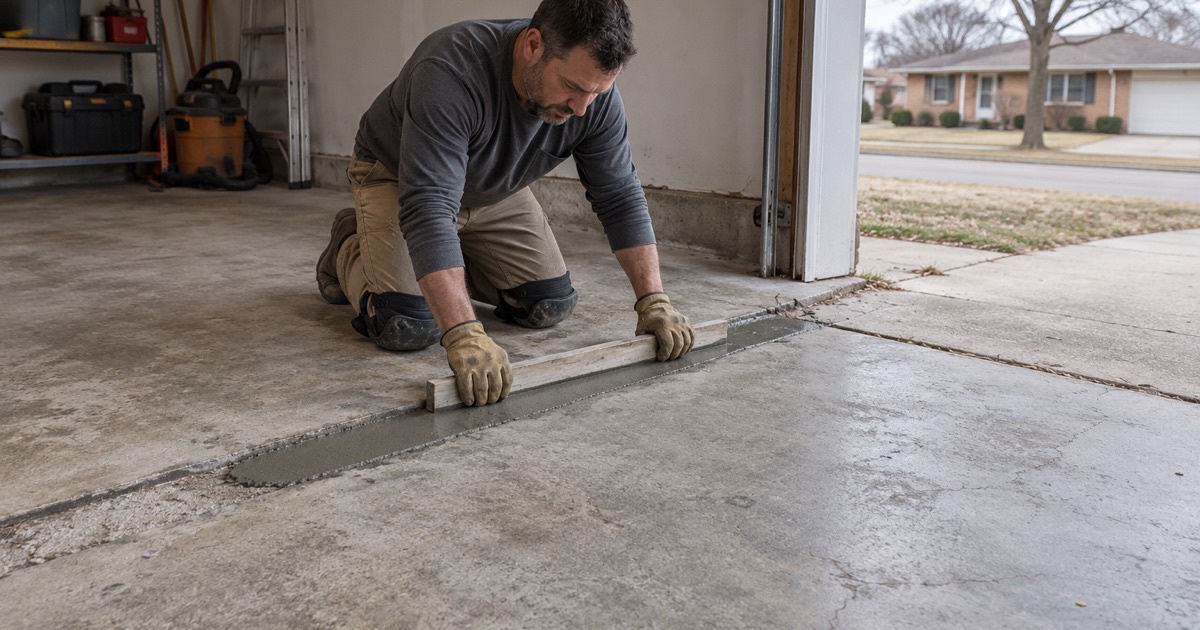
Almost every slab cracks as it shrinks while curing, leaving fine, random lines that are usually stable. Settlement cracks form when the ground beneath part of the slab compacts or washes out, and they often show a difference in height from one side to the other. Moving cracks open and close with the seasons.
We look at the width, the edges and whether the two sides have shifted vertically. A stable crack can be filled and ground flush. A moving or displaced crack needs a different approach and an honest conversation about whether it will show again.
Salt Scaling, Spalls and Pitting
Rock salt and calcium chloride brine soak into bare concrete, freeze in the pores and expand, popping off the top surface over a few winters. That scaling leaves a rough, pitted floor, especially near the garage door where the car drips first. Spalls are deeper breaks, often around cracks and joints.
All loose and weakened concrete has to come off before a repair can bond. We grind or chip back to sound material, then rebuild the surface. Patching over flaking concrete only adds a layer that falls off with it.
Heaved and Settled Slabs
Footings in this area are set below a 42-inch frost depth, but a floor slab sits on the ground near the surface, above that line. When wet soil under a garage slab freezes, it can lift sections of the floor, and when it thaws or washes out, sections can drop. The result is uneven slabs and lips at the cracks.
Small height differences can sometimes be ground down and blended. Large ones, or slabs that tip toward the house, usually point to a problem a surface repair cannot fix. We tell you plainly when a slab needs to be leveled or replaced before it can be coated.
How We Repair Concrete Floors
Crack Filling With Polyurea and Epoxy
Stable cracks are ground or routed open so the filler has clean concrete to bond to. We fill most of them with a semi-rigid polyurea that cures fast and keeps some flexibility, then grind it flush with the floor. Structural cracks in slabs that must carry heavy loads may get a rigid epoxy instead.
The choice of filler depends on whether the crack needs to stay slightly flexible or be locked solid. A rigid filler in a moving crack will just crack alongside it. We explain which material goes where and why.
Patching Spalls and Pitted Areas
Spalled areas, pits and broken joint edges are cut back to sound concrete and rebuilt with an epoxy mortar or a polymer repair compound. The patch is shaped to match the floor and ground smooth once it cures. Edges are squared so the repair has a clean shoulder rather than feathering to nothing.
On a floor that will be coated, the patch becomes part of the base for the system. On a floor that will stay bare, we choose a repair material that wears well on its own. Either way, the patch should not be the weak spot in the floor.
Resurfacing a Worn Slab
When a garage or shop floor is scaled across most of its surface, spot patching is not practical. A self-leveling or trowel-applied resurfacer can restore a smooth, sound surface over the whole slab. It is applied after the old surface is ground and any loose material is removed.
Resurfacing works on a slab that is still structurally sound underneath but worn on top. It does not fix a slab that is broken or still heaving. We test the bond on a small area before committing to resurfacing a whole floor.
Residential Concrete Floor Repair
Garage Floors Before Coating
Most garage floor repairs we do are the first step of a coating job. Cracks are filled, scaled areas near the door are rebuilt, and old patches that are failing are removed. The coating then goes over a slab that is sound from edge to edge.
Skipping repairs to save money on a garage floor rarely works. A coating over a loose patch or an open crack fails at that spot first, and the failure can spread from there. We price the repairs as their own line item so you can see what they cost.
Basement Slab Repair
Basement floors often have cracks that let in moisture, old patches around plumbing work and holes from removed fixtures. We fill and patch them so the floor is sound and flat. If water is coming through a crack, that has to be addressed before any coating goes down.
We also check for efflorescence and moisture when repairing a basement slab. A repair that bonds to dry concrete in August can fail when the water table rises in spring. Testing first helps avoid that surprise.
Commercial Concrete Floor Repair
Joint Repair Under Forklift Traffic
In warehouses and plants, control joint edges break down under hard forklift wheels and pallet jacks. The chipped edges get wider with every pass and can damage equipment and loads. We cut back the damaged edges, rebuild them with an epoxy mortar and refill the joint with a semi-rigid polyurea filler.
The repaired joint supports the wheels as they cross while still letting the slab move with temperature. For buildings along Interstate 88, we schedule this work around shifts so lanes can return to service quickly.
Shop and Warehouse Floor Repairs
Shop floors take dropped parts, dragged equipment and chemical spills, and repair needs vary from a few patches to whole bays. We plan the work so the building can keep running, often in sections, overnight or on weekends. Fast-curing repair materials shorten the downtime.
When a commercial floor is going to be coated, repairs and coating are scheduled as one job. When it is staying bare, we choose repair products that wear well under traffic. The proposal lists each repair so you can see the scope.
When a Repair Is Not Enough
Repair Versus Replacement Under DeKalb’s Code
Some slabs are too broken, heaved or deteriorated to repair economically. Replacement is a separate job with its own permits, and in DeKalb a new garage slab follows the building code adopted under Ordinance 2024-063, including the IRC R309.1 slope and curb requirements. We do not pour new concrete, but we tell you when that is the right answer.
If you replace the slab, we can coat it once it has cured enough and passed a moisture test. Planning the coating with the concrete contractor ahead of time helps the new slab start life protected.
- 20+ Years of Floor Work
- Moisture Testing in Every Scope
- Written Proposals and Contracts