DeKalb IL Epoxy Flooring has spent more than 20 years on resin floors across northern Illinois, and our epoxy-flooring in Carpentersville work keeps running into one particular mess. Garages where cars get straightened and boats get patched at home collect drips of polyester body filler and fiberglass resin. Both cure into something far harder than most owners expect, and neither wipes up the way oil or antifreeze does.
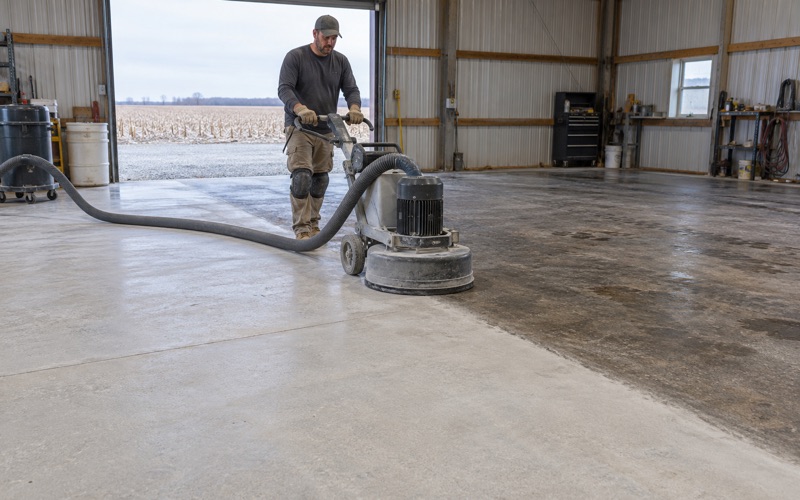
A coating can be specified with that habit in mind, but the work habits around the floor matter as much as the product. We would rather plan for the fender repair and the hull patch before a floor goes down than explain a gouged topcoat afterward. That planning starts with the slab itself, which we always open with a diamond grinder or shot blaster and never with an acid etch.
The sections below cover where this chemistry comes from, what it does once it lands on a coated floor, why the usual cleanup solvent causes trouble of its own, and how we set up a garage so filler work and a resin floor can share the same room for years.
A Resin Plant on Cottage Avenue and the Can on the Shelf
Styrene stored on the east side of the river
Carpentersville has an industrial side that many residents drive past without a second thought. The Illinois Office of the State Fire Marshal lists Polynt Composites USA at 400 East Cottage Avenue as an active facility, with a tank numbered 91 recorded for styrene and marked as currently in use. A 2018 company announcement described Polynt Americas as headquartered here, supplying unsaturated polyester resins, vinyl ester resins and gelcoat products.
We have no relationship with the plant, and we have not seen its floors or confirmed which product lines are made on site. What matters for a homeowner is the chemistry that the tank record names. Styrene is the reactive liquid that helps turn polyester resin into a hard solid, and smaller amounts of it sit on shelves in garages all over the village.
What is inside a can of body filler
The 3M safety data sheet for Bondo Lightweight Body Filler lists polyester resin at 15 to 40 percent and styrene monomer at 10 to 30 percent, with talc and magnesium carbonate making up much of the rest. The same sheet classes the filler as a Category 3 flammable liquid. Fiberglass laminating resin and gelcoat sold for boat repair follow the same general recipe of a polyester base cross-linked through styrene.
None of those retail products is tied to the plant on Cottage Avenue, and the filler brand belongs to 3M. The point is simpler than any local connection. Someone shaping a quarter panel or patching a hull in a Carpentersville garage is handling the same family of reactive resin, only by the quart rather than by the tank.
The hardener that starts the clock
The cream hardener packed with body filler is benzoyl peroxide, listed at 30 to 60 percent on 3M’s own sheet and classed as an organic peroxide. Fiberglass resin uses a liquid peroxide catalyst for the same job. Once the two parts meet, the reaction runs whether the mix is sitting on a spreader, a panel or the floor.
Looking for epoxy-flooring closer to Oswego? See Epoxy-Flooring Services in Oswego.
Minutes to Gel, Then a Lump Bonded to the Coating
Three or four minutes of working time
3M’s product page for Bondo Original Filler gives roughly three to four minutes of working time after mixing and a normal cure of 25 minutes or less. That short window is the whole problem for a floor. A drip that slides off a spreader while someone reaches for the panel stays soft for a moment, and then it becomes a hard knot of resin on the coating.
Catalyzed polyester does not simply dry on top of a surface the way spilled latex paint can. It grips whatever texture it lands on, including the vinyl flake or quartz aggregate broadcast into a textured topcoat, and cures there. On a coated garage floor that lump comes off only by scraping or grinding, and either one can take some of the coating along with it.
The soft moment is the only easy one
The best time to deal with a filler drip is while it is still soft enough to lift with a plastic scraper held flat. We tell owners to keep a scraper on the bench rather than in a drawer across the room. Once the drip has gelled, careful work with a sharp blade can sometimes shave it down, but on a thin coat or a high-gloss finish the risk of leaving a scar is real.
Fiberglass resin behaves a little differently because it is thinner and runs farther before it gels. A cup tipped on its side can spread across a broadcast floor and fill the texture before anyone notices. That turns into a repair job rather than a cleanup job, which is why we plan for it in the coating system instead of hoping it never happens.
Sanding dust settles across the whole floor
Shaping cured filler makes a fine, talc-heavy dust, and the safety sheet warns against breathing dust from cutting, sanding, grinding or machining. In a closed garage that dust drifts and settles well beyond the work area. On a textured topcoat it packs into the profile, and dragging a stiff broom across it grinds the grit against the finish.
We recommend a shop vacuum with a fine filter rather than a push broom, followed by a damp mop once the bulk is gone. The same rule we follow on our own jobs applies here on a smaller scale. Grinding dust goes into a collector at the grinder, never toward a floor drain or out the door to a storm inlet.
Acetone Belongs on a Rag, Not on the Floor
The cleanup solvent the label recommends
The 3M filler page tells users to clean tools with acetone or lacquer thinner, and that advice is right for a spreader or a mixing board. Acetone dissolves uncured polyester quickly, which is why a jug of it ends up beside nearly every bench where filler gets mixed. The trouble starts when that jug gets used on the floor to chase a drip.
Acetone only helps while the resin is still wet. Once a drip has cured, pouring solvent over it softens the floor around the lump faster than it does anything to the lump itself. That is a poor trade on a floor that cost real money to build.
What one maker’s chart says about acetone
Sika’s chemical resistance data for its Sikafloor-515 system rates acetone as limited resistance after one, three and seven days of surface exposure, and describes that rating as swelling and loss of hardness. Xylene earns the same rating on that chart, while gasoline, diesel, antifreeze and hydraulic oil are rated resistant. The chart also notes that once the chemical is cleaned off, the coating regains its properties.
That is one maker’s chart for one product, and other systems will read differently. It is still a useful warning, and it is why we never describe a floor as immune to solvents. When we propose a system for a garage where body work happens, the proposal names the product, the system build and the finished thickness, so an owner can look up that product’s own resistance data.
A short routine for solvent spills
If acetone does land on the floor, wipe it up promptly and let the area air out rather than scrubbing a softened spot. Keep the solvent in a small closed container on the bench and dispense it onto a rag, never straight from the jug onto the work. The filler’s own safety sheet advises cleaning a spill from the edges inward with an inorganic absorbent and non-sparking tools, which is a sound habit around anything flammable in a garage.
Setting Up a Carpentersville Garage for Filler and Fiberglass Work
A drop sheet, a mixing board and a scraper
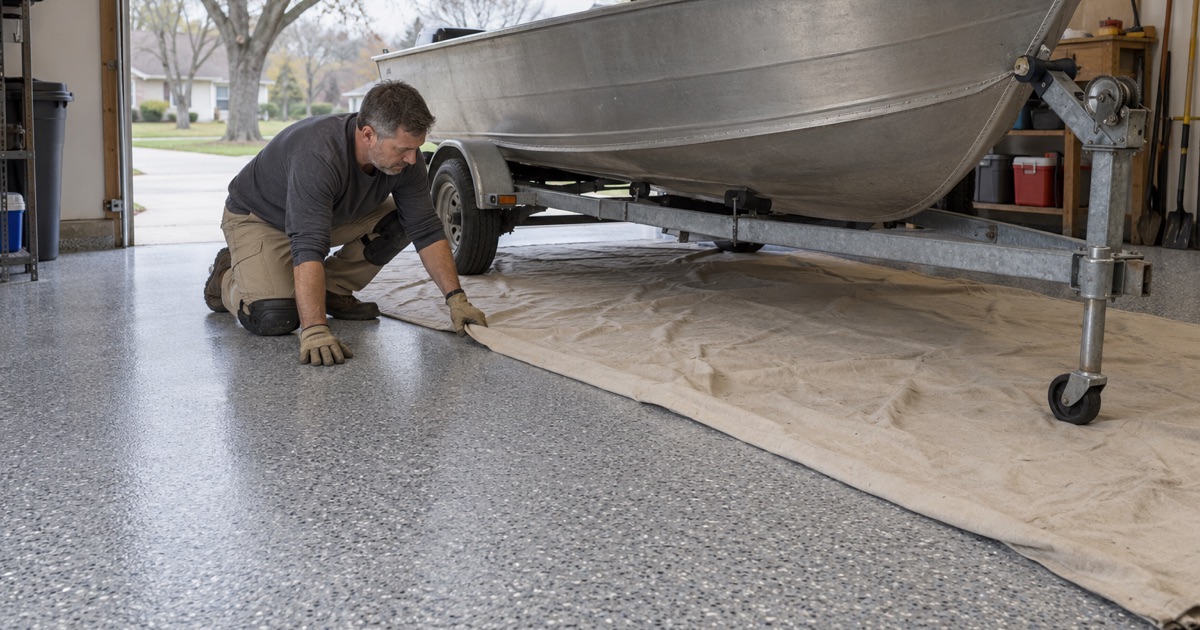
The simplest protection costs very little. A heavy drop sheet or flattened cardboard under the work area catches drips and sanding dust, and a disposable mixing board keeps catalyzed filler off both the bench and the floor. A plastic scraper within reach turns a soft drip into a ten-second fix.
For boat work or larger fiberglass jobs, we suggest taping the sheet down so a boot or a creeper wheel cannot slide it aside. The product page itself warns never to put mixed filler back in the can. Leftover mix should be left to cure on the sheet or the board, not set down on the coating.
Choosing a system for a working garage
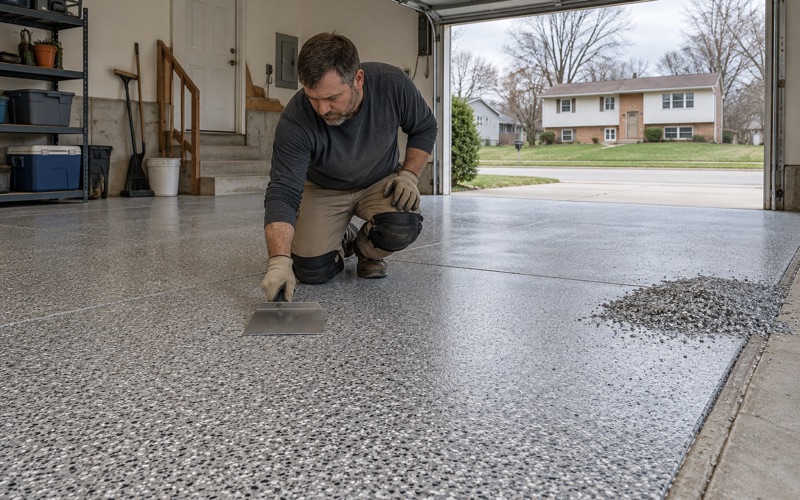
A garage that sees regular body work needs a different build than one that only parks a car. We grind the slab open first, list moisture testing as a line item in the scope, and then talk through whether a 100% solids epoxy base with a heavy flake broadcast or a tighter, smoother finish suits the way the room gets used. Heavy flake hides small scars, while a smoother surface lets a scraper lift a drip more cleanly.
The age of the house shapes the conversation too. Census figures put about 36.7 percent of Carpentersville homes in the 1950s and 1960s and another 39.1 percent in the 1990s and 2000s, so we see older slabs with decades of wear alongside newer garage floors still in good shape. We read the cracks, joints and any old coating before quoting, and we say so when a slab needs repair before it can be coated.
Winter, salt and curing schedules
The nearest long-term weather station, in Elgin, records 139.2 nights a year at or below 32 degrees, so we schedule curing against slab temperature and dew point rather than the calendar. When an unheated garage cannot hold the temperature a coating needs, we say plainly that it has to wait for spring. The finished floor also has to stand up to the calcium chloride brine and rock salt that tires carry in all winter.
Registration and paperwork before work starts
Since January 1, 2025, the Village of Carpentersville has required every contractor and subcontractor to register, with a certificate of insurance naming the village and a 10,000-dollar surety bond. Illinois issues no state license for flooring or coatings work, so we confirm that village registration before a job goes on the calendar. Whether a floor coating alone needs a village permit is a question we put to Community Development at the time of the job.
Every home job also gets a written contract and the state’s consumer-rights pamphlet before work begins, as the Illinois Home Repair and Remodeling Act requires. Our coatings are chosen within the Illinois VOC limit for floor coatings, a rule that binds whoever applies the product as well as whoever makes it. Warranty exclusions are read out before the job is sold, with moisture named first.
- 20+ Years of Floor Work
- Moisture Testing in Every Scope
- Written Proposals and Contracts