DeKalb IL Epoxy Flooring brings more than 20 years of floor coating work to epoxy flooring in Campton Hills, and the request we expect to hear most from owners here is not about color or flake size. It is about the brown marks on the garage slab that no amount of mopping removes. Those marks have a cause, and the cause shapes how we prepare and build the floor.
Our method does not change from one driveway to the next. Every slab is opened with a diamond grinder or shot blaster, never acid etched, and a moisture test sits on the written scope as its own line rather than turning up as an excuse after a coating has blistered. The proposal names the product, the system build and the finished thickness, so you can check what was quoted against what went down.
What follows explains why fallen leaves matter more to a concrete floor in this village than in most places, how leaf tannin gets into bare concrete, how we lift those stains without acid before a coating goes on, and what fall habits keep a finished garage or barn aisle looking clean.
Why Campton Hills Leaves Stay on the Property
The leaf-burning ban and the compost advice
The Village of Campton Hills publishes a flyer headed LEAF BURNING IS PROHIBITED, and it is blunt: leaf burning is prohibited in Kane County and the village no matter the zoning designation or zip code. Brush is the only material that can be burned legally, meaning trunks, limbs, branches and twigs. Larger brush piles are allowed only on sunny days between 9:00 a.m. and 3:00 p.m., with wind under 10 mph and the pile kept at least 20 feet from any building.
The second page of the flyer gives the reason residents remember. It says burning leaves can be extremely toxic to horses even if the burning is far away, and that the best way to dispose of leaves is to compost them. The flyer names no village leaf pickup, so every leaf that falls on a lot is the owner’s to rake, pile and compost.
Where the leaves end up
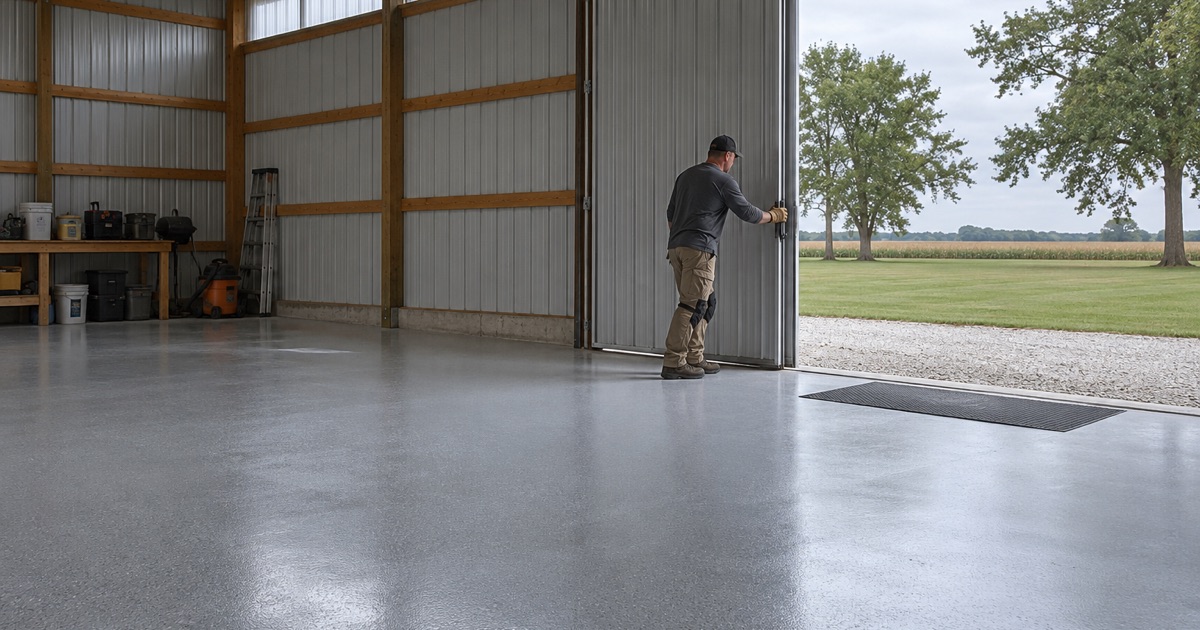
On a wooded lot that adds up to a lot of leaves, and they do not all make it to the compost bin. They blow against the garage door and slip under the seal, they ride in on boots, mower decks and wheelbarrow tires, and they collect in the corners of a barn aisle beside the paddock gate. A wet leaf that lands on bare concrete and sits there for a day or two is how the trouble starts.
None of this is a complaint about the ordinance. Keeping leaves on the property is a sensible rule for a village where horses share the neighborhood, and it simply means the garage and barn floors here see more wet leaf litter each fall than floors in a town with curbside collection.
An owner’s village on acre lots
Campton Hills was incorporated on May 14, 2007, and today it is almost entirely owner-occupied detached houses: 3,595 of them, against 48 renter households in the whole village. The person who books a floor almost always lives on it, sweeps it and will see it every fall for years. That is the customer we write our proposals for.
The estate districts under the Zoning Ordinance of 2024 set minimum lots of 1.25, 2 and 4 acres, and equines and barnyard animals are permitted in the RE-1 through R-1 districts. Large lots with mature trees and a horse or two are exactly the setting where leaf litter reaches both the house garage and the barn.
Looking for epoxy-flooring closer to Hampshire? See Epoxy-Flooring in Hampshire.
Tannin and the Brown Prints on Concrete
Why wet leaves stain and dry ones usually do not
A syndicated Washington Post home column by Jeanne Huber, published December 27, 2022, put it plainly: leaves of many trees stain concrete if they are not cleaned up promptly. The culprit is tannin, which is water-soluble, so a wet leaf releases it and leaves a brown or reddish-brown print. Dry leaves usually do not stain, which is why the damage shows up after a rain or after someone drags a wet pile across the floor.
The print is often a near-perfect outline of the leaf, veins and all, and it tends to cluster where water sits longest. On a garage slab that means the strip just inside the overhead door and the low corners where melt and rain collect.
Bare porous slab versus a sealed coating
Broom-finished concrete is porous, so tannin dissolved in water soaks into the surface paste and dries there. Scrubbing moves the leaf and leaves the stain, because the color is now inside the top of the slab rather than on it. A densifier alone tightens that surface somewhat, but it does not put a film between the leaf and the concrete.
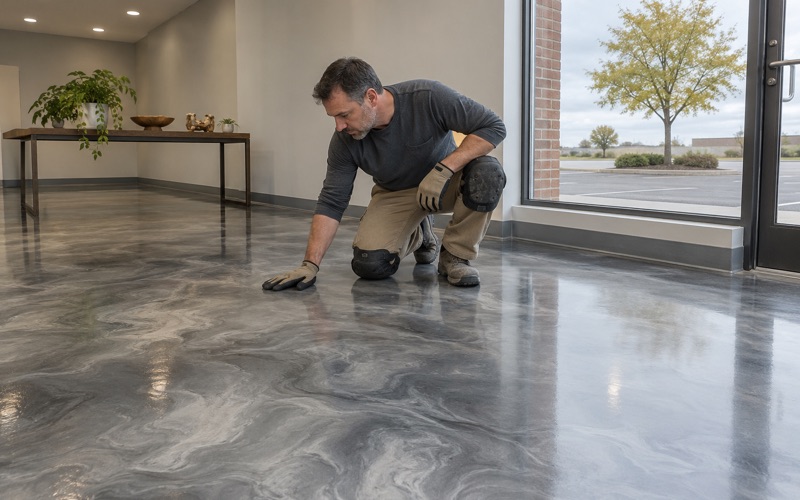
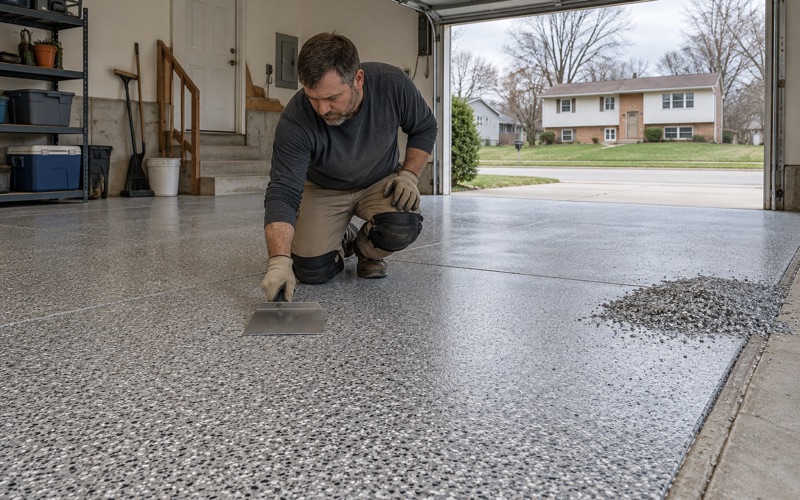
A sealed, nonporous coating changes where the tannin goes. A 100% solids epoxy base with a polyaspartic topcoat gives the dissolved tannin nothing to soak into, so it stays on top where a broom and a damp mop can take it off. On a barn aisle or a garage that sees leaves every October, that is the practical difference between a floor that stains and a floor that cleans.
What a coating does not promise
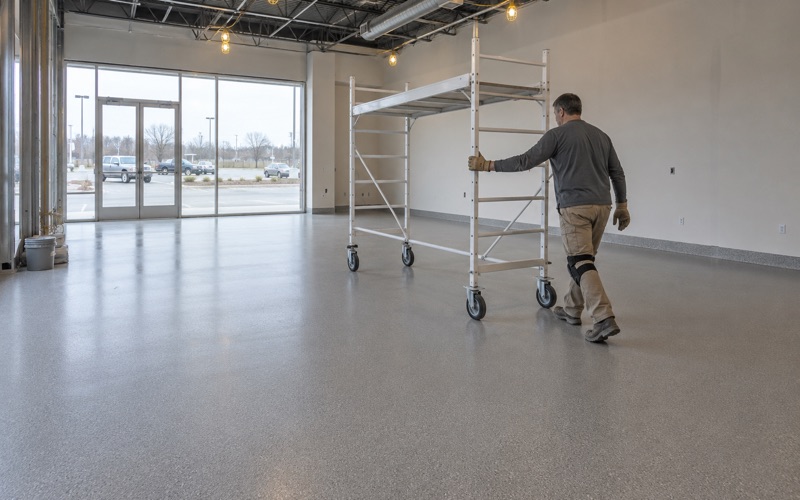
We do not sell any coating as stain-proof. Tannin left to sit for weeks under a wet pile can still shadow a light-colored finish, especially a solid gray or tan without flake to hide it. A vinyl flake broadcast in a mixed color hides a brief stain far better than a solid coat, and we will say so when you are choosing a finish.
The coating also does not replace clearing the leaves. It buys time between a leaf landing and a mark forming, and it makes the cleanup a mop job instead of a chemical one, but the leaves still have to be swept out.
Lifting Leaf Stains Before We Coat
Oxygen cleaner, not acid
A leaf-stained slab is cleaned before it is coated, both so old prints do not show through a clear or translucent system and so leftover tannin is not sitting under the bond line. The same Washington Post column recommends sodium percarbonate, the active ingredient in OxiClean, mixed with warm to hot water and mopped on, then rinsed with a garden hose rather than a power washer, because high pressure can erode concrete.
The column also warns that strong acids break down concrete and that acidic cleaners, vinegar included, are best avoided, and that bleach can strip color and damage a sealer. Those are the rules we follow. A muriatic acid wash may lighten a stain, but it attacks the cement paste, and any cleaner left behind is one more thing between the slab and the primer.
Grinding opens the surface the right way
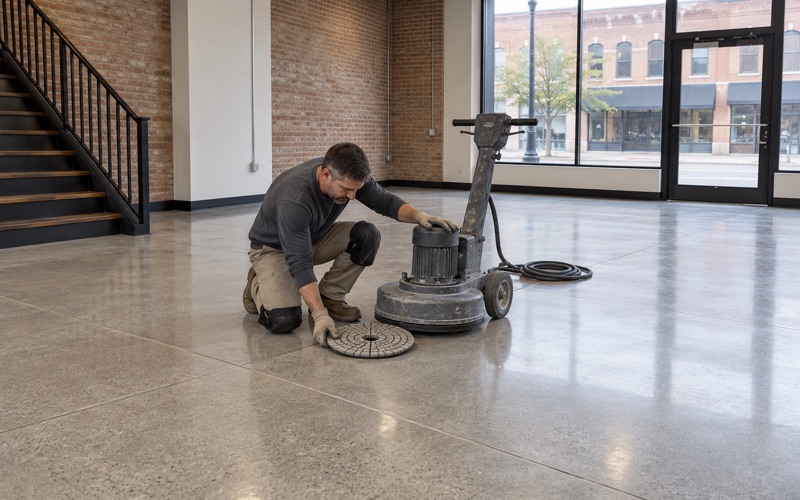
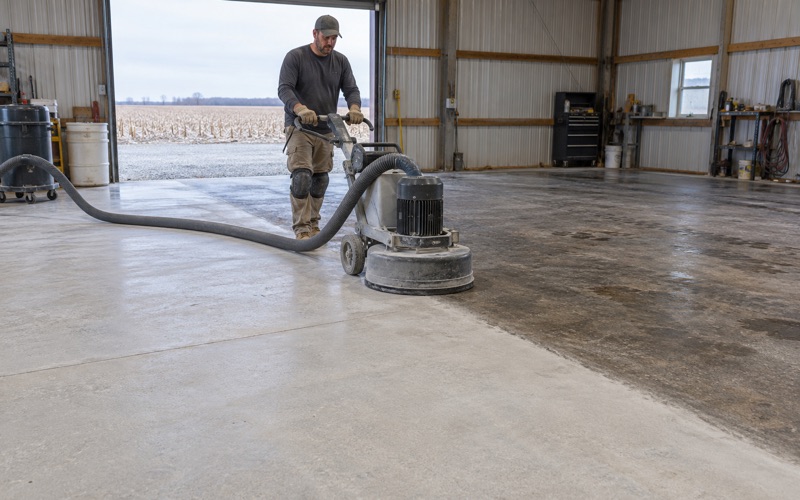
Once the stains are lifted and the slab is rinsed and fully dry, we open it mechanically. Diamond grinding or shot blasting cuts the surface to an ICRI CSP profile the system calls for, and it removes the top layer where any faint remaining tannin sits. This is the reason we do not acid etch at all: grinding gives a measurable profile without putting acid on the concrete.
Grinding dust is collected at the grinder by a vacuum, not hosed toward a floor drain. On a garage or barn floor that has seen years of leaf litter, the fresh surface under the grinder is usually sound and clean, and that is what the primer needs.
Moisture, cracks and old sealer
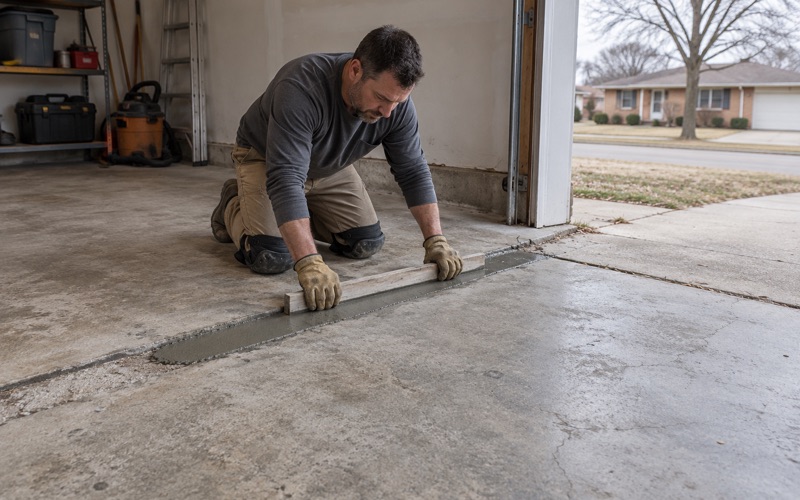
Most Campton Hills houses were built between the 1970s and the 2000s, so a slab here is often 25 to 55 years old and may already carry an earlier sealer or coating. We read the cracks, the joints and whatever is on the surface before quoting, and we say plainly when a slab needs repair or replacement before it can be coated. Cracks and joints are filled with a semi-rigid polyurea joint filler where they are stable.
Moisture testing runs before any coating is chosen, using ASTM F1869 calcium chloride tests or ASTM F2170 relative humidity probes depending on the slab. If the numbers call for a moisture-mitigation primer, it goes on the proposal, and our warranty exclusions are read to you before the job is sold, with moisture named first.
Fall Habits for Garages and Barn Aisles
Sweep wet leaves out promptly
October and November are the months that decide how a Campton Hills floor looks in spring. On a coated garage or barn aisle, a quick sweep after a wet, windy day and a damp mop where leaves sat are usually all it takes. The goal is to get leaves off before they sit wet for days, coated floor or not.
A walk-off mat inside the overhead door and a boot brush at the barn entrance catch a surprising share of the leaf litter before it spreads. Mowers and wheelbarrows coming in from leaf duty are worth knocking off outside, since their decks and treads hold wet leaves against the floor overnight.
Keep the compost pile away from the garage wall
The village asks residents to compost, and a compost pile is a good place for leaves, but not against the garage wall or beside the overhead door. A pile there stays wet, leaches tannin-stained water toward the slab edge and the door threshold, and keeps feeding leaves onto the floor every time the door opens. Set the bin a few paces off the building and on soil, not on the apron.
No coating makes a compost pile safe to keep inside a garage or barn. Wet organic matter belongs outdoors, and the floor is easier to keep clean when the leaves never reach it in the first place.
Building the garage floor for winter as well
The same sealed surface that keeps tannin on top also has to stand up to calcium chloride brine and rock salt that tires carry in from plowed roads all winter. We build garage systems with that in mind, with a topcoat that resists the salt and a broadcast that gives traction when the floor is wet. A floor chosen for leaf season alone would be half a decision.
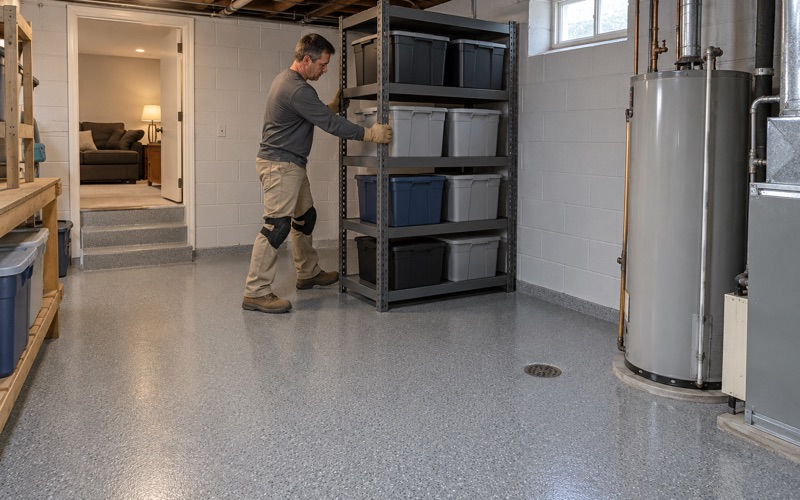
Our coatings are chosen within the Illinois limit on VOC content, which binds the installer as well as the manufacturer. For a basement floor, we start with where any water is coming from and say plainly that a coating is not waterproofing.
Paperwork before the first pass
Every home job gets a written contract and the state’s Home Repair: Know Your Consumer Rights pamphlet before work starts, as the Illinois Home Repair and Remodeling Act requires. Prices are quoted per square foot for the system we actually propose, not a national per-garage figure. Illinois issues no state license for flooring or coatings, so we confirm the village’s own contractor registration, bond and insurance rules before a job goes on the calendar.
Permits in the village run through the Village of Campton Hills Building and Zoning Department. Its permit list names finished basements and remodels but not a stand-alone floor coating, so when a coating is part of a larger basement finish, whether a permit is needed is the department’s call, and we will ask before we schedule.
- 20+ Years of Floor Work
- Moisture Testing in Every Scope
- Written Proposals and Contracts