DeKalb IL Epoxy Flooring has spent more than 20 years putting down epoxy flooring in Belvidere and across northern Illinois, and one kind of floor here is judged on something most coatings never are. It has to give up its dust completely, every time it is swept. That is a different target from a garage floor that only has to look good and shrug off salt.
On a grain-handling floor, the question is not how glossy the finish looks on the first day. It is whether a broom or a vacuum can take the surface back to bare, and whether anyone walking past can see dust building before it becomes a problem. Pitted, cracked and open-jointed slabs fail that test long before they look worn out.
This page walks through the federal rule that sets the dust line, why worn concrete works against it, how we build a floor that cleans down to nothing, and how floor work fits around a facility that cannot simply stop running. The same thinking carries down to a farm machine shed or a grain-bin service floor.
A Grain Warehouse on West Locust Street and the 1/8-Inch Line
A Family Grain Business With Roots Back to 1957
Belvidere is the county seat of Boone County, settled on the Kishwaukee River in far northern Illinois and part of the Rockford metropolitan area. Grain handling is part of its working life. Central Grain Company, at 1140 West Locust Street inside the city, describes its work as federal warehouse storage and merchandising, a family business whose roots go back to 1957.
We have not been inside that facility, and it is not one of our customers. We name it because it shows the kind of floor this page is about: the floors around elevators, dryers and grain equipment, where the rule on dust is written in fractions of an inch.
What the Grain-Handling Standard Asks of a Floor
The federal standard for grain handling facilities, 29 CFR 1910.272, exists to control grain dust fires and explosions. Its housekeeping section requires a written program to reduce accumulations of fugitive grain dust on ledges, floors, equipment and other exposed surfaces. Fugitive grain dust means the combustible particles from the handling system that are fine enough to pass a US Standard 40 mesh sieve, 425 microns or less.
Some floors get closer attention than others. The rule names priority housekeeping areas that include floor areas within 35 feet of inside bucket elevators, floors of enclosed areas containing grinding equipment, and floors of enclosed areas containing grain dryers located inside the facility.
Why 1/8 Inch Is the Number That Matters
In those priority areas, the employer must immediately remove fugitive grain dust whenever accumulations exceed 1/8 inch, or demonstrate equivalent protection. That is a thin layer, and the floor is measured against it all the time, not once a year.
Spilled grain and product are treated differently: they do not count as fugitive dust accumulations, though the housekeeping program still has to cover removing them. For a floor, the practical result is simple. Whatever the surface is made of, it has to let a crew get dust back below that line quickly and completely.
Looking for epoxy-flooring closer to West Dundee? See Epoxy-Flooring Services in West Dundee.
Why Worn Concrete Holds Dust After a Sweep
Where the Fines Hide
Bare concrete that has seen years of traffic is rarely flat at the scale grain dust lives at. Pitting, surface spalls, popouts, an uneven broom texture and saw-cut joints that were never filled all leave low spots below the general surface. A broom rides over them and a vacuum head bridges them, so the fines stay behind.
The floor can look swept from standing height and still hold dust in every pit and joint line. That residue becomes the starting point for the next accumulation instead of zero. On a floor measured in eighths of an inch, starting above bare matters.
Reading the Slab Before We Quote
Before we price a grain-handling or farm floor, we walk it and read the cracks, joints and any old coating. Some damage is ordinary wear that grinding and filling will correct. Some is a slab that is breaking up, heaving or delaminating, and then we say plainly that it needs repair or replacement before anyone coats it.
Old coatings get the same scrutiny. A peeling paint or failed sealer holds dust at every lifted edge and has to come off entirely, which changes both the scope and the price.
Moisture Is Still a Line Item
A grain floor is still a slab on ground, and a slab can push moisture up into a coating from below. Moisture testing is written into our scope as a line item, using calcium chloride testing under ASTM F1869, in-situ relative humidity probes under ASTM F2170, or a plastic sheet test under ASTM D4263 as the slab calls for. Where readings run high, we specify a moisture-mitigation primer rather than hoping for the best.
Moisture is also the first warranty exclusion we read out before a job is sold. A coating that blisters off a damp slab leaves exactly the kind of lifted edges and loose flakes a dust-sensitive floor cannot afford.
A Floor That Vacuums to Bare and Shows Dust Early
Opening the Surface Without Acid
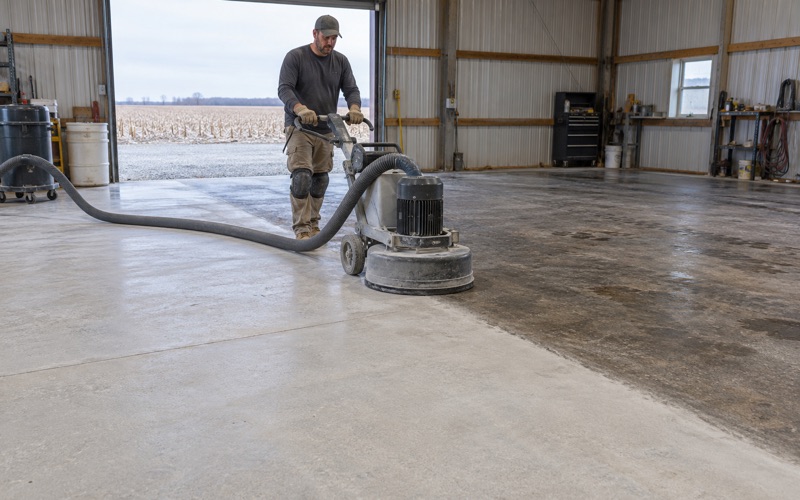
Every slab we coat is opened with a diamond grinder or shot blaster to the profile the system needs on the ICRI CSP scale. We do not acid etch. Grinding takes off the weak top layer, old coatings and contamination, and it brings high spots down so the finished floor has fewer places for dust to settle.
Our grinders run with dust collection at the head, so the dust we make is captured as it is made rather than swept up later. None of it is washed toward a floor drain or storm inlet.
Filling Joints and Cracks Flush
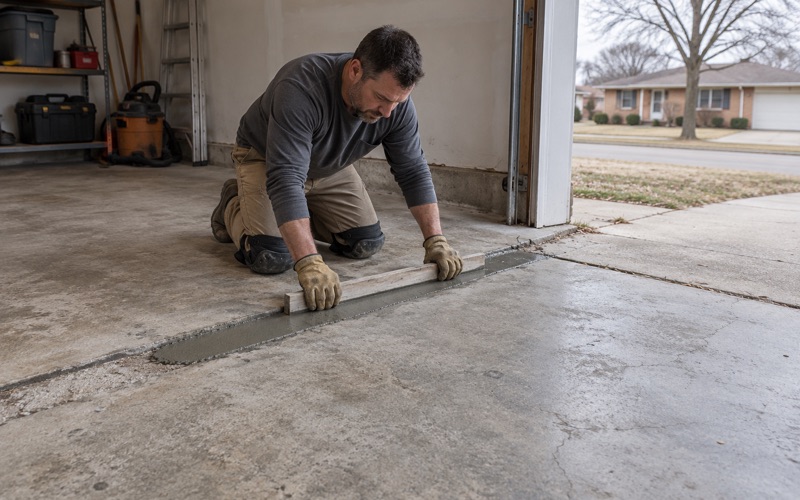
Open joints are the longest dust traps on most working floors. We fill control joints and routed cracks with a semi-rigid polyurea joint filler, then shave it flush with the surface so a squeegee or vacuum crosses without catching. Pits and spalls are patched before the base coat goes down.
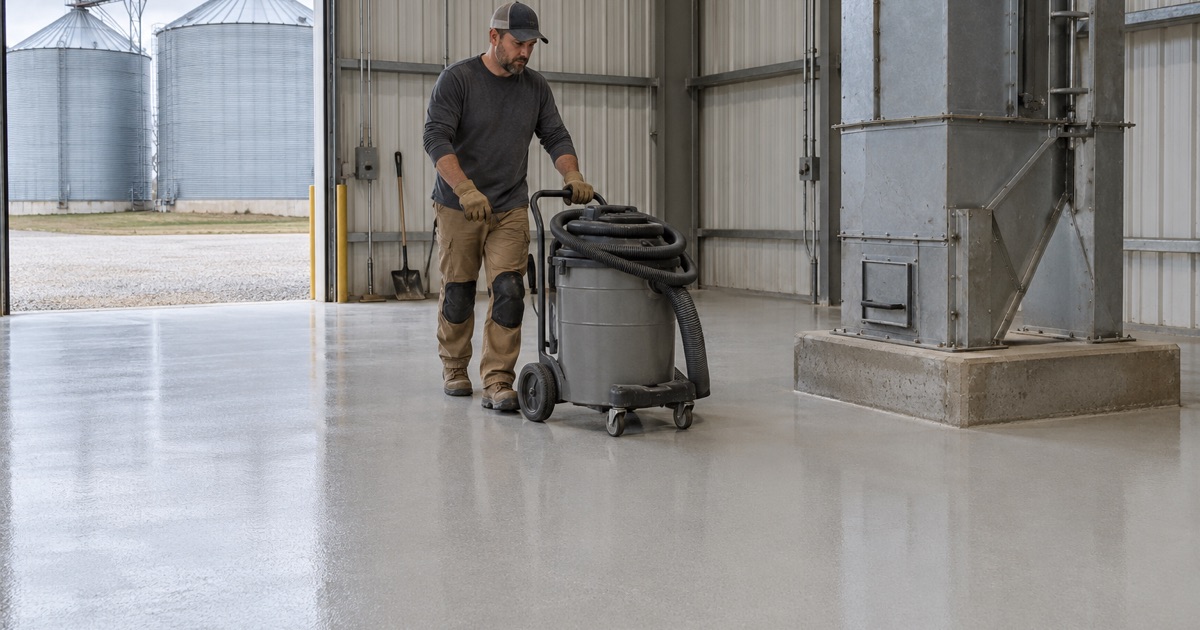
A sealed, filled surface changes how housekeeping works. Instead of chasing dust out of grooves, a crew can vacuum or sweep the floor to bare in one pass, and nothing is left underneath for the next layer to build on.
Choosing a System That Cleans
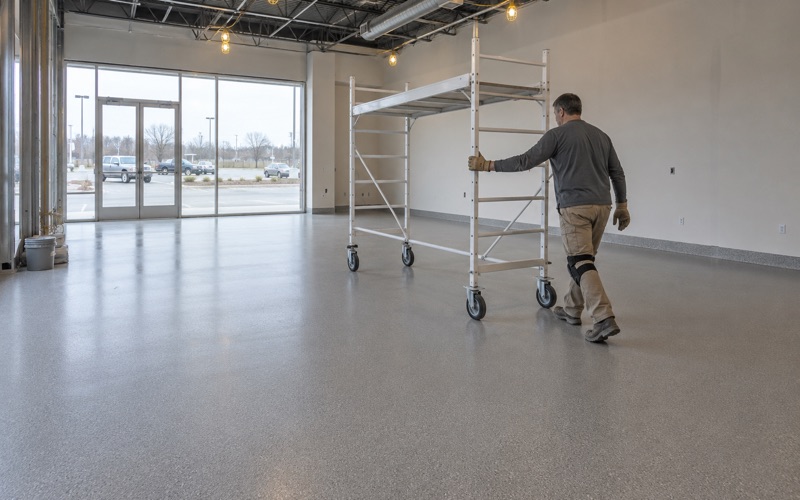
Where cleaning matters more than decoration, we usually lean toward a 100% solids epoxy base with a smooth or lightly textured topcoat rather than a heavy vinyl flake or quartz aggregate broadcast. Texture still has its place where footing matters, and we weigh slip resistance against how easily the surface gives up dust.
The proposal names the product, the system build and the finished thickness. That way what was quoted can be checked against what actually went down.
A Light Color as an Early Warning
Grain dust on dark gray concrete is easy to miss until it is thick. A light-colored coating shows a film of dust well before it reaches the 1/8-inch line, so the floor itself becomes a signal that a priority area needs attention. That is a practical housekeeping aid, not a measurement.
What a coating does not do is protect against an explosion or satisfy the housekeeping standard on its own. The rule is met by the facility’s written program and the people who carry it out. A floor that cleans easily only makes that program easier to keep.
Doing Floor Work Inside a Working Elevator
Grinding and Coating Are Dust and Ignition Work
Surface preparation makes its own dust, and grinders, blasters and some coating equipment can be ignition sources. Inside a grain facility, that means our work is scheduled within the operator’s own program, not around it. Equipment in the area is shut down, existing dust is removed first, and we follow whatever ignition controls the facility sets.
The standard is strict even about routine cleaning: compressed air may blow dust from ledges and walls only when ignition-source machinery is shut down and other ignition sources are removed or controlled. We bring the same caution to work that makes far more dust than a broom. We install floors and give no combustible-dust advice, so the facility’s own people decide when an area is ready for us.
Shutdown Windows and Cure Time
A grain operation has stretches when it cannot stop, and we plan around them. Shop, warehouse and farm floors are scheduled into the hours a building can spare, including overnight and weekend windows, and a priority area can be done in sections so the rest of the site keeps moving. Curing is scheduled against slab temperature and the dew point spread at the surface rather than the calendar.
An unheated grain building or machine shed in a Belvidere winter may simply be too cold for resin to cure properly. When that is the case, we say so and book the job for spring rather than leave a soft floor that holds dust worse than the bare concrete did.
Machine Sheds and Grain-Bin Service Floors
The same logic carries down to the farm. A machine shed where combines and grain carts come in off the field, or the service floor beside a set of grain bins, collects corn dust and chaff in every crack and joint. A sealed, joint-filled floor there sweeps to bare after harvest instead of holding a season of chaff.
Farm shop floors also take tracked-in calcium chloride brine and rock salt every winter, so the topcoat we choose has to handle deicers as well as dust. Where a shop doubles as a home garage, the same build carries over.
Permits, Contracts and VOC Limits
Illinois issues no state license for flooring or coatings work, so before we schedule a Belvidere job we confirm the city’s own contractor registration, bond and insurance rules. The City of Belvidere Building Department administers the 2021 codes the city adopted under Ordinance 703H, and any new concrete or structural repair runs through that office.
Every coating we use stays within the Illinois Administrative Code Part 223 limit on VOC content, which binds the installer as well as the manufacturer. Home jobs get a written contract and the Home Repair: Know Your Consumer Rights pamphlet before work begins, as the Illinois Home Repair and Remodeling Act requires. Every price is quoted per square foot for the system we actually propose.
- 20+ Years of Floor Work
- Moisture Testing in Every Scope
- Written Proposals and Contracts