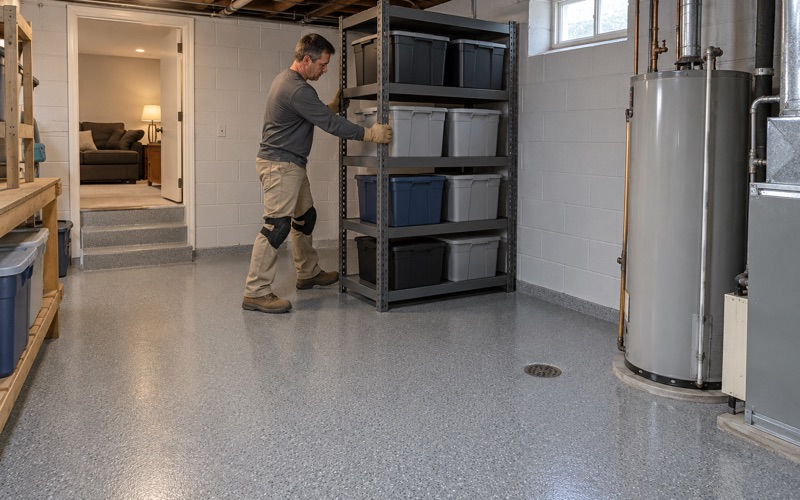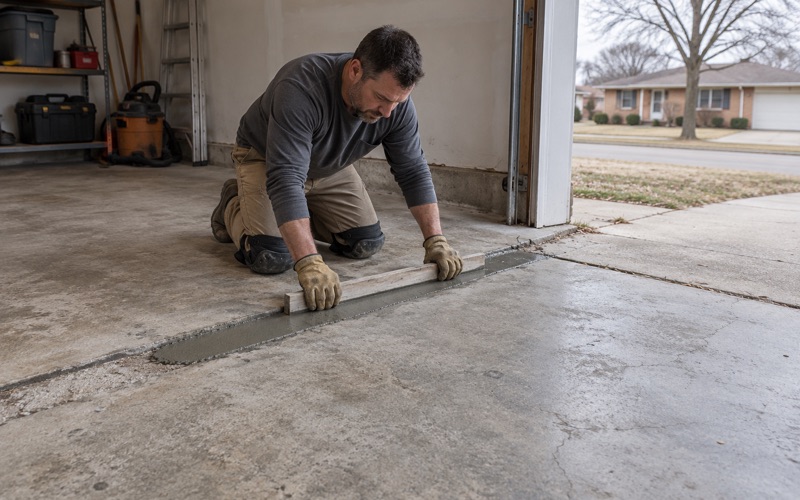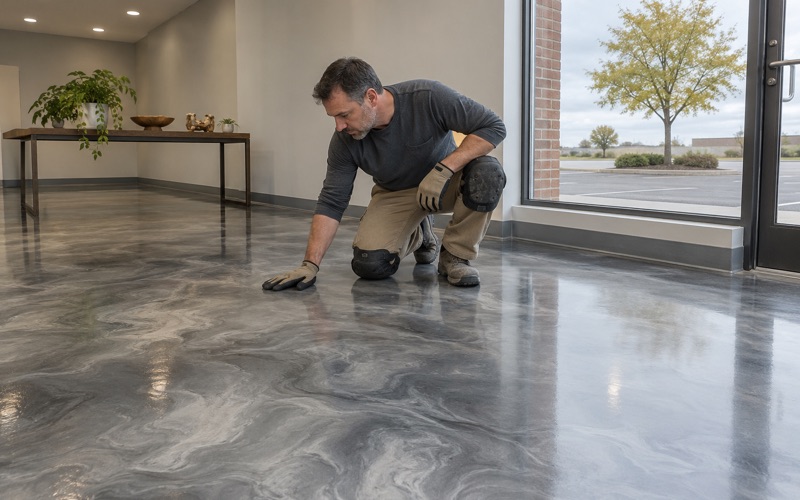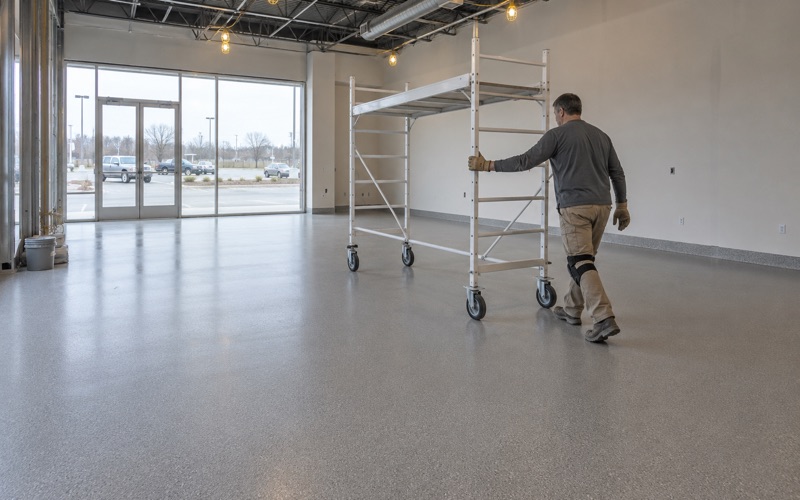
DeKalb IL Epoxy Flooring has spent more than 20 years putting down epoxy flooring in Batavia, on home garages, basements, shops and commercial floors. On a basement job here, the first question we ask is not which flake color to broadcast. It is where the water under the slab is coming from.
That order matters because a floor coating is bonded to the top of the concrete. It can stand up to what lands on it, from salt brine to dropped tools, but it cannot hold back water rising through the slab, and no maker whose products we install claims that it can.
So our scope opens with moisture testing as its own line item, priced before anything else. If the readings come back dry, we grind the slab and build the system named in the proposal. If they do not, we say so, point the owner toward drainage work first, and come back when the floor tests ready.
Batavia, Illinois: A Quarry Town Built on Stone
At least ten quarries by 1860
The Batavia Historical Society traces local quarrying to 1834, when Joseph Lyon dug limestone to line the walls of his well, and commercial quarrying followed from 1842. By the society’s count, Batavia had at least ten quarries operating in 1860. Barker’s quarry on the west side, opened in 1852, was the largest, with 35 to 40 men working it by 1887.
A great deal of that stone went into the rebuilding of Chicago after the 1871 fire, and many stone buildings still stand in Batavia. The city’s Government Center occupies the remaining 1901 Appleton Manufacturing building on North Island Avenue. The quarries themselves closed shortly after 1900, when the city banned further mining over blasting concerns.
Dolostone close to the surface
The rock those crews cut is Silurian dolostone. The Illinois State Geological Survey’s Aurora North bedrock map shows it just below the bedrock surface across most of the quadrangle, and along the Fox River it is covered by less than 10 feet of alluvium and colluvium. Several large quarries there expose as much as 30 feet of cherty and non-cherty dolostone.
That map works at the scale of a quadrangle, not a house lot. We have not measured bedrock depth under any Batavia address, and we would not guess at one from a regional map. What it does tell us is that stone sits close to the surface in parts of this city, which is reason enough to test a basement floor before we quote it.
Underground springs in the old pits
The historical society also records what happened once the digging stopped: water seepage from underground springs filled the holes made by the west side quarries. Rock that can fill an open pit with spring water is rock that moves water through its fractures and bedding planes.
Where a basement slab sits on or near rock like that, moisture can reach the floor from underneath rather than from the room above. That is a description of the setting, not a reading of any one home. It is why each Batavia basement gets tested on its own terms instead of being judged by the house next door.
Looking for epoxy-flooring closer to Marengo? See Marengo Epoxy-Flooring.
Water From Below and Why Epoxy Cannot Stop It
What negative-side pressure means
Contractors who deal with below-grade water talk about the positive side and the negative side of a wall or floor. The positive side faces the water, while the negative side is the face you walk on. A basement floor coating always goes on the negative side, so any water pushing up through the slab reaches the coating from behind.
When the soil or rock under a slab is saturated, hydrostatic pressure drives water and vapor upward through the concrete. A coating bonded to the top surface has nothing resisting that push except its grip on the concrete. Over time the bond lets go as blisters, soft spots or peeling patches, usually at the lowest part of the floor first.
What the product data sheets say
Manufacturers are direct about this limit. The Sikafloor-264 product data sheet states that the product is not designed for use against water on the negative side, and it tells installers to ensure there is no vapor drive at the time of application. It names the ASTM D4263 plastic sheet test as one visual indication of vapor drive.
We take that language at face value. An epoxy is not a membrane that holds back groundwater, and it is no defense against rising water, so we will never describe one that way. If a floor shows active moisture coming up through it, the coating conversation waits.
White bloom is a separate signal
Owners sometimes ask whether a white powder on the basement floor means the same thing. That bloom is efflorescence, the salt left behind as moisture evaporates, and it still calls for testing. Liquid water under pressure from the rock is the more serious condition, and it is the one that stops a job outright.
Drain First, Then Test the Slab
Finding where the water comes from
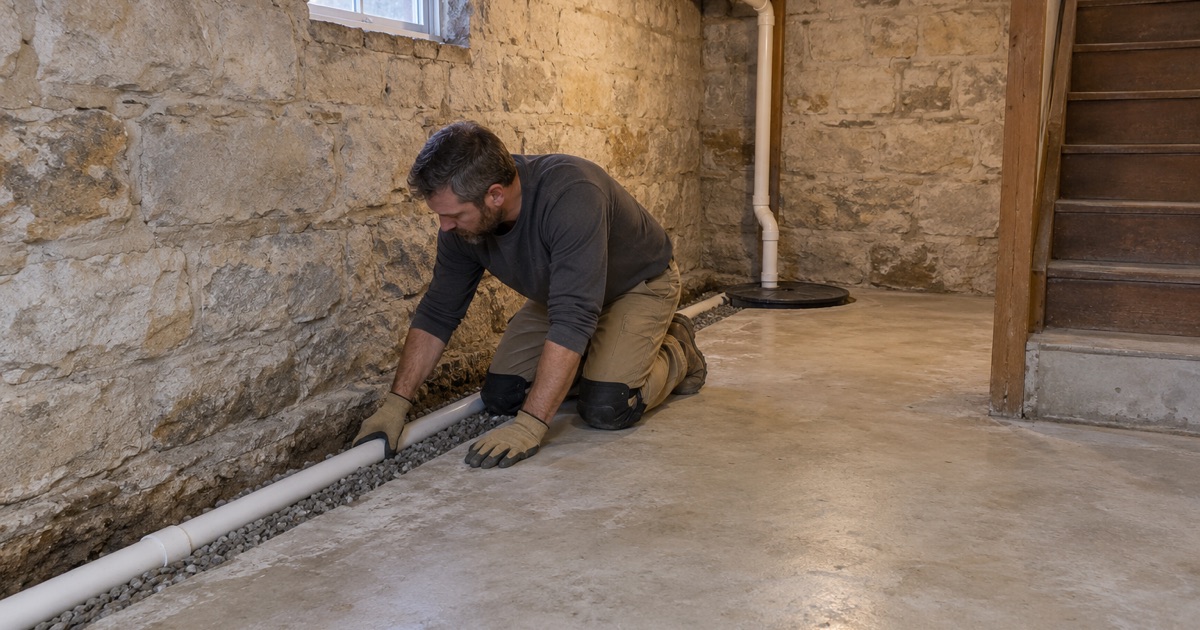
A basement job starts with the water source. Spring water moving through fractured stone, a failed perimeter drain tile, a sump pit that cannot keep up, and surface runoff aimed at the foundation all produce a wet floor, and each one has its own fix. None of those fixes is a coating.
We do not install drain tile, sumps or drainage systems of any kind, and we say that at the first visit. When a slab shows standing water or a damp edge, we recommend the owner bring in a drainage contractor. We come back once that work is done and the concrete has had time to dry out.
Sump discharge and the city’s sewers
Drainage work in Batavia touches the city’s sewers, so it is worth asking the Building Division where a sump is allowed to discharge before anything is piped. A June 2015 Daily Herald report described residents with flooded basements even in areas with separate storm sewers, because rainwater was infiltrating the sanitary sewers.
The Building Division works out of the Government Center and can be reached at 630-454-2700. A sump line that has to be rerouted after the fact means opening the floor again, and a floor coated before that correction is a floor that gets disturbed twice.
The tests that make the call
Once the water source is handled, moisture testing decides the next step. We use ASTM F2170 in-situ relative humidity probes set into the slab, a concrete moisture meter and the ASTM D4263 plastic sheet test, and on larger floors we add ASTM F1869 calcium chloride testing.
The Sikafloor-264 data sheet gives a clear ladder for the numbers. Concrete moisture no higher than 4 percent by mass, or relative humidity no higher than 85 percent under ASTM F2170, suits the standard system. Between 85 and 96 percent the maker calls for a moisture-tolerant primer, Sikafloor-1620, and at 96 percent or more it moves to a urethane cement.
When the answer is not yet
Some readings mean no coating at all for now. We would rather tell an owner that than install a floor the warranty will not cover. Our warranty exclusions are read out before the job is sold, with moisture named first, so nobody learns about them after a blister appears.
How We Build a Batavia Floor That Tests Dry
Opening the slab
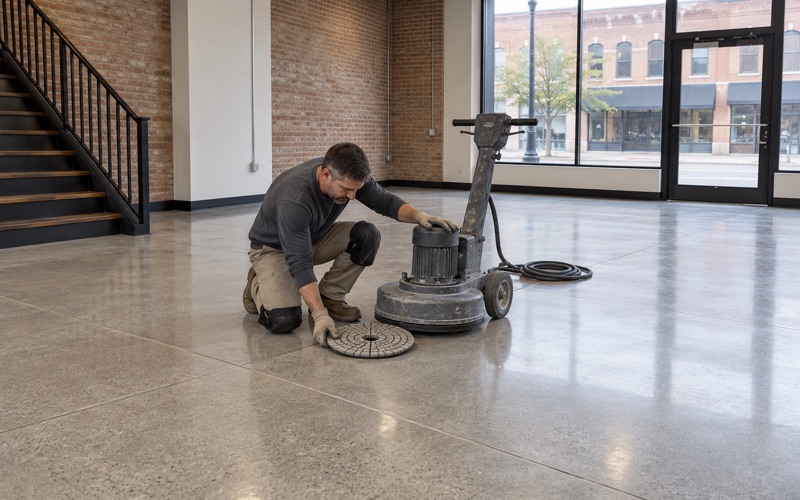
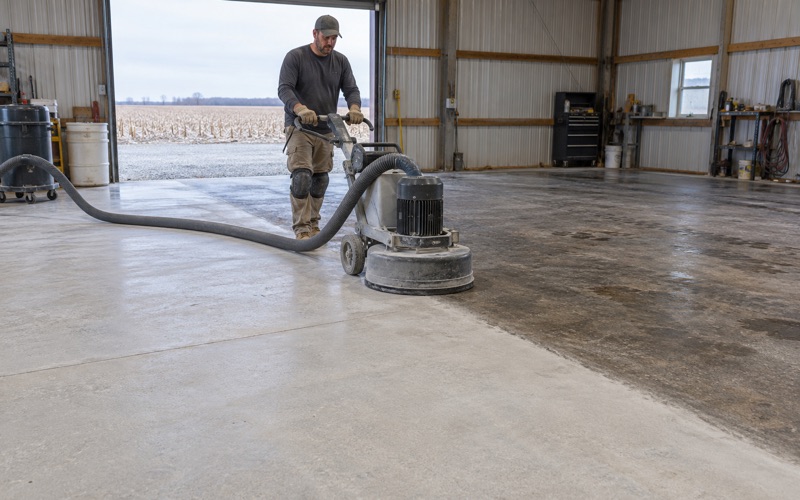
A slab that passes testing is prepared mechanically. We use a diamond grinder or a shot blaster to open the surface to the profile the system calls for, and we never acid etch. Grinding dust is collected at the grinder, so none of it gets washed toward a floor drain or a sump pit.
Before quoting, we also read the cracks, the joints and any old coating on the floor. Some older slabs need repair before they can be coated, and a few need replacement, and we say so plainly. Joints and cracks that stay in the floor get a semi-rigid polyurea joint filler where the system calls for one.
Choosing the system
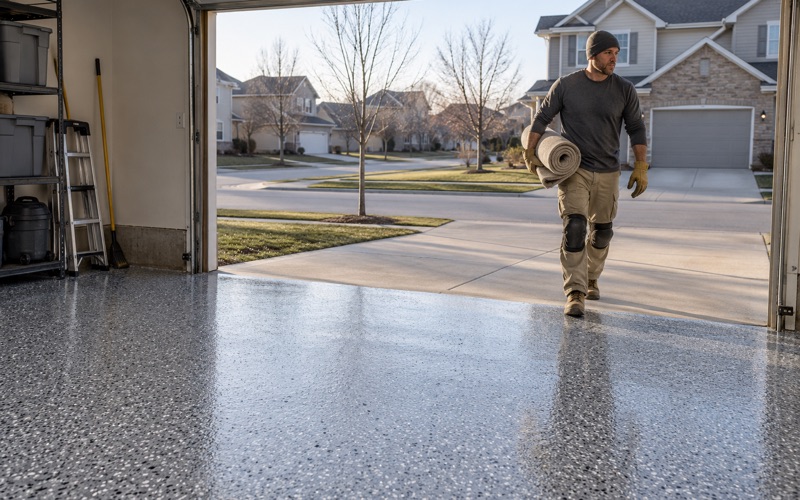
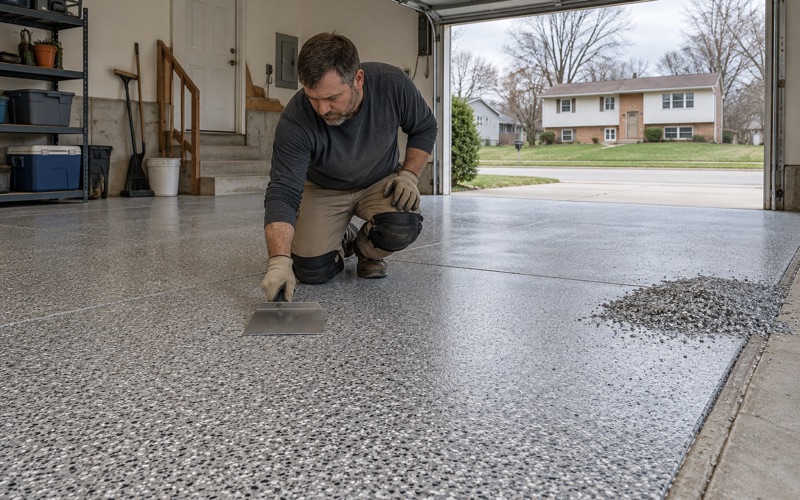
For a dry basement, a 100% solids epoxy base with a vinyl flake or quartz aggregate broadcast and a polyaspartic topcoat is a common build. The proposal names the product, the system build and the finished thickness, so the floor that goes down can be checked against the quote. Pricing is per square foot for that system, not a national per-garage figure.
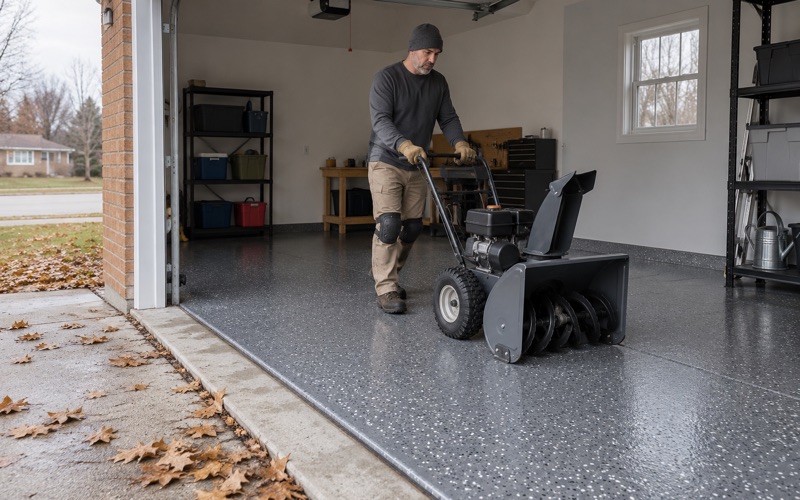
Garages get the same moisture test, but there the bigger enemy is the calcium chloride brine and rock salt that winter tracks in on the tires, and the topcoat is chosen to stand up to it. Every coating we use stays within the Illinois limit of 250 grams per liter of VOC for floor coatings, a rule under the Illinois Administrative Code that binds the installer as well as the manufacturer.
Stone buildings and food businesses
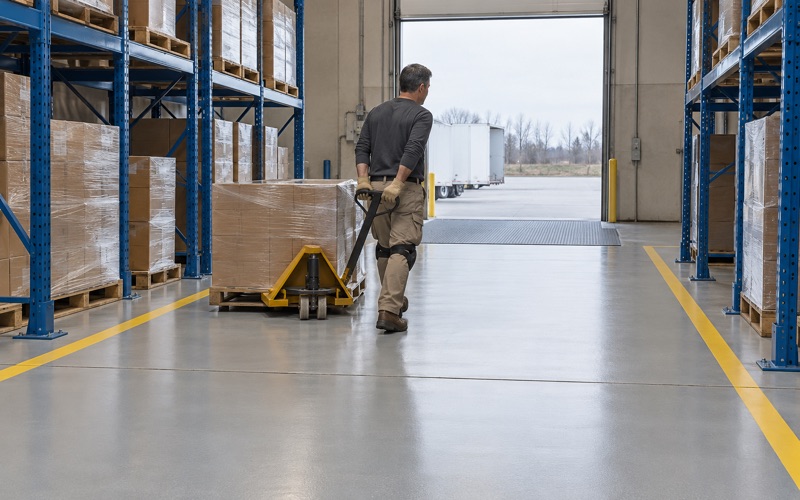
Many of Batavia’s limestone factory buildings remain in use as offices and storefronts. Their floors get the same test-first approach, and shop and commercial jobs are scheduled around the hours a building has to keep running, including overnight and weekend windows.
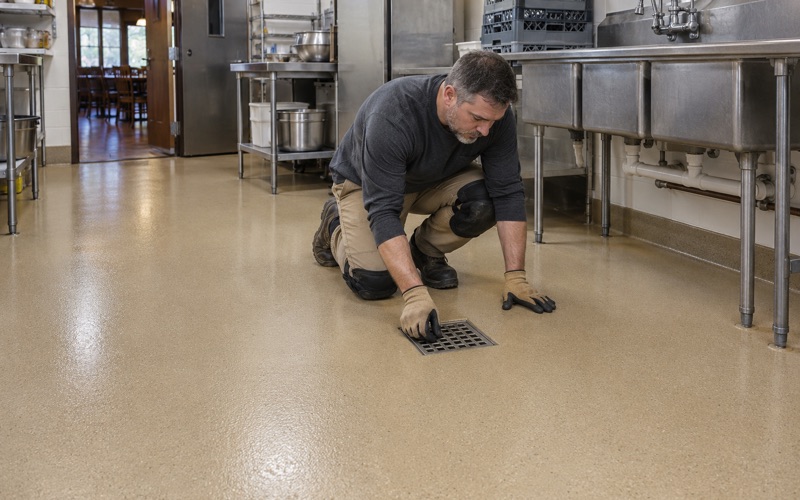
Food businesses fall under the Kane County Health Department. Its Food Construction Manual lists seamless poured epoxy at a 3/16-inch minimum, requires specific approval for poured monolithic kitchen floors and calls for a 3/8-inch base cove. We specify the floor for that plan review before the permit is issued.
Paperwork before the first pass
Illinois issues no state license for flooring or coatings work, so we confirm Batavia’s own registration, bond and insurance rules with the Building Division before a job is scheduled. Every home job gets a written contract and the Home Repair: Know Your Consumer Rights pamphlet before work starts, as the Illinois Home Repair and Remodeling Act requires.
- 20+ Years of Floor Work
- Moisture Testing in Every Scope
- Written Proposals and Contracts