DeKalb IL Epoxy Flooring has spent more than 20 years on epoxy flooring in Aurora and across the Fox Valley, and the Aurora jobs that need the most care up front are not always the hardest floors. They are the ones where the coating is one piece of a bigger project the homeowner has already pulled a permit for. On that kind of job, who is allowed to put the floor down is settled by city code, not by the quote.
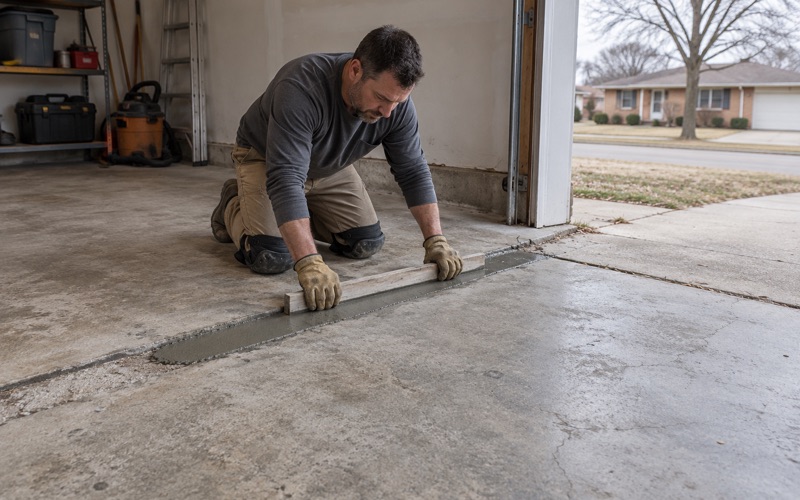
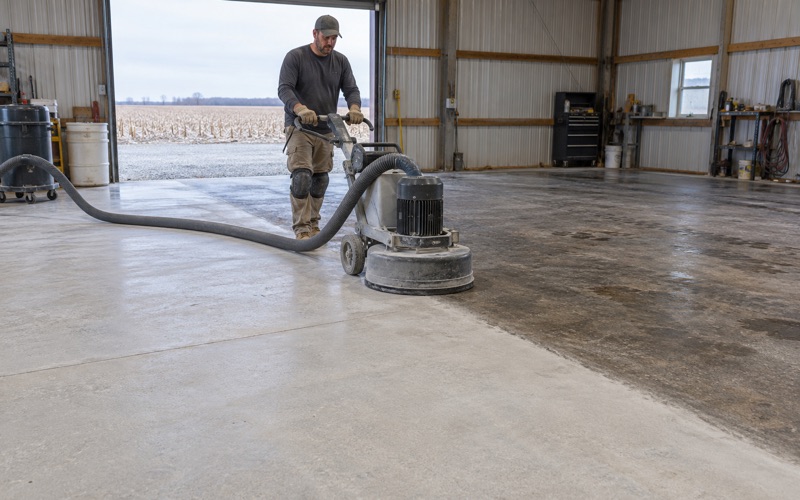
The floor itself gets the same treatment it would anywhere. We open every slab with a diamond grinder or a shot blaster and never acid etch it, and moisture testing is priced as its own line in the scope. Our proposal names the product, the system build and the finished thickness, and we read the warranty exclusions aloud before anyone signs, with moisture at the top of that list.
This page covers the part that is particular to Aurora: the owner-occupant permit, the rule against hired help on an owner’s project, where a floor coating falls under the 2024 codes, and what contractor registration involves here. It ends with the questions worth taking to the city before the first kit of resin is opened.
Aurora’s owner-occupant permit and the hired assistance line
Doing your own work on a single-family home
Aurora lets the owner of record who lives in a single-family house pull permits and do the work without a registered contractor. The condition is that the owner keeps living in the home for at least six months after the job is finished. The exemption sits in the city’s contractor registration rules, Section 12-16.4 of the municipal code.
It is a real freedom, and plenty of Aurora owners use it to finish a basement or build out a garage over a run of weekends. It does have edges, though. New electrical services and alternative power equipment stay reserved for licensed contractors even on an owner’s permit, and the whole exemption assumes the owner is the person doing the work.
What Hired Assistance Prohibited says
Section 12-16.4.1.2.2 of the Aurora code carries the heading Hired Assistance Prohibited. It says an owner doing their own work without a licensed contractor is prohibited from hiring assistance in any way on the project unless the hired assistant becomes a licensed contractor in the appropriate trade. If a permit application fraudulently indicates the owner is doing the work when hired people are doing it, the owner faces fines of up to two times the permit fees.
The wording is broad. It does not set aside a helper who handles only one piece of the job, and the penalty lands on the homeowner rather than on the helper. A homeowner who pulled the permit in their own name is the one exposed if a paid crew arrives partway through the project.
Why a coating crew can land inside that line
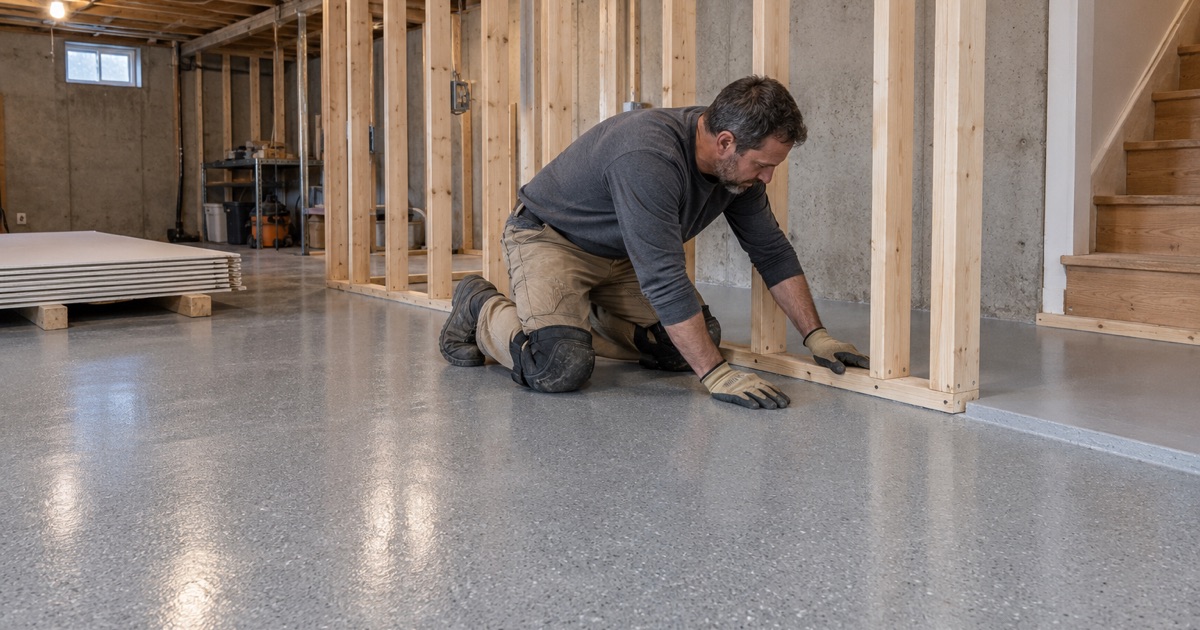
A floor coating is rarely the whole project on an owner-permitted job. Picture an Aurora basement finish with framing, drywall and plumbing rough-ins under the owner’s permit, and a coated floor as the last step before the furniture comes down. The crew grinding and coating that slab is hired help working on a permitted project.
We cannot tell you how the city reads the phrase in any way on the project for a finish trade that would be exempt on its own, because that has not been confirmed with the Division of Building and Permits. What we can say is that the sensible order is to ask before the coating is booked. Asking after the permit already says the owner did everything is the wrong way around.
Looking for epoxy-flooring closer to Carpentersville? See Epoxy-Flooring in Carpentersville.
When a floor coating is finish work, and when it is part of a permitted job
The 2024 codes and the finish-work exemption
Aurora builds to the 2024 codes, adopted by Ordinance O25-082 on December 9, 2025 and in force since January 1, 2026. The city amended R105.2 of the residential code so that painting, papering, tiling, carpeting, cabinets, counter tops and similar finish work need no permit. Jobs where the building official judges material costs to be under 750 dollars, or material plus labor under 1,500 dollars, are exempt as well unless they cure a code violation.
Our reading is that a stand-alone garage or basement floor coating fits within similar finish work, so a coating job by itself should not need a permit. That is our characterization, not a city ruling. The exemption also says nothing about who may do finish work that happens to sit inside a larger permitted project, which is where the hired-help rule comes back in.
A coating on its own versus a coating inside a basement finish
The same floor can sit on either side of the line depending on what else is happening in the room. A homeowner who calls us to coat an existing, already finished basement floor is hiring a finish trade for exempt work. A homeowner who holds an open owner-occupant permit for finishing that basement, and wants the floor coated as part of it, is bringing hired help onto a permitted project.
We ask about open permits on every Aurora basement walk-through for exactly that reason. If there is one, we would rather pause and settle the registration question with the city than leave a homeowner facing a penalty tied to their own permit fees. The pause usually costs a phone call, and it is cheaper than the alternative.
Driveways, patios and parking pads
Aurora also amended section 105.1 to require a permit for any driveway, and for private walks, patios or parking pads next to a driveway that are able to park vehicles. Public sidewalks, aprons, curbs and curb cuts need one too. Permitted paving calls for a registered private-property paving contractor, with an exemption for owners.
We coat floors; we do not pour pads. When a homeowner is planning a new parking pad or driveway alongside a garage floor job, we keep the two scopes apart so the paving permit and the paving contractor are settled on their own terms.
Registered in Aurora: 200 dollars a trade, insurance and the StAR discount
What registration involves
Under Section 12-16.4, no construction work covered by sections 117.2 through 117.8 may be installed or replaced within the city except by a registered contractor. Registration costs 200 dollars per year for each trade, and general contractor registration is required for any work that needs a permit. An owner acting as general contractor on their own building is exempt for work up to 40,000 dollars, while a tenant may not act as general contractor unless licensed.
Registered contractors carry commercial general liability insurance of 500,000 dollars per occurrence and 1,000,000 dollars aggregate, with the City of Aurora named as additional insured on a primary and non-contributory basis. Workers’ compensation at statutory limits is required as well. The city’s 2022 application form also lists a 5,000-dollar surety bond that must stay valid for at least one year.
The Aurora StAR program
Aurora rewards contractors whose work passes inspection. Contractors who qualify as Aurora StAR contractors, based on their inspection passing percentage over the prior 12 months, are credited with a 100-dollar discount at annual renewal. The city says it publishes those passing percentages online each year.
We were not able to find that published list, so we do not quote anyone’s pass rate here, ours included. If you want to compare contractors on it, the Division of Building and Permits is the place to ask. Outstanding or expired permits also block a renewal, which is one more thing the division can confirm about a contractor.
How we handle registration before scheduling
Illinois issues no state license for flooring or coatings work, which leaves each city or village to set its own registration, bond and insurance rules. Before an Aurora job goes on the calendar, we check what the city expects of the work as scoped. If an open permit changes the answer, we put that in writing before the job is scheduled.
Every home job also gets a written contract and the state’s Home Repair: Know Your Consumer Rights pamphlet before work starts, as the Illinois Home Repair and Remodeling Act requires. That paperwork is separate from city registration. One does not stand in for the other, and a homeowner should see both.
Aurora slabs, winters and questions for the city
Basement slabs and the water question
Aurora holds the Illinois 24-hour rainfall record, 16.94 inches on July 17-18, 1996, measured at the National Weather Service gauge in the city. The city’s floodplain page still shows the Blackberry Creek flood from that storm, and plenty of Aurora basements have a water story of their own.
That is why a basement job starts with where the water comes from: sump pits, perimeter drain tile and hydrostatic pressure under the slab. A coating is not waterproofing and will not stop water. We measure the slab with ASTM F2170 in-situ relative humidity probes or ASTM F1869 calcium chloride tests, and the results go into the proposal next to the system we recommend.
Garage floors through an Aurora winter
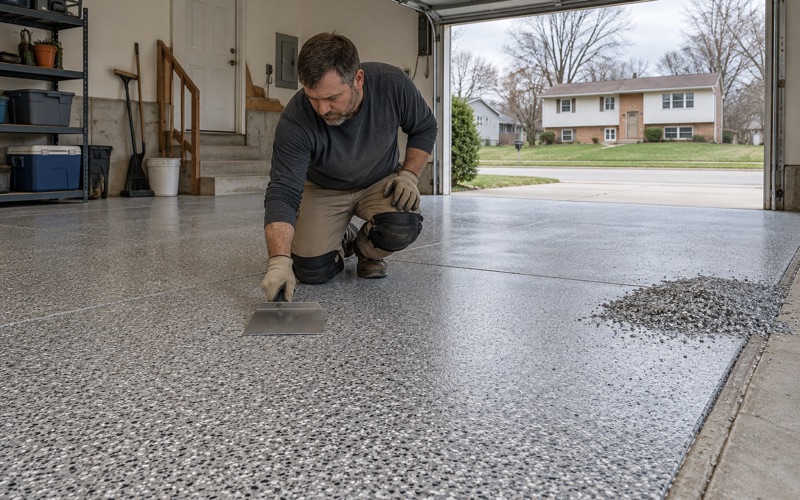
The NCEI weather station inside Aurora records 134.1 nights a year at or below 32 degrees and 27.9 inches of snow, so brine and rock salt ride into garages for months. We build garage floors for calcium chloride and rock salt, usually with a 100% solids epoxy base, a vinyl flake broadcast and a polyaspartic topcoat. Curing is scheduled against slab temperature and the dew point spread, not the calendar.
An unheated Aurora garage in January may simply have to wait for spring, and we say so at the quote rather than on install day. Grinding dust is collected at the grinder and kept away from floor drains, and we choose coatings within the Illinois VOC limits, which bind the installer as well as the manufacturer.
A city of owner-occupied homes
Aurora is the second-most populous city in Illinois after Chicago, with 180,542 residents at the 2020 census, and it sits along the Fox River across Kane, DuPage, Will and Kendall counties. Of its occupied homes, 66.4 percent are owner-occupied, and a large share of its housing went up during the 1990s and 2000s. Its largest employers include Rush Copley Medical Center, School Districts 131, 129 and 204, and Hollywood Casino.
That mix adds up to a lot of single-family owners taking on their own basement projects. It is exactly the setting where the hired-help question comes up, and why we raise it at the first walk-through.
Questions to settle with the Division of Building and Permits
The Division of Building and Permits sits at 77 South Broadway, first floor, and answers at (630) 256-3130, with permits handled through its eTRAKiT portal. Before an owner-permitted basement finish includes a coated floor, ask whether the coating crew needs to register, whether the permit should name that crew, and whether any part of the floor work changes the permit itself.
One caution while researching: searches for Aurora building codes often surface Aurora, Colorado documents, including an adopted-codes PDF and monthly building reports. Those describe another state’s city, so read the City of Aurora, Illinois pages or call the division directly. Once the answers are in hand, we schedule the floor around them.
- 20+ Years of Floor Work
- Moisture Testing in Every Scope
- Written Proposals and Contracts