DeKalb IL Epoxy Flooring has spent more than 20 years on epoxy flooring in Algonquin and across northern Illinois, and the garage floors we quote here sometimes carry a problem most coating sales pitches never ask about. Before we talk about flake color or topcoats, we ask what gets parked over the slab. In a river town, the answer is sometimes a boat.
A boat on a trailer in the garage is not a problem by itself. The trouble starts when the owner cleans the hull right where it sits, with a product made to dissolve mineral deposits, and lets the runoff fall onto bare concrete or onto a resin floor that cost real money to put down.
This page covers what those cleaners contain, what they do to a slab, and how we build and protect a garage floor that shares its space with a boat through the off season. It also covers what we check before quoting any floor in the village, from slab moisture to the local building code.
Boats Stored and Launched on the Fox
A marina on North Harrison Street
Fox 14 Marina sits at 811 North Harrison Street, inside the village limits in Algonquin Township on the McHenry County side. Its published services include slip rentals, a gas dock, a launch ramp, boat rentals and sales, and winterization and summerization. For storage it lists one plan that keeps the boat inside one of its secure buildings and another that leaves it outside on the owner’s trailer.
We have no connection to the marina and have never done work there. We name it because it shows something true about the village: the Fox River runs north to south through downtown, and launching, storing and laying up boats is part of ordinary life in Algonquin.
Winter layup in a home garage
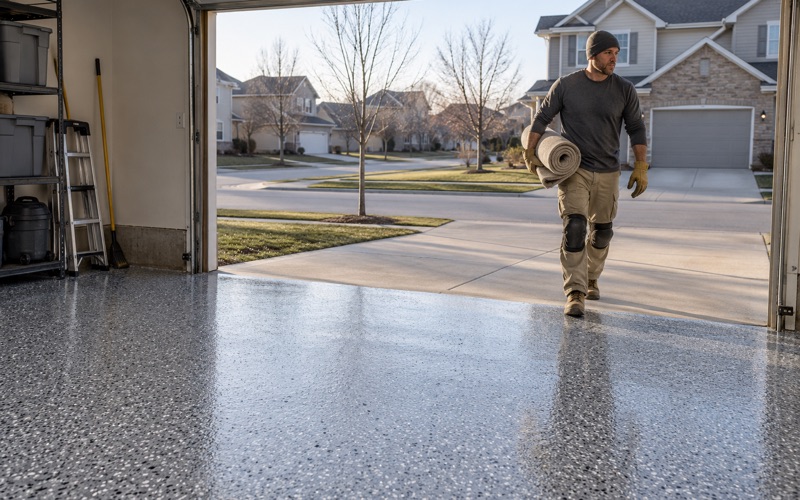
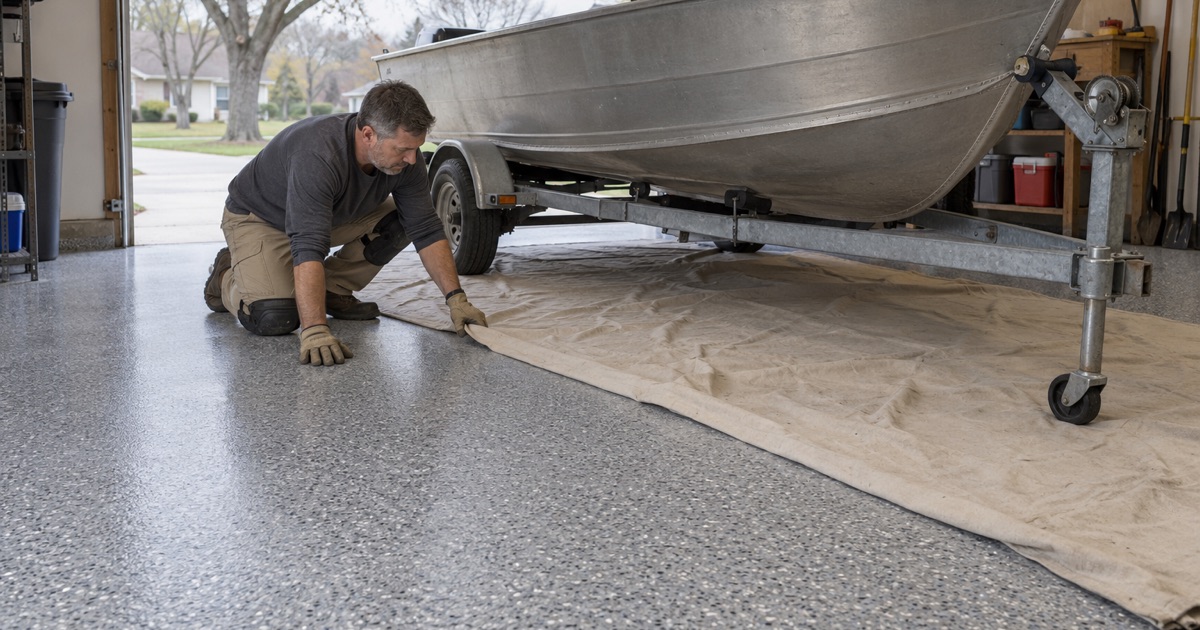
Not every boat goes into building storage for the season. Plenty of owners tow theirs home after the last trip of the year and back the trailer into the garage, where the hull sits over the slab until spring. In a village where most homes are detached and owner-occupied, that garage is often the only covered space big enough for the job.
A boat parked for months is also a boat that gets worked on where it sits. Owners wax it, check the drive, change fluids and, before the first launch, scrub off the stains it picked up the year before. That last chore is the one that matters to the floor underneath.
Looking for epoxy-flooring closer to West Chicago? See Epoxy-Flooring in West Chicago.
What Hull Cleaners Contain and Where They Drip
Scum lines and tannin stains
River and lake boats tend to collect a brown scum line at the waterline and tea-colored tannin stains along the hull. The products sold to remove those marks are strong acids. One widely sold example, Star brite EZ-ON EZ-OFF Hull and Bottom Cleaner, is labeled for tannic stains, marine deposits and scum lines, and it lists hydrochloric acid and oxalic acid as its contents.
Its directions say to brush the cleaner onto a dry hull, keep the surface wet and foaming for a few minutes, then rinse with water, repeating with light scraping where deposits are heavy. The label warns against mixing it with bleach or ammonia, calls for rubber gloves and safety glasses, and says to use it only in a well-ventilated area. It gives no guidance at all about the surface sitting underneath the boat.
A safety data sheet for another hull cleaner, CRC’s On and Off, classifies that product as corrosive to metals and corrosive to skin. These are not mild soaps, and we treat them the way we would treat any strong acid used near a finished floor.
Gravity does the rest
A hull is a curved surface, and a cleaner kept wet and foaming does not stay where the brush put it. It runs down toward the keel, gathers at the lowest points and drips off. On a trailer parked in a garage, that lowest point hangs directly over the slab, and the rinse that follows spreads diluted acid across the floor toward the door or the low corner.
Those drips are easy to miss because they land under the trailer, in the shadow of the hull. Nobody looks there until the boat leaves in spring and the floor finally shows what happened over the winter.
How Acid Treats Bare Concrete and a Resin Floor
Bare concrete loses its surface
Concrete is alkaline, and the cement paste that binds the sand and stone is exactly what hydrochloric acid attacks. On an uncoated garage slab, a puddle of hull cleaner dissolves that paste at the surface and leaves exposed sand and a rough, pale patch that will not wash out. Season after season of it opens the slab further to deicing brine, oil and tire marks.
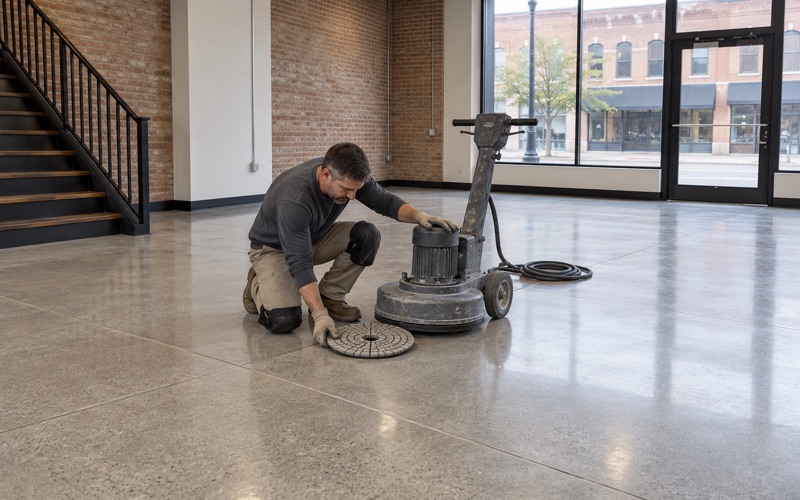
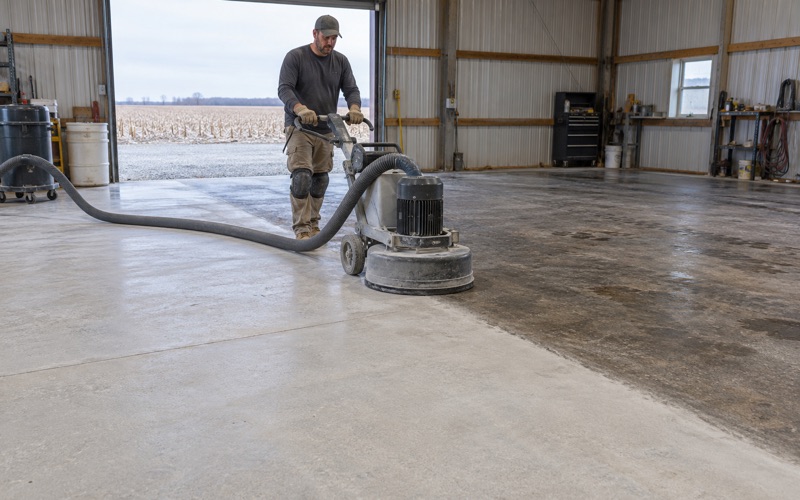
The same chemistry is why we never acid etch a slab to prepare it for coating. Every floor we coat is opened mechanically with a diamond grinder or a shot blaster to a measured ICRI concrete surface profile, so no acid residue is left in the pores to fight the primer.
A coated floor resists, but on a clock
A good resin floor protects concrete from short contact far better than bare cement paste can, but chemical resistance always has a time limit attached. One maker’s published chart for its Sikafloor-515 product, based on surface exposure at 20 degrees Celsius, rates 20 percent hydrochloric acid as resistant after one day and as limited resistance after three and seven days. The chart’s own key describes limited resistance as swelling and loss of hardness.
That is one product from one manufacturer, and other systems will rate differently. The pattern holds across all of them, though: a drip wiped up the same afternoon is a nonevent, while a puddle left under a trailer for a week can soften and dull the coating where it sat.
No resin floor we install shrugs off acid forever, and we say so before the job is sold. We read the warranty exclusions out loud at the proposal, with moisture first and chemical exposure close behind, so a boat owner knows which damage is covered and which is maintenance.
Building the floor for a boat garage
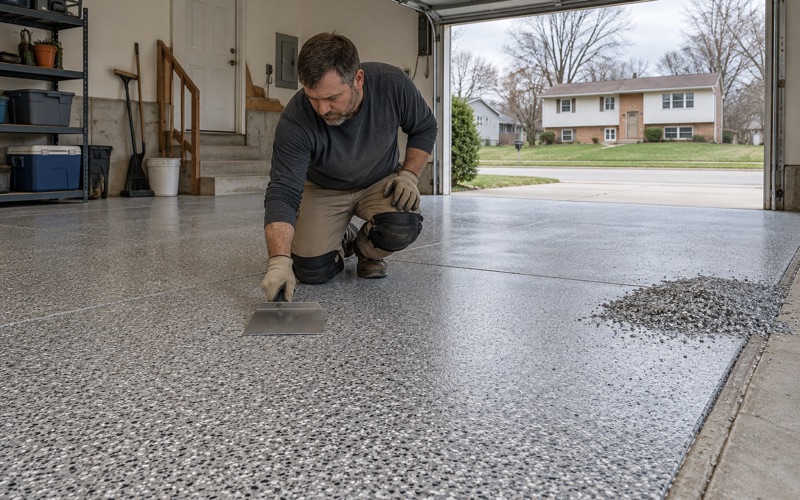
For a garage that will hold a boat, we usually propose 100% solids epoxy base coats with a vinyl flake or quartz aggregate broadcast and a polyaspartic or polyurea topcoat. That build also stands up to the calcium chloride brine and rock salt that ride in on tires through a northern Illinois winter. The proposal names the product, the system build and the finished thickness, and it prices the job per square foot for that system rather than from a national per-garage figure.
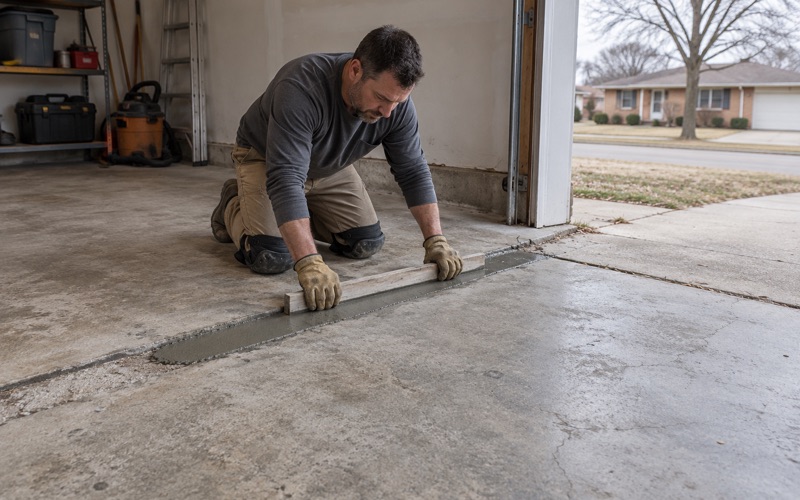
Quartz broadcast adds texture, which helps when a rinse leaves the floor wet around the trailer. We read the cracks, joints and any old coating before quoting, fill joints with a semi-rigid polyurea joint filler where trailer wheels cross them, and tell you plainly if a section of slab needs repair before anything can go over it.
Cleaning the Hull Away From the Garage Floor
Outdoors, or at the marina
The simplest protection is location. Hull cleaning belongs outdoors, with the boat on its trailer over gravel or another surface that is not the finished floor, or at a marina that has a place set aside for that work. Pull the trailer out of the garage, clean and rinse the hull there, and let it dry before it goes back inside.
Working outside also answers the label’s own call for good ventilation. A closed garage is not a well-ventilated area, and acid fumes are no kinder to the people standing in it than to the floor.
If the work has to happen nearby
Sometimes weather or space pushes the job close to the garage. In that case, cover the floor under the hull completely before the brush comes out, and if any cleaner reaches the coating, flush the spot with plenty of water right away rather than letting it dry. The longer acid sits, the closer the floor moves toward the limited end of any resistance chart.
Check under the trailer after every cleaning session, not only in spring. A dull, soft or tacky patch under the waterline position is the moment to call us, before it turns into a peeled area that needs grinding back.
What we confirm before coating in Algonquin
The village code’s Chapter 23 adopts the 2018 International Residential Code with local amendments, along with the 2021 International Energy Conservation Code. We have not read every amendment, so whether a given coating job needs a permit is a question we put to the village’s Community Development department before scheduling. Illinois issues no state license for flooring or coatings work, so we also confirm the village’s own contractor registration, bond and insurance rules.
Moisture testing is part of every scope, using ASTM F2170 relative humidity probes or ASTM F1869 calcium chloride tests, and curing is timed to slab temperature and the dew point spread at the surface. An unheated garage where the boat waits out the cold may have to wait for spring as well. Every home job comes with a written contract and the Home Repair: Know Your Consumer Rights pamphlet, as the Illinois Home Repair and Remodeling Act requires.
Grinding dust is collected at the grinder, and the coatings we use stay within the Illinois VOC limit for floor coatings, a rule that binds the installer as well as the manufacturer. McHenry and Kane counties, which share the village between them, both sit inside the Chicago ozone nonattainment area, which is part of why that limit carries weight here.
- 20+ Years of Floor Work
- Moisture Testing in Every Scope
- Written Proposals and Contracts